Porsche tells owners of its most expensive cars to leave them parked
Porsche has told owners of some of its most expensive performance cars in the US to leave them parked. The company has expanded a US “Do Not Drive” recall covering 2024 model-year cars fitted with centre-lock wheels, after a supplier defect was found to cause fractures in the wheel fastening system and, in the worst case, allow a wheel to detach.
The expansion adds 548 cars to an earlier recall, taking the total to 2,399. The original action was issued in October 2024, and the new batch shows how a single out-of-specification material batch can slip past a screening process designed to catch it.

Which Porsche models are affected
The expanded batch is a roll call of Porsche’s fastest road cars, all from the 2024 model year:
- 911 GTS: 168 cars
- 911 Turbo S: 94
- 718 Cayman GT4 RS: 73
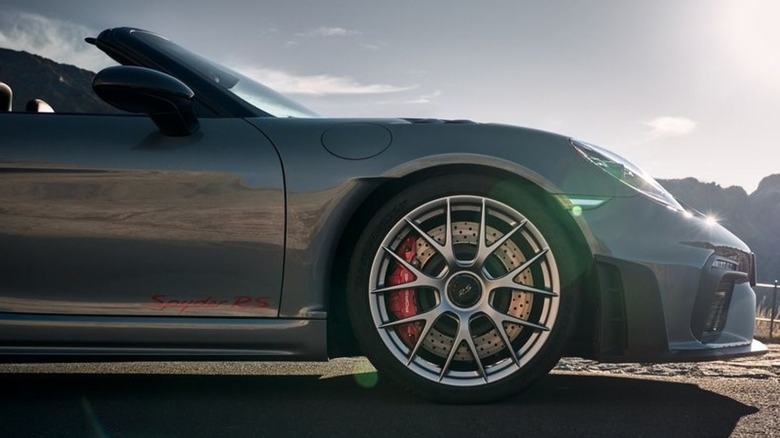
- 718 Spyder RS: 70
- 911 GT3: 50
- 911 GT3 RS: 41
- 911 S/T: 39
- 911 Turbo: 13
These are largely GT-division and Turbo cars, the models most likely to be specified with centre-lock wheels, a motorsport-derived system that saves weight and speeds up wheel changes but demands precise torque procedures.
The 911 S/T, a limited-run heritage special, and the 718 Cayman GT4 RS and Spyder RS, both nearing the end of their production lives, are among the most sought-after cars Porsche has built in recent years. Telling an owner not to drive one is not a decision the company will have taken lightly.
The cause: a material batch outside specification
The root of the problem is a supplier defect. Components in the centre wheel fastening system, within certain production ranges, were “manufactured out of specification.” Analysis of the affected material batch confirmed lead and bismuth contents outside the specification.
Porsche’s investigation, carried out with its parts supplier, found that the original process for identifying defective components had missed some potentially affected parts. Further vehicles may therefore have received parts from the same out-of-specification batch, which is what triggered the expansion.
Screening processes are built to catch known failure modes, and when a material drifts outside its specified composition, the tests designed around the original specification can wave it through. A single batch, mixed into a supply chain, can put a defect into thousands of cars before anyone knows to look for it.
The risk, and the warning sign to watch for
The expansion followed two further field reports of fractured centre-lock components, one in May and one in August this year. No injuries have been reported. Porsche says several incidents attributable to centre-lock fractures are known.
For drivers, the warning sign is immediate and physical. If a centre-lock fractures, the driver should feel vibration straight away, which gives clear warning to pull over before anything worse happens.
The numbers also suggest the risk is concentrated rather than universal. The first action appears to have covered a broad population of potentially faulty parts, with 100% of cars in that recall estimated to be affected, against 1.4% expected in the new batch. The expansion is a much narrower net thrown around specific suspect components.
What owners should do
The instruction is blunt. Owners are told not to drive their cars until a Porsche dealer has checked the centre-lock wheel fastening system and replaced any out-of-specification parts. The work is free of charge, and repairs are covered under warranty, so there is no reimbursement process to navigate.
Porsche will contact owners by phone, email and push notification through the MyPorsche app by 15 December. Owners who would rather not wait can check their vehicle identification number: VINs became searchable on the NHTSA website on 20 October. Both dates apply to the US recall, as does the NHTSA lookup.
For anyone weighing up a used performance Porsche, the recall is a reminder to check whether outstanding safety work has been carried out before handing over money.
What it means for centre-lock wheels
Centre-lock wheels are a genuine engineering choice, not a styling gimmick. Born in motorsport, where a single nut means faster pit stops, they cut unsprung and rotating mass and simplify the hub. Porsche has long offered them across its GT range, and for track-focused owners they are part of the appeal.
That appeal comes with trade-offs. A centre-lock depends on a single fastening point doing the work of five, and it depends on correct torque, applied with the right tool, to the right figure, every time. Get it wrong, or fit a component that is not what the drawing specifies, and the margin for error is smaller than with a conventional five-stud hub. Track use is exactly where centre-locks earn their keep, and exactly where correct fastening procedure matters most.
The wider lesson is about supplier quality control. A performance car is only as good as the weakest component in its supply chain, and a material batch with the wrong lead and bismuth content is not something a customer can see, feel or inspect. It has to be caught upstream, and in this case the first attempt at catching it was not quite good enough.
The bottom line for owners and buyers
If you own one of the 2,399 cars caught by this recall, the advice is simple: park it and wait for the call. The fix is free and no injuries have been reported. The expansion is a sign the system worked, if later than anyone would have liked.
For everyone else, the story is a useful window into how modern performance cars are built and how they fail. A centre-lock hub is a beautiful piece of engineering with a narrow tolerance for error, and the difference between a safe car and a recalled one can come down to the composition of a single batch of metal.