What is the GRMN Corolla?
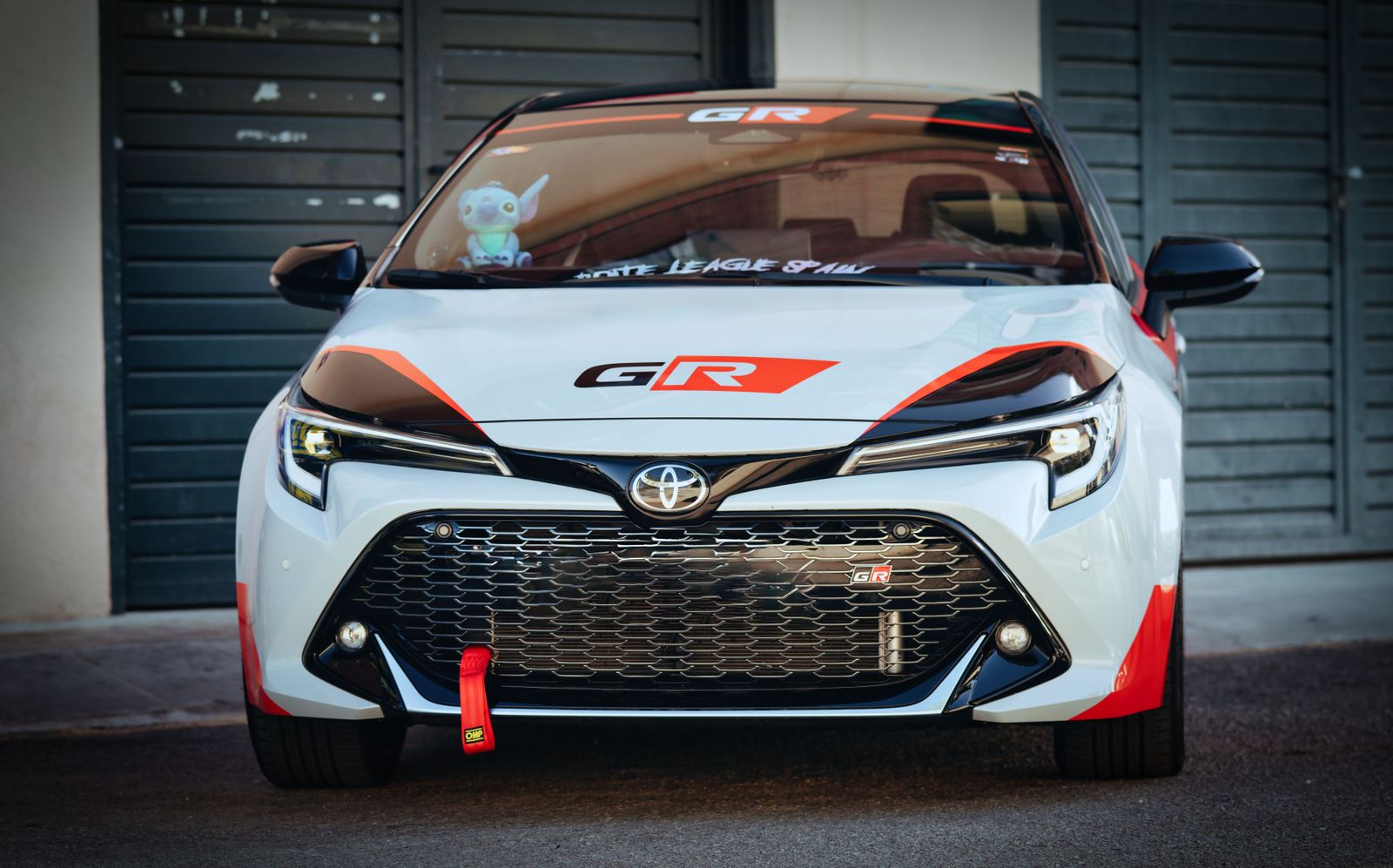
Toyota has spent the past few years steadily sharpening the GR Corolla, and the 2026 Toyota GRMN Corolla is where the gloves come off. Limited to just 730 units worldwide, it is the most track-obsessed version of Toyota’s hot hatch yet: a car with a carbon-fibre bonnet, a driver-triggered intercooler spray and a chassis tuned with one eye firmly on the Nürburgring. The GRMN badge, which stands for Gazoo Racing tuned by Meister of Nürburgring, has been reserved since 2009 for limited-run, high-performance specials aimed primarily at the Japanese home market. Now it has been applied to the Corolla for the first time, and the result is considerably more serious than the standard car.
Think of the GRMN as the GR Corolla taken to its logical extreme. Toyota has already updated the standard car several times: chassis and aero tweaks arrived for 2024, an automatic gearbox followed in 2025, and 2026 brought more power and further chassis work. The GRMN sits above all of that, positioned as a low-volume track special rather than a showroom staple.
Toyota’s release confirms the 730-unit run is “primarily for North America, Japan, and Australia.” That phrasing matters, because it leaves the door open for other markets without committing to them. The GRMN nameplate itself carries weight: it signals that Gazoo Racing has been given licence to prioritise lap times and driver confidence over everyday usability.
Engine and drivetrain
Underneath the carbon panels sits the familiar G16E-GTS: a turbocharged 1.6-litre three-cylinder producing 300bhp. Torque rises by 7lb ft to 302lb ft, and crucially it is concentrated between 4,000 and 4,600rpm, exactly where you want it on a track. The gearbox is a close-ratio six-speed manual (the EA68F), with a taller first gear and a shorter third, plus a revised shifter-cable mount for a more direct action.
Drive goes to all four wheels through two Torsen limited-slip differentials and a clutched centre driveline coupler. The variable Track Mode, introduced for 2025, splits torque anywhere between 60:40 and 30:70 front to rear depending on driver inputs and track demands, replacing the earlier fixed 50:50 arrangement. It is a more sophisticated system than the spec sheet alone suggests, and it plays a big part in how the car behaves at the limit.
Aero and bodywork
The visual and aerodynamic changes are the most obvious sign of intent. There is a carbon-fibre bonnet with a unique centre duct and ten slots cut into its underside, designed to direct air in a way that makes high-speed steering more predictable. New front side spoilers and carbon-fibre front fenders with their own ducts complete the front-end package, while a rear wing offers five settings.
Toyota says the aero package was shaped by lessons learned from the hydrogen-powered GR Corolla racing in Japan’s Super Taikyu series, a direct link between race car and road car. There is also around 14 metres more structural adhesive than in earlier cars (both the GRMN and 2025-and-newer GR Corollas), stiffening the body in a way you feel through the wheel and the seat. It is the kind of unglamorous engineering detail that separates a genuine track special from a sticker package.
Chassis and steering
The suspension has been comprehensively reworked. Twin-tube shocks make way for monotube units, inverted at the front, with internal rebound springs to keep the tyres in contact with the road. Front bump-stop stroke is shortened by 4mm, while the rear gains 2mm. The electric power steering hardware is largely unchanged, but the calibration is described as aggressive, and the steering-wheel rim is thinner, presumably to give the driver a cleaner feel for what the front tyres are doing.
These are small numbers and subtle changes individually. Together they represent a car that has been tuned corner by corner rather than given a blanket “sportier” makeover, and the choice of Michelin Pilot Sport Cup 2 tyres on the test car (versus Pilot Sport 4S on the regular GR Corolla) underlines the track-first brief.
Cooling and track hardware
Track cars live or die by their cooling, and the GRMN has two notable additions. The first is an optional oil cooler for the all-wheel-drive system. The second is a driver-actuated intercooler water-spray system, fed by a 3.8-litre tank mounted beneath the cargo floor next to the battery. It provides roughly 150 seconds of spraying, and Toyota claims it lowers intake temperatures by around 8 to 12°C.
The system works, but its status indication is poor. There is no gauge-cluster display, just a small button with a tiny amber light, which is a strange oversight on a car built for repeated track sessions. It is the sort of flaw that would irritate an owner on their third lap of a hot day, and it stands out precisely because the rest of the package is so carefully considered.
Driving impressions
Car and Driver tested the GRMN at Eagles Canyon Raceway near Decatur, Texas, a 4.3km circuit with 16 turns and around 46 metres of elevation change. Toyota added a back-stretch chicane and a pit-lane pass each lap to limit top speed and keep the drivetrain cool, a sign of how hard the car was being worked.
The verdict from that test was largely glowing. Steering is much tighter and more direct, with dramatically quicker turn-in and stronger self-centring. The suspension displayed what the magazine called “the most Porsche-like behavior” it had experienced in a rival to the Hyundai Elantra, with no ugly secondary motion over curbing. The manual shift is “not Honda Civic Type R good, but still really good.” Hagerty, meanwhile, found the car handled far more power application than expected, even with the wheels not perfectly straight, with the differentials shuffling power to keep the nose pointed the right way.
There was one flaw. During quick countersteering inputs, the electric steering occasionally delivered an unnatural kick through the wheel, as if the power assist had hit its limit. It happened three times over at least 20 laps and never on the street, and chief engineer Naoyuki Sakamoto could not explain it. Given how polished the rest of the car is, that mystery is worth watching as production cars reach owners.
Pricing and availability
In the United States, the GRMN Corolla is priced at $65,655 against $41,815 for the base GR Corolla, a substantial premium that buys the carbon parts, the chassis work and the exclusivity of one of 730 cars. Toyota has not announced UK pricing or allocation, and with the run aimed at North America, Japan and Australia, a right-hand-drive allocation for British buyers looks unlikely.
How it drives: Nürburgring-tuned
The GRMN’s character comes directly from the top. Chief engineer Naoyuki Sakamoto said: “Morizo challenged us to create not simply a faster car, but a car that gives the driver the confidence to keep pushing, even under the extreme conditions of the Nürburgring.” Morizo is the racing pseudonym of Toyota CEO Akio Toyoda, who raced at the 24 Hours of Nürburgring under that name in 2007 and returned in 2009, 2014, 2016 and 2019. The name now also identifies the other high-performance GR Corolla variant, which shows how central the Nürburgring is to Toyota’s performance identity.
That brief explains the car’s priorities. The GRMN is not chasing raw power or a headline 0-62mph time; it is chasing confidence, the quality that lets a driver keep pushing lap after lap without the car feeling nervous or unpredictable. The carbon bonnet duct, the monotube dampers, the water spray and the aggressive steering calibration all serve that single goal.
Who the GRMN Corolla is for
This is a car for the buyer who already knows they want a GR Corolla and wants the sharpest version Toyota will sell them. Against rivals, the obvious benchmark is the Honda Civic Type R HRC, which shows Honda is also exploring a harder-edged take on its hot hatch.
What the GRMN really demonstrates is how far Gazoo Racing is willing to go when given a free hand. The engineering detail is genuine, the racing link is real, and the flaws are few and specific. For Toyota’s performance division, it is a statement of intent: the GR badge is not a trim level, and the GRMN is proof.