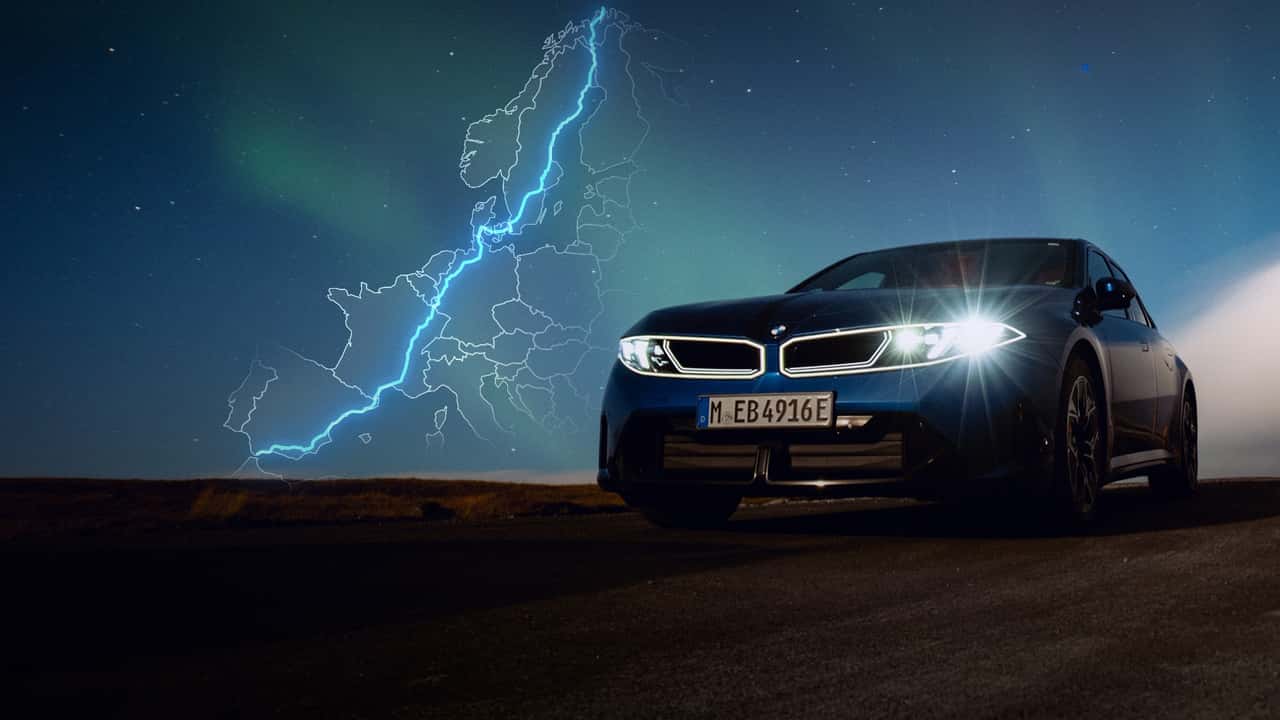
BMW has a habit of building cars that quietly rewrite the rules, and the new i3 electric saloon has just done exactly that. In a continent-spanning run from the top of Norway to the southern tip of Spain, a production i3 covered 3,657.8 miles while spending a grand total of 2 hours, 45 minutes and 54 seconds plugged in. That is under three hours of charging for a journey that would take most petrol cars the best part of a week behind the wheel.
But the headline distance is not the most interesting number here. The real story is the charging rate. During stops, the i3 averaged 275 kW. That is an average, not a peak, and it is higher than the maximum charging speed of a great many electric cars on sale right now. Including BMW’s own i5, which tops out at 205 kW. That is the detail that separates this run from a publicity stunt.
The run: North Cape to Tarifa
The route ran from the North Cape on Norway’s island of Magerøya, the northernmost point of mainland Europe, all the way to Tarifa in southern Spain. Eight countries in total, including Denmark, Germany and France. Drivers had to pass set checkpoints but were free to choose their own route and their own charging stops, which makes the result all the more impressive: this was not a carefully stage-managed motorway cruise with a support crew holding a charger ready at every exit.
The Paneuropeana challenge was devised by Rafael de Mestre, and it has become a useful benchmark precisely because it reflects real driving rather than laboratory conditions. Drivers pick their own route and their own chargers, so the result says something about the car and the infrastructure together.
BMW says the run beat the previous Paneuropeana record, set back in 2017, by more than seven hours. That is a huge margin in a discipline where teams usually scrap over minutes.
The numbers behind the record
The driving itself took 3 days, 2 hours and 41 minutes at an average speed of 49.5 mph. That average tells you something important: this was not a low-speed hypermiling exercise. It was a genuine long-distance drive at realistic road speeds, using public charging infrastructure throughout.
The charging stops averaged 275 kW. To put that in context, plenty of brand-new EVs still peak below 200 kW, and many only hold their maximum rate for a short window before tapering. Sustaining a 275 kW average across a whole journey implies the i3 pulls high power deep into the battery’s state of charge, which is precisely what 800-volt architecture and modern cell chemistry are supposed to deliver. Here, it delivered in the real world.
Efficiency that beats the official claim
Here is the part that will raise eyebrows among the engineers. The i3 averaged 5 miles per kWh over the entire run. BMW’s own WLTP claim for the car is between 3.5 and 4.6 miles per kWh. Beating an official WLTP figure out on the open road, across mountain passes and motorways, is not something that happens by accident.
At 5 miles per kWh, the 108.7 kWh battery works out to roughly 540 miles on a full battery. BMW quotes 566 miles on the WLTP cycle and 468 miles on the US EPA test for the i3 50 xDrive. The record car ran 19-inch aero wheels and low-rolling-resistance tyres, which flatters consumption somewhat, but the underlying efficiency is clearly genuine.
BMW credits new cylindrical cells, a drag coefficient of just 0.21, low-rolling-resistance rubber and a 40% reduction in motor energy losses compared with older EVs. A 0.21 Cd is sports-car territory for a four-door saloon.
These are BMW’s European figures for the i3, and UK pricing and availability have not been confirmed.
The car: i3 50 xDrive
The i3 in question is the Neue Klasse electric saloon, not the quirky little compact hatchback that carried the name a decade ago. It sits on the platform that debuted under the iX3 SUV, and it is the car BMW hopes will define its electric era.
The 50 xDrive pairs a 108.7 kWh battery with a dual-motor drivetrain producing 463 bhp, good for 0 – 62 mph in 4.7 seconds. It uses an 800-volt architecture, a sixth-generation electric drive unit and a cell-to-pack battery layout, plus bidirectional charging. Peak DC charging is 400 kW, with BMW quoting 10 – 80% in 21 minutes and up to 263 miles of WLTP range added in just 10 minutes.
If you want to see how this car stacks up against its closest rivals, our BMW i3 vs Mercedes C-Class Electric vs Hyundai Ioniq 6 comparison digs into the three-way fight at the heart of the electric saloon market.
The other i3: 40 xDrive
Not everyone needs the flagship. The i3 40 xDrive uses the same dual-motor layout but detunes it to 369 bhp, with 0 – 62 mph taking 5.4 seconds. The battery shrinks to 82.8 kWh and charging is capped at 300 kW, still comfortably above much of the competition. BMW claims up to 436 miles of WLTP range.
That 300 kW cap is worth pausing on. The entry i3 charges faster at its peak than the range-topping i5, which underlines just how quickly the goalposts are moving. Buyers who signed up to an EV two or three years ago are already driving hardware from a previous generation.
Why charging speed is the real headline
Range anxiety gets all the column inches, but the Paneuropeana run demonstrates that charging speed is what actually changes how a long journey feels. A car that adds 263 miles in 10 minutes turns a cross-continent trip into a series of coffee stops rather than overnight stays. The i3 did not need a huge battery to cross Europe quickly. It needed a battery that could accept energy at a ferocious rate, and it needed the charging network to supply it.
That is the same philosophy behind BMW’s wider electric push. The technology is spreading across the range, and it will soon reach the performance division too: our look at the 2028 BMW M3 EV with 838bhp and a 406-mile range explains how the Neue Klasse platform will underpin M’s first true electric car.
The charging arms race is not confined to saloons. Our report on the BYD Atto 8 vs BMW iX4 shows how two flagship electric SUVs are betting on very different answers to the same question, with charging claims front and centre.
What this means for buyers
BMW has been building a case for its next-generation EVs for a while. A production iX3 recently drove 626 miles from Debrecen in Hungary to Munich without recharging, arriving with 2% left, albeit with air conditioning off and some preparation. The i3’s run is a more honest test: public chargers, full climate control, real traffic and eight countries of varied terrain.
For anyone shopping in the electric saloon market, the message is clear. A car that charges at 275 kW on average will get you across Europe faster than one with a bigger battery and a slower charger. That is the number to weigh up against the boot size and the finance quote when you get to the dealer.