The electric pickup has become one of the industry’s favourite promises and one of its most stubborn problems. Every few months another manufacturer announces an affordable battery-powered truck, and every few months the price creeps up or the launch slips back. Which is why a Lockheed engineer with a saw and a clear sense of what he actually needed has ended up beating most of them to the punch, in his own driveway, using a car nobody expected to see with an open cargo bed.
The build and the builder
Michael Pick is an engineer who spent years at Lockheed before turning to YouTube, where he documents ambitious builds. Faced with the choice of waiting for the Slate electric truck to reach customers or making something himself, he went to an auction and bought a rough BMW i3 sight unseen. Not a pristine example, not a carefully specced one, just a used i3 with the wear and tear to match its price.
The car in question is an i3 REX, the range-extender version with a small petrol engine on board to top up the battery. That distinction matters, because BMW’s naming has become genuinely confusing of late. The i3 badge is returning on a new electric saloon, and anyone searching for the original hatchback needs to know they are looking at two entirely unrelated cars. Pick’s donor is the quirky, tall, carbon-bodied hatch from the early 2010s, not the forthcoming saloon.
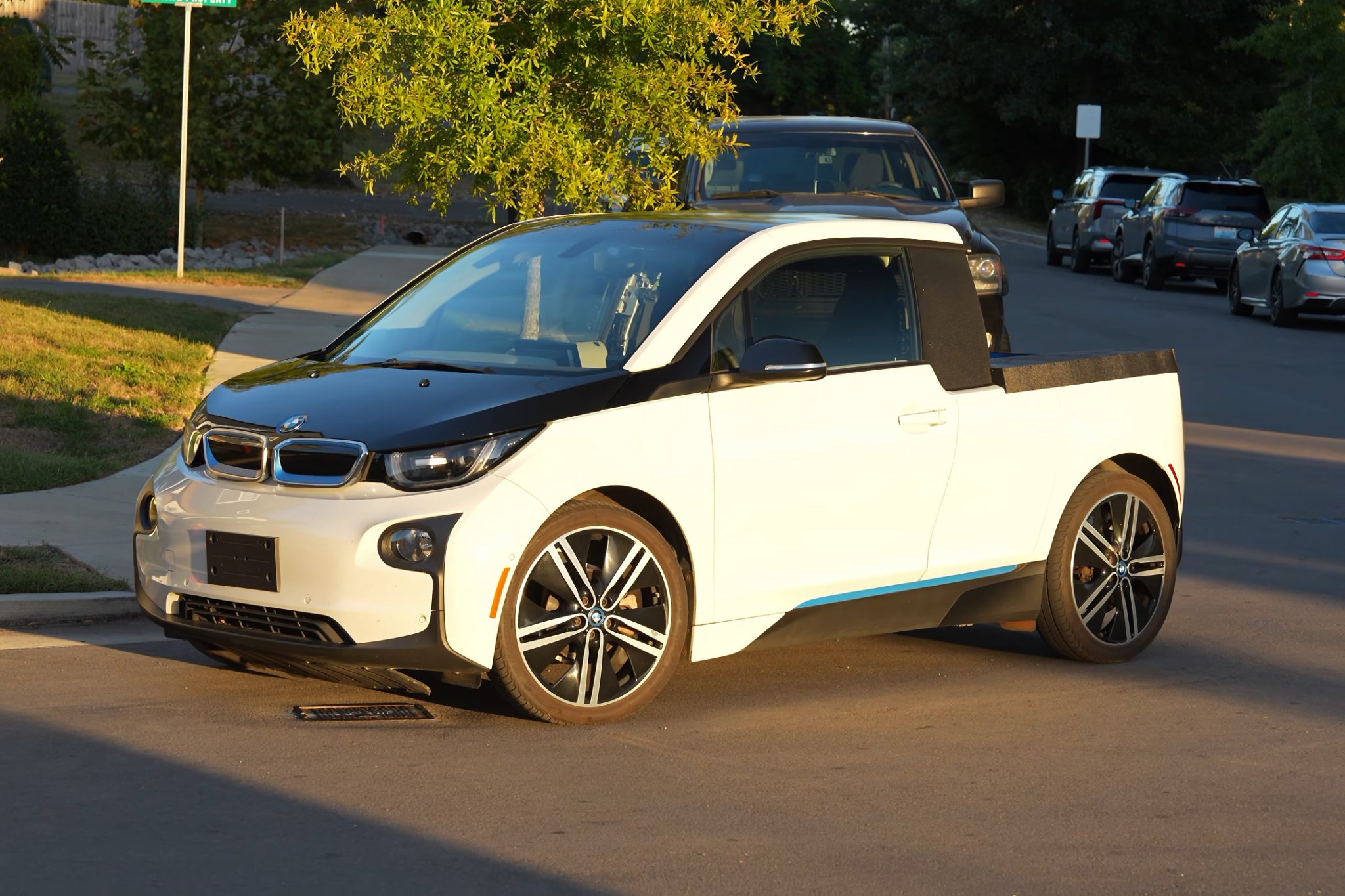
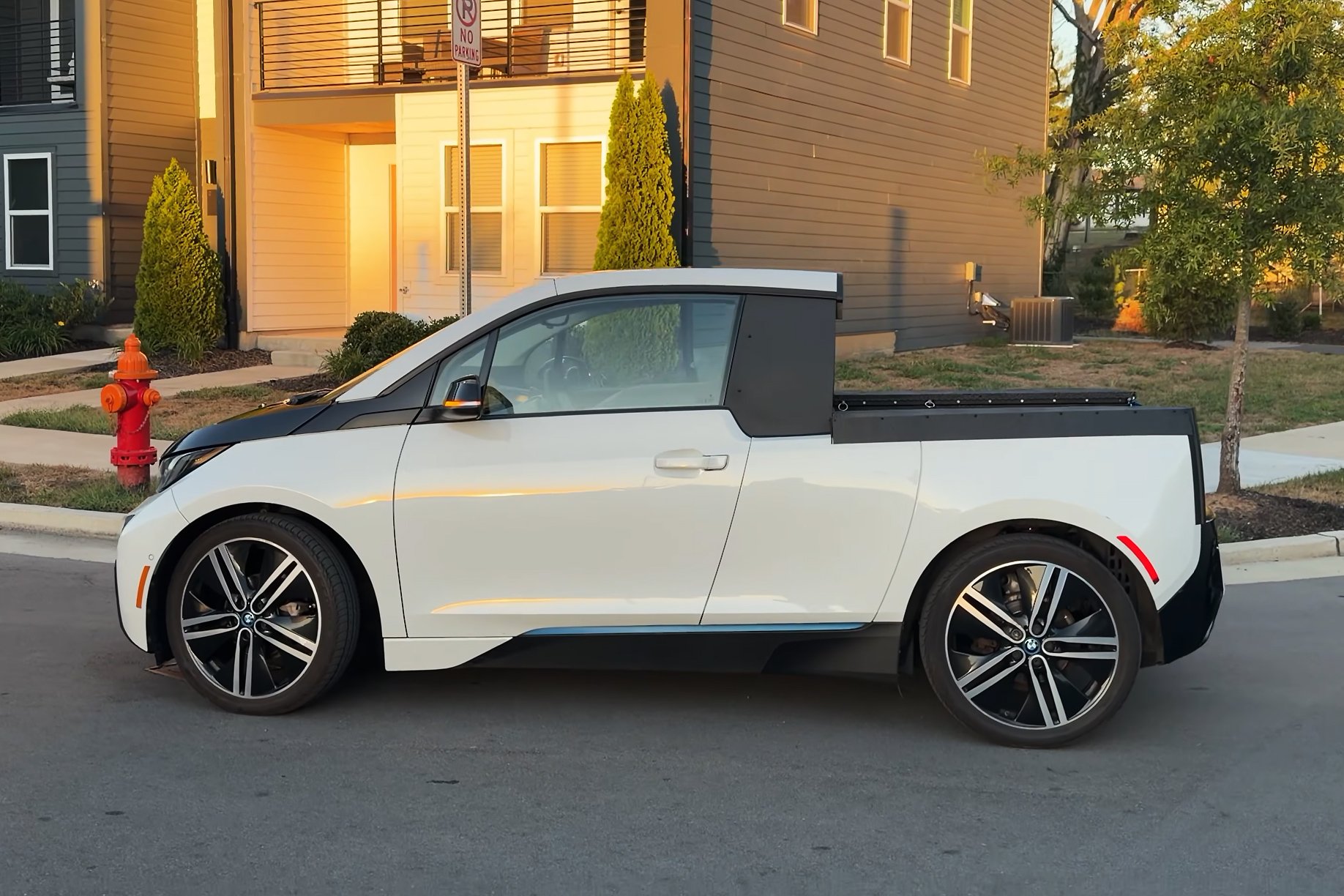
The plan was simple enough to explain and considerably harder to execute: cut the back off a range-extender i3 and turn what remained into a small electric pickup.
Why the i3 makes an odd but intriguing donor
The i3 hatch arrived in 2014 with a carbon-fibre monocoque, which was unusual for a mainstream car then and remains rare now. That structure is the reason the car is worth converting at all, and it is largely immune to the rust that would have condemned a steel-bodied hatchback of similar age and condition.
It was also never a strong seller, which is precisely what makes it a good donor. Depreciation has done its work, auction prices are low, and there is no shortage of scruffy examples. A car that failed commercially can be an excellent starting point for something else entirely.
The i3’s reputation for clever packaging helps too. Its motor, battery and range-extender layout were designed around a small footprint, so there is less mass to drag around than a converted larger car would carry. The result is a light, quick electric pickup that no manufacturer currently offers.
How the conversion was done
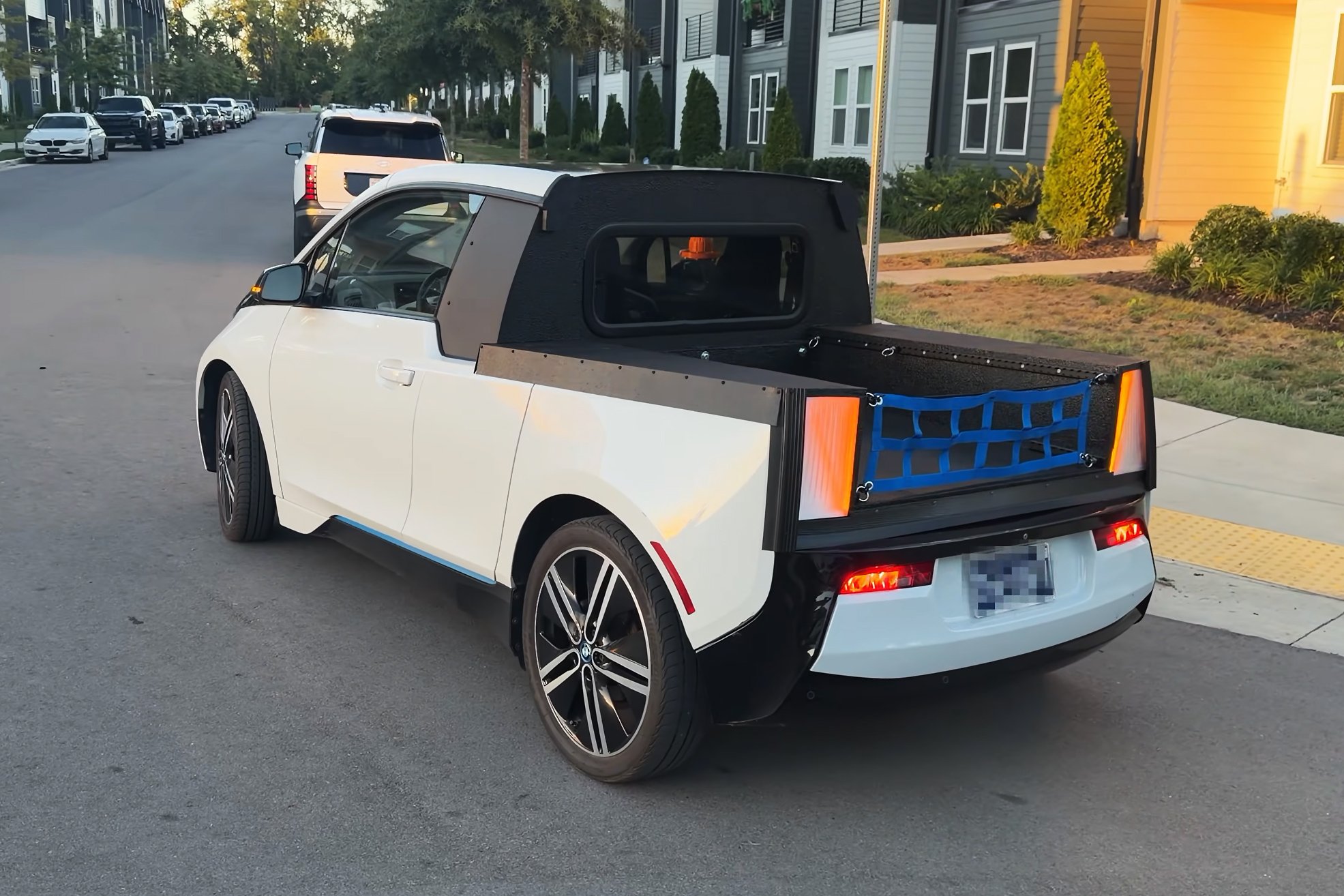
The rear of the car was removed and replaced with an open cargo bed, joined to the remaining structure by a steel frame. The bed itself is plywood, sealed with epoxy and finished with bedliner, which is about as pragmatic a solution as you will find. It is not a styling exercise. It is a working surface designed to take a knock and be repaired cheaply if it does.
Crucially, the bed is removable. That is not a convenience for carrying awkward loads. The i3 REX’s petrol engine sits where the rear seats used to be, and with the rear bodywork gone it needs to remain accessible for servicing. A permanently fixed bed would have buried the one component most likely to need attention, so the design accommodates it. It is the kind of detail that separates a build which gets used from one which gets abandoned after the first fault code.

Protecting the carbon-fibre monocoque
The i3’s party trick is its carbon-fibre reinforced plastic passenger cell, and cutting into it is not the same as cutting into steel. Bare carbon fibre is vulnerable once its surface is broken, so every cut edge was coated in epoxy to seal it, and waterproofing sealant went on every seam. The monocoque is stiff and light, but it is not forgiving of exposed edges and standing water.
What is perhaps more interesting is how much of the original car survived. BMW’s electronics are deeply integrated, and removing locks, taillights or data connections means persuading the car’s computers that everything is fine. Pick judged that hacking the firmware to cope with missing hardware was more trouble than simply keeping the hardware in place. So much of the original i3 remains, not because it was wanted, but because the car insisted on it.
That is a lesson anyone contemplating a home-built EV will run into sooner or later. Modern vehicles are networks as much as they are machines, and the body control modules do not take kindly to having their inputs removed.
Other work and the cost
Beyond the structural surgery, the build gained a new head unit with a larger display and a replacement windscreen after the original turned out to be cracked. Neither is glamorous, but both are the sort of thing that decides whether a converted car is pleasant to live with.
The target was under $10,000 for the whole project, in the US, and Pick came in comfortably beneath it at around $8,000. For context, that is well below the expected price of the Slate, though the comparison is not like for like. One is a factory product with a warranty and the other is a one-off, but it is a striking number all the same.
The affordability problem is not unique to small start-ups. Ford has spent years discovering that a well-executed electric pickup and an affordable one are different achievements entirely, a story we covered in our look at the Ford Fathom, Ford’s planned affordable electric pickup. The F-150 Lightning earned praise but has faced cost and demand pressures. Pick sidestepped all of it by starting with a depreciated hatchback and a saw.
What it says about the DIY EV scene
The appeal here is not really the truck. It is the idea of a cheap, light, carbon-bodied EV as a blank canvas. As early electric cars fall into the hands of people who fix things themselves, the pool of affordable donors grows, and the i3 is one of the more interesting candidates in it. Its structure is exotic, its electronics are awkward and its resale value is modest. That combination is exactly what a certain kind of builder is looking for.
The trade-offs are real, though. Retaining factory electronics makes a conversion more reliable but less flexible, and it means the finished vehicle carries the original car’s quirks along with its strengths. There is a fine line between respecting a machine’s original design and being held hostage by it. BMW itself has moved on, with the Neue Klasse language and technology now arriving on core models.
What Pick has demonstrated is that the affordable electric truck does not have to arrive from a factory. It can be assembled in a garage from a car the market rejected, for less than the price of the shiny alternative still waiting in the wings. The manufacturers are spending billions trying to build something similar. One engineer got there first with a second-hand hatchback, a steel frame and a sheet of plywood.
We covered electric pickup reality check in more detail elsewhere.