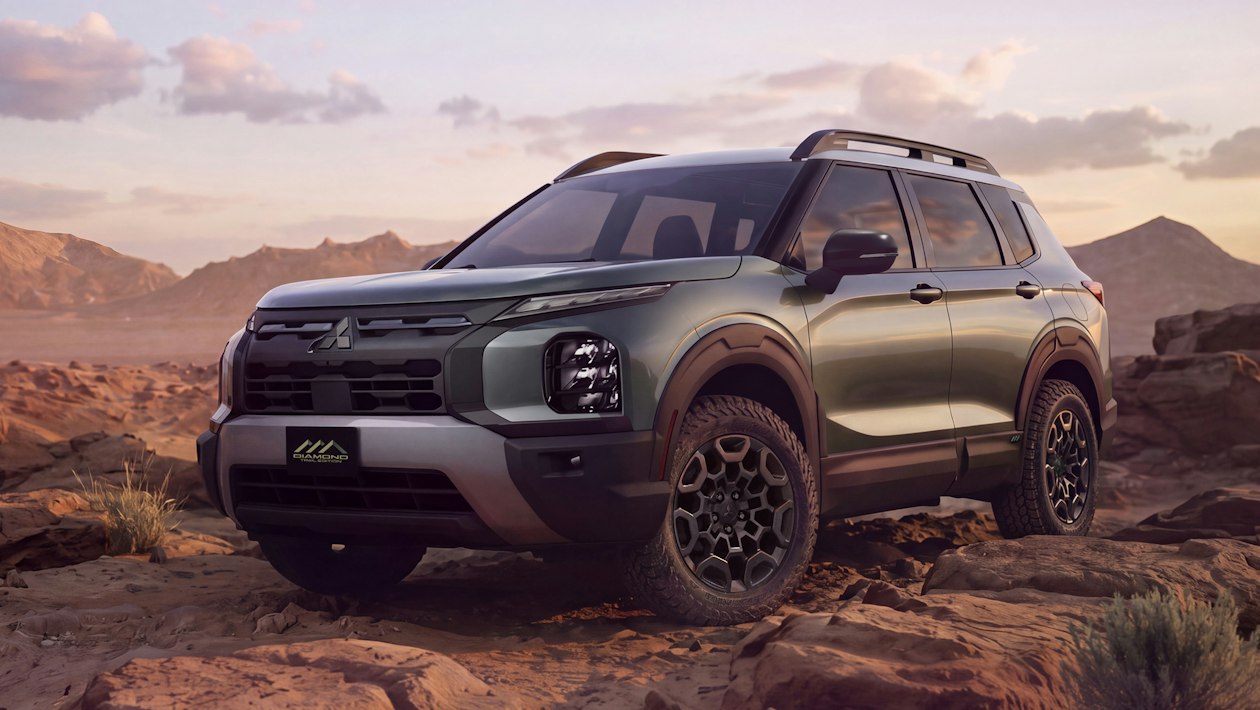
Mitsubishi has spent the past few years rebuilding its reputation around ruggedness rather than raw performance, and the new Outlander Diamond Trail Edition is the clearest expression of that strategy yet. Confirmed for the 2028 model year and unveiled at the SEMA show in Las Vegas, it is described by the company as the most off-road-capable Outlander it has ever built. That is a meaningful claim for a family SUV that has traditionally competed on value, plug-in hybrid efficiency and seven-seat practicality rather than dirt-road credibility. It is also, plainly, a North American vehicle: Mitsubishi has not confirmed the Diamond Trail for the UK, and everything below applies to the US market unless stated otherwise.
The debut also marks Mitsubishi’s return to SEMA after a 13-year absence, its last appearance having come in 2012. The show runs from 3 to 6 November, and Mitsubishi is using it to make a statement: the Diamond Trail is not a sticker pack and a set of black badges, but a genuinely reworked take on the Outlander with hardware to back up the styling.
Bumpers reworked for real approach and departure angles
The most telling changes are at the ends of the car. Mitsubishi has redesigned both the front and rear bumpers to reduce overhangs, and the numbers that result are the sort of thing you would normally read in a pick-up launch rather than a family SUV press release.
The approach angle rises from 18.3 to 20.5 degrees, while the departure angle climbs from 22.2 to 23.1 degrees. Those gains are modest in isolation, but they are the difference between scraping a bumper on a steep verge and clearing it, and they show the engineering team was given a genuine brief rather than a styling one.
The visual package follows suit. There are chunky wheelarch extensions, a matte black grille with a different mesh pattern from other Outlanders, black-finished headlights and raised roof rails. It reads as more purposeful without tipping into the cartoonish, which is a difficult line to walk with a seven-seat family car.
All-terrain tyres and a new paint colour
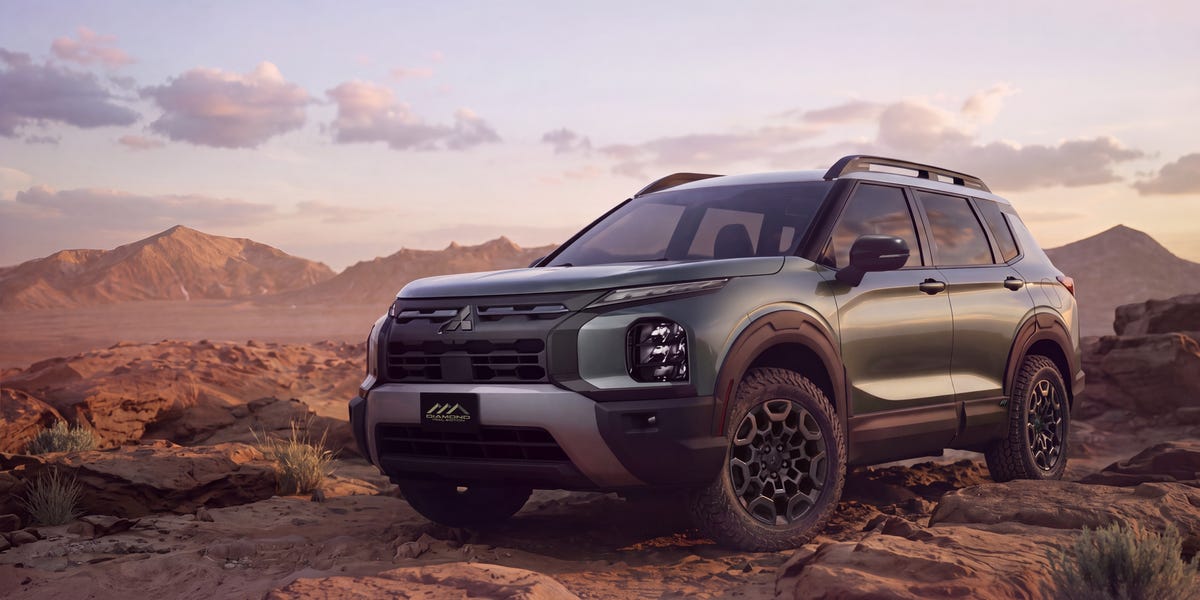
The Diamond Trail rides on 18-inch black alloy wheels wrapped in Nexen Roadian ATX all-terrain tyres. That is a proper all-terrain fitment rather than a road-biased compromise, and it should give the car genuine capability on grass, gravel and muddy tracks where standard Outlanders would start to struggle.
Mitsubishi is also using the trim to debut a new colour called Trail Green Metallic, which is likely to be the one most buyers gravitate towards. It suits the brief, and it gives dealers something distinctive to put in the showroom.
Cabin built for muddy boots
Inside, the Diamond Trail gets dark grey upholstery with khaki stitching. The material is water-repellent and easy to clean, which is exactly the right priority for a car like this. Anyone who has tried to vacuum a family SUV after a weekend at a trail centre will understand why.
Matte black, chrome and satin finishes break up the cabin, and Diamond Trail Edition logos appear on the seatbacks, floor mats and door trim. The logo itself is a nice piece of design work, referencing Mitsubishi’s three-diamond motif alongside a winter sports theme.
No interior images have been released yet, so the cabin remains something of an unknown quantity, but the specification suggests Mitsubishi has thought about the practical realities of the use case rather than simply adding a badge.
There is a useful technology upgrade too. The Multi-View Camera System now operates at speeds of up to 18.6mph (about 30km/h), up from 6.2mph. That is a small-sounding change with a big effect in practice: it means the camera views remain available while manoeuvring on a track or positioning the car on a narrow lane, rather than cutting out the moment you pick up any speed at all.
S-AWC carries over, with a new Rock mode
Underneath, the Diamond Trail retains the regular Outlander’s S-AWC all-wheel-drive system. The significant addition is a new Rock mode, which provides more traction to suppress wheelspin and automatically activates Hill Descent Control.
That automatic activation is the clever part. Hill Descent Control is one of those features many owners never use because they never remember to switch it on. Wiring it into a terrain mode removes that barrier entirely and makes the system genuinely useful to drivers who are not off-road enthusiasts.
Mitsubishi has not released powertrain details specific to the Diamond Trail, but the S-AWC system is the same one used across the Outlander range, so expect the familiar plug-in hybrid setup to carry over.
Three show cars and a stand full of rally hardware
Mitsubishi is not bringing a single car to SEMA. Three Diamond Trail models are on display: the standard car plus two modified variants that show what the aftermarket and the accessories catalogue could offer.
The first modified build runs BFGoodrich Trail Terrain T/A tyres, a 1.5-inch (38mm) lift kit, additional lighting and a custom-painted GulfStream trailer. A Thule roof rack carries two Specialized Stumpjumper mountain bikes, making it the lifestyle build of the pair.
The second is described by Mitsubishi as the most extreme. It gets a 2.5-inch (64mm) lift kit, more lighting accessories, traction boards and a roof tent. That is the overlanding interpretation, and it is the one likely to generate the most attention on the stand.
Also on display is the Ralliart AXCR Triton rally pick-up, the Delica D:5 Ultimate Gear (first seen at the 2026 Tokyo Auto Salon) and the Outlander Sport Trail Edition. The stand as a whole tells a coherent story about where Mitsubishi wants to position itself.
The rugged SUV space is getting crowded, and Mitsubishi is not the only brand moving in this direction. Ford’s Bronco RTR shows how much appetite there is for factory-built trail hardware, and you can read our coverage of the 2027 Ford Bronco RTR US pricing for a sense of how that market is shaping up.
Momentum 2030 and what comes next
The Diamond Trail Edition sits within Mitsubishi’s Momentum 2030 project, which aims to boost the brand’s North American presence by 2030 with a heavy emphasis on rugged, off-road-ready vehicles. The Outlander is expected to be a key model in that plan, and giving it a genuine trail variant is a sensible way to differentiate it in a segment where most rivals compete on screen size and finance rates.
Pricing and a release date have not been announced. Car and Driver expects the Diamond Trail to sit above the current Outlander Trail Edition, which starts at around $42,500 for the 2027 model year, and suggests it will likely exceed $45,000. Those are US figures for the US market.
For now the Diamond Trail remains a North American proposition, with no UK availability confirmed. Whether that changes depends on how the Momentum 2030 plan plays out and whether Mitsubishi decides the formula travels. On the evidence of the SEMA stand, it is a formula worth watching.
For more on this, see brabus p900 rocket edition.
For more on this, see cuts off peak charging.
For more on this, see ktm bow road legal.