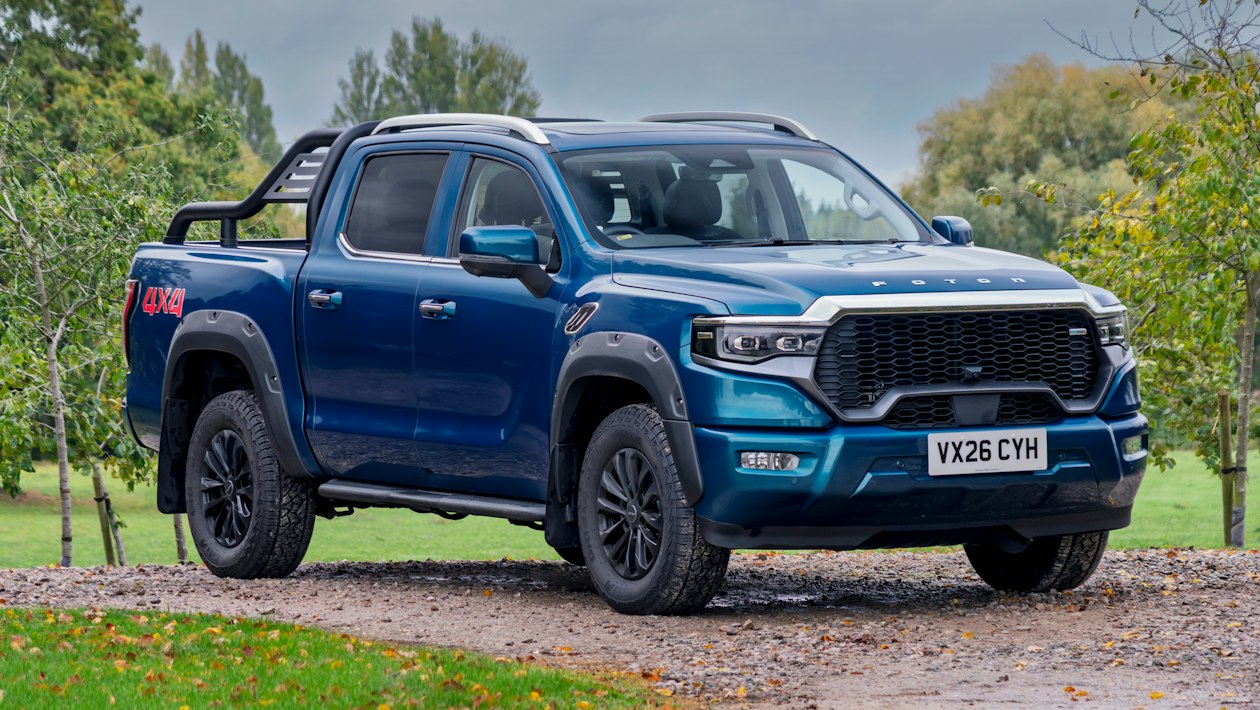
The pick-up market has been quietly conservative for years. Leaf springs, a ladder frame and a cabin built to survive muddy boots have long been the formula, and buyers have accepted it because the alternative was usually nothing at all. Foton’s plan is to offer that alternative. The Chinese manufacturer has confirmed that the Tunland, a diesel mild-hybrid double-cab pitched squarely at comfort and technology, will reach British showrooms in early 2027, with International Motors handling distribution. The date is a target rather than a signed-off commitment, and Foton has confirmed the Tunland will be built in right-hand drive for this market.
Foton Tunland launch: what’s confirmed so far
Pricing, final specifications and the dealer network will be “announced in due course”, so the numbers that matter to buyers, from monthly PCP rates to insurance groups, are still some way off.
What is settled is the route to market. International Motors will act as the UK distributor, the same arrangement it used for the Great Wall Steed and, more recently, the GWM Poer300. Foton previewed the brand to the UK at the Commercial Vehicle Show earlier in 2026, giving dealers an early look at both the Tunland and the Cavan C1 electric van.
Foton UK brand manager David Clark framed the launch as a statement of intent: “The Foton Tunland represents our ambition to offer UK buyers a compelling alternative in the pick-up market, combining strikingly bold looks and the practical qualities they need with the comfort, technology and design they increasingly expect from their vehicles.”
Powertrain and chassis: mild hybrid, eight speeds, multi-link rear
Under the bonnet sits a 2.0-litre diesel with 48V mild-hybrid assistance, paired with an eight-speed automatic. Foton has not released output, torque, economy or emissions figures, so claims about towing and real-world mpg will have to wait.
The more interesting engineering decision is at the back. The Tunland uses a multi-link rear suspension set-up that Foton describes as comfort-oriented, rather than the leaf springs that remain standard on most pick-ups sold here, including the Ford Ranger and Toyota Hilux in their mainstream forms. Leaf springs are cheap, tough and excellent at carrying loads, which is why they have survived so long on working vehicles. They are also the main reason an unladen pick-up can skip and jolt over a poor B-road. A multi-link arrangement should tame that behaviour considerably, at the cost of some payload headroom and complexity.
How much payload is sacrificed is one of the open questions. The same goes for towing capacity, which matters enormously in this class, where 3.5-tonne braked limits are the benchmark buyers compare. The mild-hybrid hardware is a 48V set-up rather than a plug-in system, so expect modest gains in refinement and low-speed response rather than dramatic economy figures. The eight-speed automatic is a sensible choice for the lifestyle brief, since it widens the appeal beyond buyers who actually want a manual.
Cabin and equipment: a pick-up that behaves like an SUV
Inside, the Tunland reads like a family SUV that happens to have a load bed. There is a large touchscreen, a digital instrument cluster and, notably, a wide array of physical buttons. That last detail will please anyone who has spent time stabbing at a touch-sensitive climate panel on a cold morning in gloves.
Equipment includes wireless phone charging, stitched leather upholstery and a panoramic glass roof. The glass roof is an unusual sight in a pick-up and underlines where Foton sees the customer: someone who wants the practicality of a load bed without giving up the trappings of a well-equipped passenger car.
Clark’s pitch leans on that dual purpose. The Tunland, he said, is “a versatile mild-hybrid pick-up that can suit almost every requirement, be it business or pleasure, and we are eager to showcase the vehicle to the UK audience.”
Positioning: lifestyle first, workhorse second
The Tunland is not being sold as a site vehicle. Every signal, from the multi-link rear end to the stitched leather and the panoramic roof, points to a buyer who needs a load bed occasionally and wants comfort the rest of the time. That is a growing slice of the UK pick-up market, particularly among double-cab buyers who use the truck as a family car during the week and a tip-run and tow-car at weekends.
It is also a crowded slice. Established names dominate, and the double-cab lifestyle sector has absorbed a steady stream of new entrants over the past decade. Foton’s differentiator is the combination of mild-hybrid diesel and a comfort-biased chassis at what will presumably be a keen price. Whether that price is keen enough will decide everything.
Chinese brands have also arrived in Britain in force, with new marques appearing at a rate that would have seemed implausible five years ago, and any change to government policy on imports would affect the arithmetic for every one of them, Foton included.
International Motors’ track record: a ready-made route in
Foton’s most valuable asset in the UK may not be the truck at all. International Motors has done this before, having brought the Great Wall Steed to Britain and more recently taken on the GWM Poer300. That experience covers type approval, parts supply, dealer recruitment and the day-to-day work of keeping commercial customers mobile.
For a new brand, that matters more than a spec sheet. Pick-up buyers, especially business users, care about downtime. A dealer network with a track record of supporting Chinese commercials is a meaningful reassurance, and it gives Foton a running start that a standing-start importer would not have.
Clark was keen to stress that Foton is not a blank-slate newcomer. “Foton has many global commercial and engineering partnerships, meaning this is not just another Chinese entrant in the UK market,” he said. “The result of this technical collaboration is a versatile mild-hybrid pick-up that can suit almost every requirement.”
Chinese brands are arriving in force, but pick-ups remain rare
The scale of Chinese penetration into the UK market is now hard to miss, but it has been concentrated in passenger cars. Commercial vehicles, and pick-ups in particular, remain a rarity. That is partly because the pick-up segment is small here and dominated by a handful of long-established models, and partly because the homologation and aftersales demands of commercial buyers are tougher to meet than those of private motorists.
Foton is hedging by bringing two strings to the bow. Alongside the Tunland, the Cavan C1 electric van is also set for a UK launch, giving the brand a presence in the zero-emission commercial sector where demand is rising and choice is still limited. That combination of a diesel mild-hybrid pick-up and an electric van suggests a distributor thinking about fleet buyers as much as retail ones.
The engineering story behind the Tunland’s mild-hybrid diesel also fits a wider pattern of manufacturers squeezing efficiency out of combustion engines rather than abandoning them. Toyota’s approach to the same problem is instructive, as we set out in our look at Toyota’s new 1.5-litre hybrid engine and the 85mpg powertrain.
What we still don’t know about the Foton Tunland
Plenty, and the gaps are the ones buyers care about most. There is no UK price, no confirmed trim structure and no word on which dealers will stock the Tunland or when order books will open. Payload and towing figures have not been published, nor have power, torque, CO2 emissions or official economy. Those numbers will determine company car tax treatment and benefit-in-kind costs for business users, and they will decide whether the Tunland can undercut a Ranger or Hilux on monthly PCP payments rather than just on the sticker.
The mild-hybrid diesel also raises a question about longevity in a market moving toward electrification. For now, though, a comfortable, well-equipped double-cab with a multi-link rear end and a sensible automatic gearbox is a genuinely different proposition from the leaf-sprung norm. If Foton and International Motors get the pricing right, the Tunland could carve out a useful niche when it lands in early 2027. We will update this page as UK specifications and prices are confirmed.