The KTM X-Bow has been on sale since 2008, yet it has never been offered in a road-legal production form in the United States. That is about to change, with one significant caveat: the car KTM has just opened for orders has not actually been approved for American roads yet.
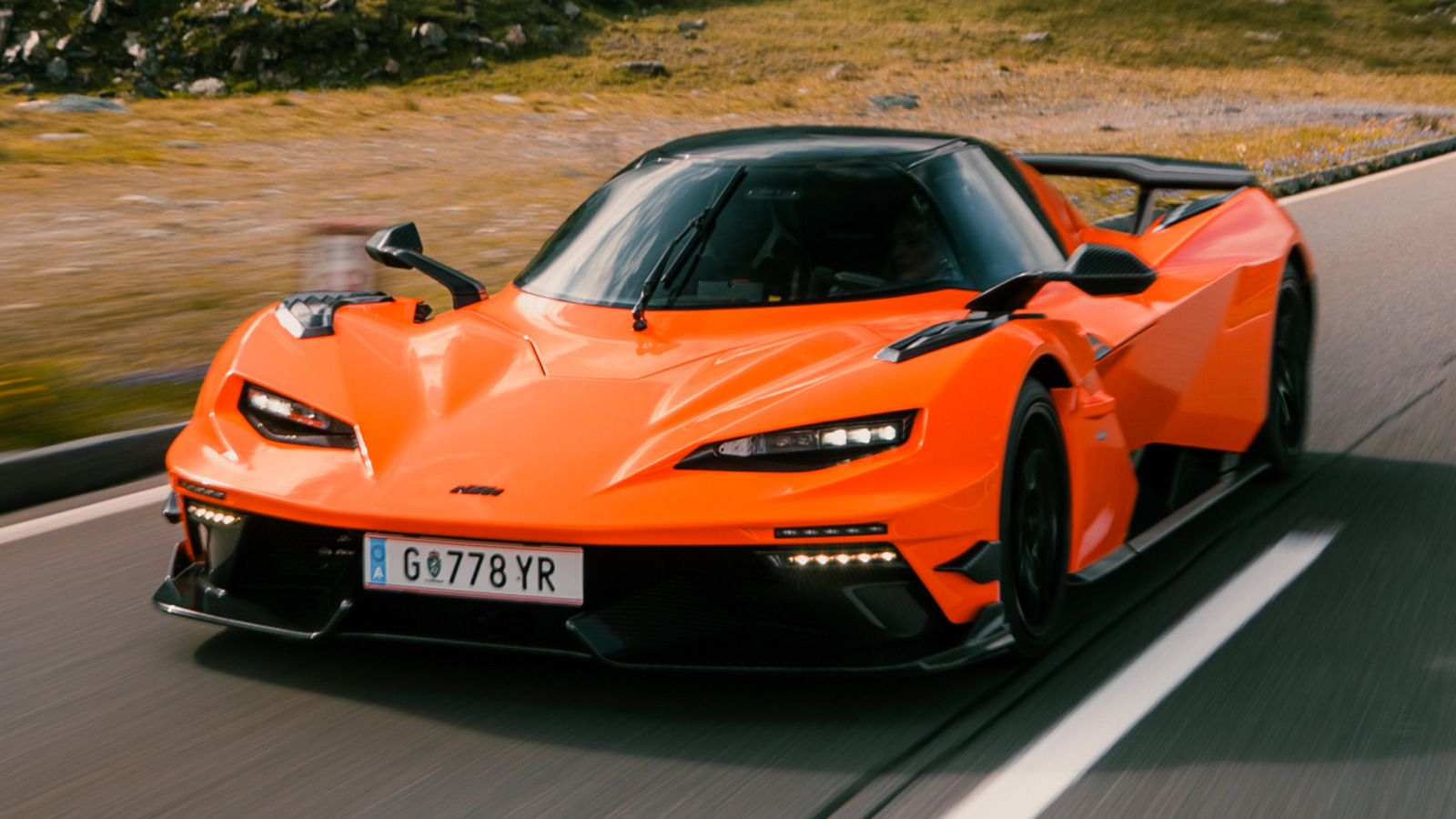
The GT-XA is the Austrian firm’s US-market take on the GT-XR, the closed-cockpit X-Bow that has been quietly terrorising European back roads for several years. It is a carbon fibre monocoque with a number plate, a 592 hp (around 600 PS) five-cylinder engine and a canopy that lifts up like a fighter jet’s. It is also, until the paperwork catches up, a very expensive track toy with a road-car price tag.
What the GT-XA actually is
Strip away the marketing and the GT-XA is a lightly adapted GT-XR, built around the same lightweight carbon fibre monocoque and drawing heavily on the GTX and GT2 race cars KTM builds. The X-Bow was originally developed in partnership with Dallara, the Italian chassis specialist behind everything from Formula 3 cars to road-going hypercars, and that racing DNA has not been diluted.
Where the original X-Bow was an open-cockpit machine with no roof and no pretence of practicality, the GT-XR and now the GT-XA wear a full windshield and a canopy-style roof. It is the difference between a track day toy and something you could conceivably drive to the track, thrash, and drive home again.
The road-legal question mark
Here is the part that matters most. The GT-XA has not yet been approved for US road use. KTM’s exclusive US partner Carbon Yard is working to secure that legalisation, and the company is taking orders now anyway.
The deposit is $50,000, and it is fully refundable until the car becomes road legal. That is an unusually honest arrangement in a market where deposits are often treated as non-refundable commitments, and it tells you something about the confidence KTM has in the approval process. It also tells you the firm knows exactly how it would look to take six-figure sums from customers for a car that might never be registrable.
If you want a cautionary comparison, look at how the Tesla Roadster Re-Revealed: 0.81s to 60mph, Rocket Thrusters and a $250,000 Deposit – But No Guaranteed Delivery has played out: a big deposit and a distant delivery date, with no guarantee the car arrives at all. The refundable structure here is a meaningful difference.
Price, production and timing
Expect prices to start at around $490,000, just under the half-million mark. These are US-market figures; the GT-XA is not being offered in the UK. Technical specifications and a final MSRP have not been announced, which is a curious position for a car you can now put money down on, but such is the way with low-volume specials.
KTM plans to build 30 cars in the model’s first year. Assembly takes place at the factory in Graz, Austria, with a delivery target of 2027. That timeline rests on a regulatory process outside KTM’s control.
From open cockpit to canopy
The GT-XA’s existence traces back to 2015, when KTM took the X-Bow racing. A factory GT4 version was required to meet regulations, and those regulations demanded a closed cockpit. The problem was that the existing monocoque made conventional doors impractical, so the engineers did the obvious thing and fitted a canopy instead.
That canopy made its road-legal debut in 2022 with the GT-XR, and the GT-XA is the likely beneficiary of that lineage. The canopy lifts up from the bodywork, bringing the carbon fibre roof, windshield and side windows with it. It is theatrical, it is impractical in a multi-storey car park, and it is exactly the sort of solution that makes a low-volume track car feel special.
Powertrain and chassis
The GT-XR has been upgraded for 2027 with a new Factory 600 package, and the GT-XA is expected to share that specification. The engine is Audi’s turbocharged 2.5-litre five-cylinder, a unit with a strong reputation in its own right, fitted with a new turbo, intake manifold and larger intercooler to produce 592 hp.
That power goes through a dual-clutch transmission and a mechanical limited-slip differential to the rear wheels. No hybrid assistance, no all-wheel drive, no torque vectoring trickery. Just a five-cylinder, a twin-clutch gearbox and two driven wheels, which in a car this light should be more than enough to keep the driver honest.
US-specific changes
KTM has made a handful of changes for the American market, and they are telling. There is a new suspension system with adjustable compression and rebound, a front-axle lift system to make it easier to pull into driveways, and tyre-pressure monitoring.
Buyers can also choose custom materials, colours, trim and interior stitching. KTM says the GT-XA aims to combine the X-Bow’s track capabilities with extra composure and comfort for the street. The front-axle lift is the giveaway: this is a car designed for people who have a driveway with a slope, not just a garage at the end of a pit lane.
Weight and usability
The GT-XR weighs around 1,252 kg. That is over 450 kg heavier than the original open-cockpit model, a figure that sounds alarming until you remember the original had no roof, no windows and no pretence of crash protection beyond the bare minimum.
The canopy and fixed seats are the other usability story. The seats are fixed, with an adjustable pedal box and steering wheel to set the driving position, which is a common solution in low-volume cars and works better than it sounds once you are in. Whether it works well enough for a 300-mile drive is another matter entirely.
What ownership looks like
Each car is hand-built at KTM’s facility, and owners can spend time with the engineers during the build. There are also exclusive driving experiences, including at the Red Bull Ring, which is a rather good venue for discovering what 592 hp and a carbon monocoque feel like when there is no oncoming traffic.
Carbon Yard is handling local operations and will sell the GT-XA through select partners. That model, a specialist importer with a small retail network, is familiar from other low-volume performance brands.
The company behind the car
KTM fell on hard times in 2024, entering self-administration while struggling with hundreds of millions of euros of debt. The motorcycle arm was sold to Indian manufacturer Bajaj Auto. The company behind the X-Bow was split off into a separate entity, now backed by a Belgian investment consortium that includes racing driver Guillaume de Mévius.
That separation matters for anyone considering a deposit. The X-Bow business is no longer tied to the financial fortunes of the motorcycle division, and the involvement of a consortium that includes a racing driver points to a genuine interest in the programme rather than an asset-stripping exercise. It is not a guarantee, but it is a better position than the one KTM found itself in two years ago.
The bottom line
The GT-XA is a $490,000 car that does not yet have a confirmed specification, a final price or permission to use American roads. On paper that sounds absurd. In practice it is how the low-volume end of the market has always worked, and the refundable deposit is a meaningful protection that many rivals do not offer.
Everything now rests on homologation. If approval arrives in time for the 2027 delivery target, 30 customers will get a hand-built, canopy-roofed, five-cylinder track car with a front-axle lift and a Red Bull Ring invitation. If it does not, they get their $50,000 back and KTM gets a very public reminder that selling cars is harder than building them. Until the paperwork is signed, the GT-XA is a promise rather than a product.
Related: audacious automotive 350 000.
Related: 300 track car experiment.
Related: road track gearhead gift.