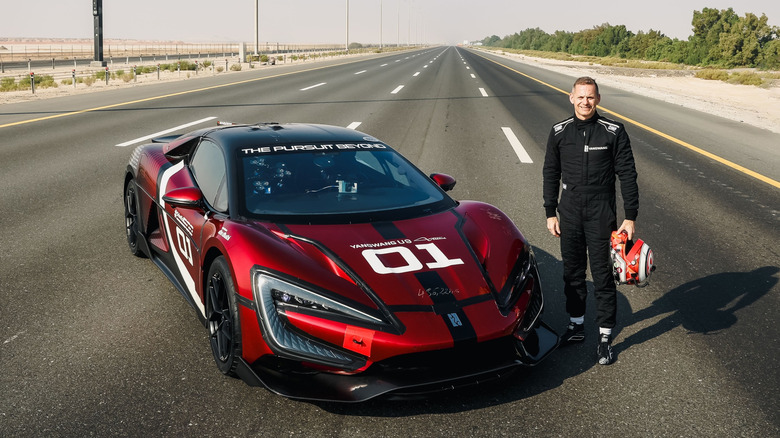
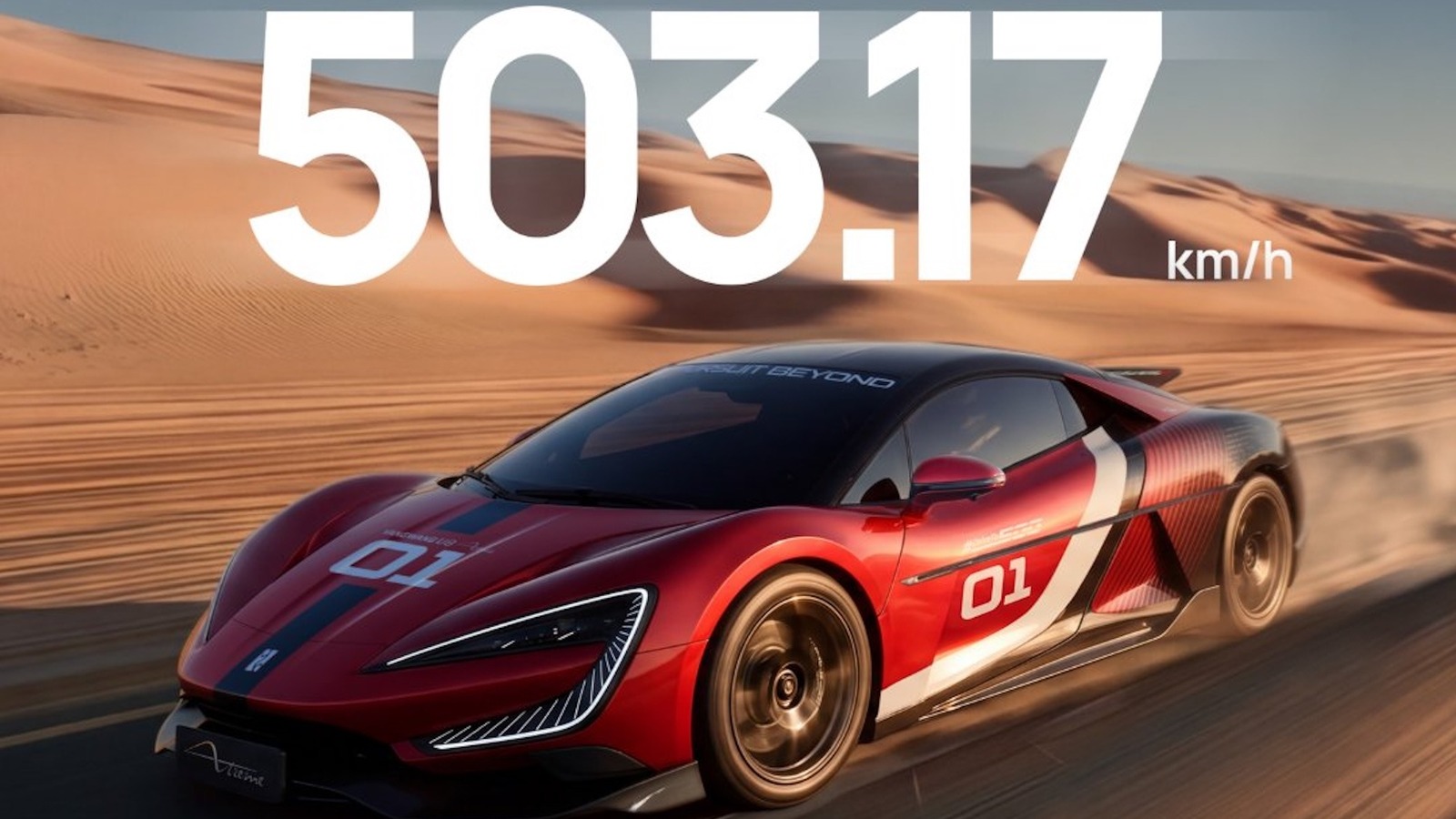
On 1 November, on a closed stretch of road in Abu Dhabi’s Al Dhafra region, a Yangwang U9 Xtreme reached 503.17 km/h (312.66 mph). That makes the car from BYD’s flagship luxury brand the first production model to break the 500 km/h barrier. Guinness World Records ratified the run, and the FIA recognised it. German racing driver Marc Basseng was at the wheel, just as he had been for the car’s previous record.
It is a staggering number, and it deserves the attention it is getting. It is also, by the standards that have traditionally governed top-speed records, only half a run. Both Guinness titles attached to the attempt are specified as “single direction”, and that detail matters as much as the speed itself.
The run on the E11
Abu Dhabi closed a 10 km section of the Sheikh Khalifa Bin Zayed International Road, better known as the E11, for the attempt. Of that, 7 km was usable. The road was cleared of debris and desert sand beforehand, which tells you something about the margins involved at this speed.
The attempt ran across two days. On day one, Basseng reached 490 km/h (304 mph), according to the FIA. Overnight, engineers adjusted the rear wing angle, suspension rebound damping and tyre pressures, and brought the battery and motors to optimum temperature. On the second day, the car went past 500 km/h.
BYD announced the result on X on 1 November, calling the U9 Xtreme “the fastest production car on the planet” and saying it “has done the impossible”. It is the first top-speed record set on public roads since the Koenigsegg Agera RS averaged 447.19 km/h (277.9 mph) on Nevada State Route 160 in 2017, and the first public-road top-speed record attempt at this level since then.
From Papenburg to Abu Dhabi
The record has had a short and busy history. The U9 Xtreme first set a benchmark of 496.22 km/h (308.3 mph) at Germany’s ATP Papenburg proving ground in September 2025. That figure had already beaten the Bugatti Chiron Super Sport 300+’s 490.48 km/h (304.8 mph) from 2019, ending a six-year reign.
So this is a car breaking its own record, on a different surface, in a different country, under a different set of conditions. The progression from a German proving ground to a Gulf road is not incidental. Proving grounds offer controlled surfaces and repeatable conditions; a closed public road offers length, and the E11 offered enough of it to find another 7 km/h.
How the run was engineered
The headline figure hides a lot of preparation. Beyond the overnight setup changes and the road cleaning, the run depended on managing battery and motor temperatures across two days of running in desert conditions. The U9 Xtreme’s 1,200-volt architecture, up from 800 volts in the regular U9, is central to that: higher voltage means lower current for a given power output, which means less heat to shed.
The tyres are bespoke semi-slicks developed with Singapore-based Giti Tire.
The car underneath the number
The U9 Xtreme runs four electric motors, each rated at 555 kW and spinning to 30,000 rpm, for 2,220 kW combined. BYD quotes “over” 3,000 PS. Energy comes from a track-grade version of BYD’s Blade Battery, using LFP cells rather than the nickel-rich chemistry usually associated with maximum output.
It is not only a straight-line machine. The car holds the production EV lap record at the Nürburgring Nordschleife with a time of 6:59.157, which puts it in rare company. Only 30 will be built, at around $3 million each (approximately £2.3 million at the time of writing, a rough conversion rather than a UK price). For context, the Rimac Nevera R tops out at 431.45 km/h (268.1 mph).
That combination of a sub-seven-minute Nordschleife lap and a 500 km/h maximum is the real technical story here. Plenty of cars can do one or the other. Very few can do both.
The caveat: one direction and two titles
Here is where the record book gets interesting. Top-speed records have traditionally been the average of two runs in opposite directions, completed within an hour, to cancel out wind and road gradient. That is the method behind the Koenigsegg Agera RS’s 2017 record, and it is why that figure has always carried extra weight.
The U9 Xtreme’s run was one way. The two Guinness titles listed for the attempt, highest speed by a production car and highest speed by an electric production car, are both specified as single direction. BYD’s post claims four Guinness records, but the FIA’s announcement lists only those two for this run; BYD also claimed records for fastest electric production car and fastest road tyre.
Bugatti faced similar criticism in 2019 when the Chiron hit 490 km/h (304.5 mph) one way on a pre-production car. Bugatti itself said it was not an official record, which was a candid admission and one that set a marker for how these claims should be read.
Commentators have duly argued that a one-way road run is a strong demonstration rather than a definitive record. That is a fair reading. It does not diminish the engineering, but it does mean the number should be understood as the best a car did in one direction on one day, not as a settled benchmark.
The other U9 Xtreme: a 450 km/h crash in China
The record announcement arrived alongside more sobering footage from China, where another U9 Xtreme was destroyed during a top-speed run on a test track. Video showed the car hitting guardrails and breaking apart, leaving only the central carbon monocoque around the driver. The driver survived without major injuries, which says a great deal about that structure.
BYD did not disclose the speed or the cause. Electrek reports the impact was at about 280 mph, roughly 450 km/h. BYD went back out and recorded 457.89 km/h (284.5 mph) on the next run.
At these speeds, the difference between a record and a catastrophe comes down to preparation, surface and luck. The crash is a reminder that the margins at 500 km/h are not generous, and that a carbon monocoque doing its job is the reason this story is about a damaged car rather than a fatality.
What the record means for Yangwang and BYD
For buyers, the U9 Xtreme’s relevance rests on technology transfer rather than the 30 cars themselves. Nobody reading this is shopping for a £2.3 million, 30-unit hypercar. But 1,200-volt architecture, LFP battery development at track grade, and motor control at 30,000 rpm all feed downwards into the wider range over time, and BYD is building a European presence on the back of exactly this kind of visible capability.
A milestone that still needs a second run
The U9 Xtreme is the first production car past 500 km/h, and that is a genuine milestone. It was achieved on a public road, in a car built to a customer specification, with a driver who had done it before. The engineering behind it, from the 1,200-volt system to the LFP Blade Battery to the bespoke Giti rubber, is serious work.
But a one-way run is not the same as a two-way average, and the record’s own paperwork says so. Until someone takes the U9 Xtreme back out and does it in both directions within the hour, the 503.17 km/h (312.66 mph) figure stands as the fastest a production car has been clocked, not as the settled answer to how fast one can go. The distinction is small in the marketing material and large in the record books.
Related: yangwang u9x hits 312.
Related: yangwang xtreme becomes production.