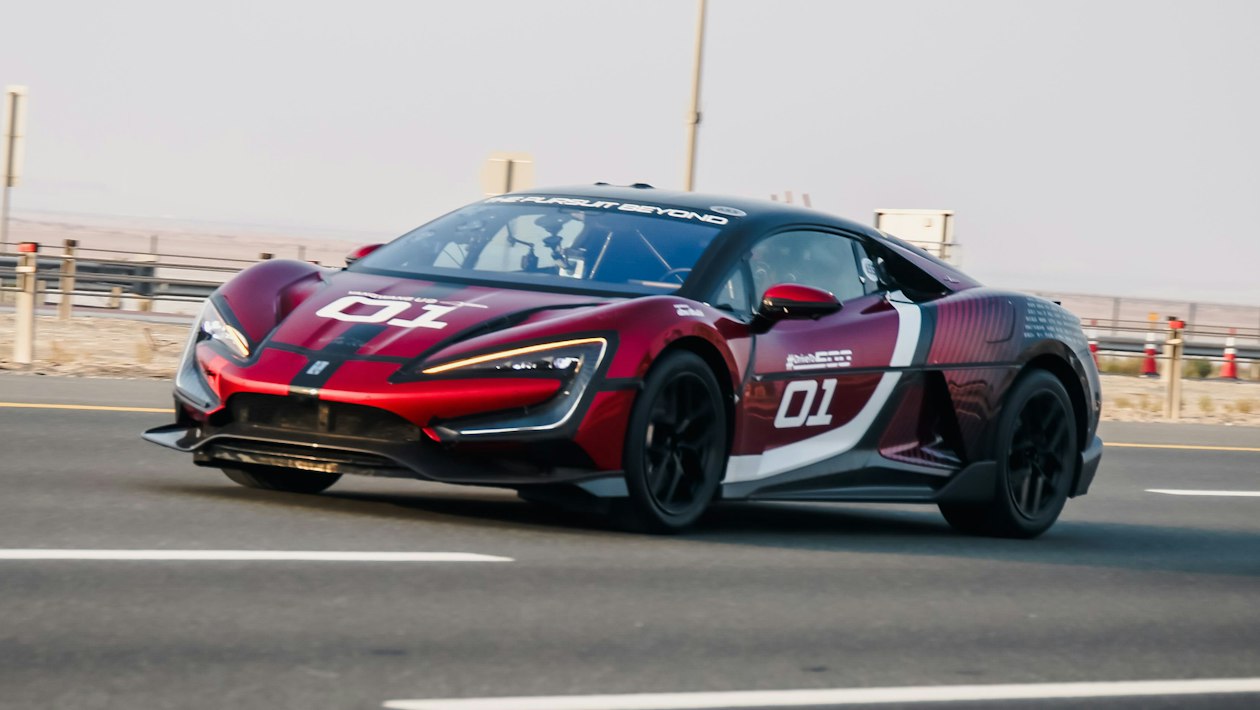
The run that broke the 500kmh barrier
The venue was the Sheikh Khalifa Bin Zayed International Road in the United Arab Emirates, a ribbon of tarmac laid through desert with almost nothing to interrupt it. Roughly six miles were closed for the attempts, and the surface was swept beforehand because normal traffic leaves debris and fluids behind on a road like that. This is not a banked oval or a proving ground with run-off designed for the job. It is a public road, temporarily borrowed. The car itself was finished in a colour that photographs as “look at me”, which is entirely in keeping with the occasion.
Marc Basseng, a Le Mans 24 Hours winner, was at the wheel. The U9X had already gone past 300mph in earlier form, and this run added another 4.32mph to the brand’s own benchmark. The record was verified by Guinness World Records as the fastest production car over a single-direction run, and with it came the fastest electric production car title. Our earlier report on the Yangwang U9 Xtreme’s 503 km/h pass covered the immediate aftermath; what has become clearer since is how much preparation sat behind those few seconds.
What the record actually means
Here is the part that deserves scrutiny before the headline gets repeated for the next decade. The official production car speed record requires an average across two runs in opposite directions, which cancels out wind, gradient and surface variation. The U9X’s 312.65mph is a single-direction figure. Manufacturers increasingly ignore the two-way convention because a one-way run is easier to stage and produces a bigger headline, and Guinness has been willing to certify it.
On the traditional two-way basis, the SSC Tuatara’s 282.9mph average still stands as the fastest production car. The Bugatti Chiron Super Sport 300+ also ran one way only for its 304mph. So the honest reading is this: the U9X is the fastest car ever recorded on a road in a single direction, and the first to pass 500kmh. It has not yet proved it can do it both ways. That distinction matters to engineers and matters not at all to marketing departments, which is precisely why it will keep being blurred.
There is a certain irony in a Chinese EV brand taking a record long contested by small European firms with enormous engines. The industry has spent years arguing about whether electric performance could match combustion at the very top end. The argument is now settled in a straight line, at least.
Two days, several attempts, one clean number
The record did not arrive on the first try. Runs on 31 October peaked at 490kmh, around 304mph, which is a staggering speed and still short of the target. The team went back to the car overnight and changed two things.
Adaptive damper software was recalibrated to increase rebound damping, which matters enormously at these speeds. Over road undulations, a car can unload and reload its tyres in a way that turns a straight line into a suggestion. Rebound control keeps the rubber pressed into the surface when the body wants to float. Separately, the rear wing angle was adjusted to generate more downforce, trading a little drag for stability.
One of two runs on 1 November produced the record figure. The other attempt did not, which is worth remembering when a single number gets repeated around the internet.
The car underneath the headline
Four electric motors, 0-62mph in 2.36 seconds, and a production run capped at 30 units. The U9X is a halo machine in the traditional sense: barely any will be built, and fewer still will ever see a track, let alone a closed desert road. What it does is drag the Yangwang name into conversations where it would otherwise never appear.
The brand also builds the U8 SUV, which can turn on the spot thanks to independent wheel control. That party trick is the more commercially relevant piece of engineering, because it is the sort of thing a buyer can actually use in a multi-storey car park. Yangwang’s move from a footnote in BYD’s portfolio to a record holder is the kind of transformation enthusiasts love to argue about, and it earns a place alongside the biggest automaker reinventions of recent decades.
The crash that shadowed the celebration
Around the same time as the record run, video circulated of a U9X crashing during high-speed testing in China, with local media reporting that the driver was unharmed. Pushing a two-tonne electric hypercar beyond 300mph is an inherently violent activity, and testing at the limit exists precisely because things go wrong there rather than on the road. The numbers on the press release are bought with real risk.
What comes next
The obvious challenger is Koenigsegg. The Jesko Absolute, with its V8, has been built for exactly this fight, and if it beats 312mph outright then Yangwang keeps the electric record and loses the overall one. That is the nature of the game: records are loans, not deeds.
What the 312.65mph run has done is simpler than any of that. It has moved the ceiling. For a century, the fastest road cars were measured against 300mph as the outer limit of sanity. That limit has now been passed, by an electric car, from a company that was selling affordable plug-in hybrids while its rivals were building V12s. The two-way purists have a point, and it will keep being made. Nobody is going to forget which brand got there first.
For more on this, see jlr byd bailiffs raid.