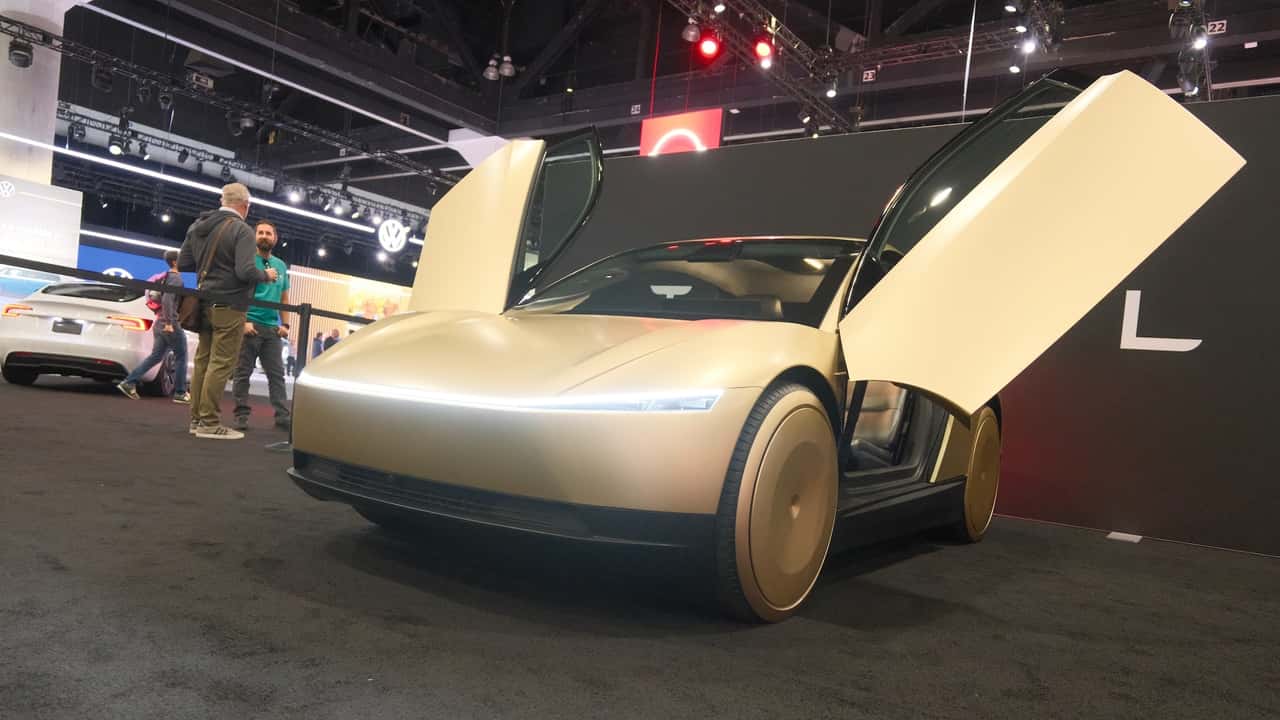
Tesla has spent the best part of a decade telling anyone who would listen that the steering wheel’s days are numbered. Now it is asking private buyers to put down real money on that claim. The car in question has no steering wheel and no pedals, it is on sale in a handful of American cities, and federal regulators have not formally agreed it is legal to sell.
The announcement landed quietly on a Friday evening, via Tesla’s Robotaxi account on X. Select customers were being invited to buy the Cybercab through an early-access, limited-release programme for personal use. It is a remarkable pitch: pay full price for a two-seat pod with no controls, and trust that the software will do the job. General public sales have not been confirmed, and Tesla has not said when, or whether, they will open.
How the early-access programme works
The invitation is being framed as a limited release rather than a conventional launch. Buyers in the first batch are restricted to one Cybercab each, for personal use only. Fleet operators are not being served yet, although Tesla has put an interest form on its website for anyone running a commercial outfit.
Tesla describes the personally owned Cybercab as “fully autonomous”, with owners monitoring and managing the car through the Tesla app rather than climbing in and taking over. That is the entire ownership experience in a sentence: you are not buying a car so much as a subscription to a robot that happens to live on your driveway.
The price, and the subscription you cannot skip
The Cybercab starts at $29,990 in the United States, roughly £23,500 at current rates, and that includes the first month of a mandatory autonomy subscription. After that, the subscription runs at $299 per month, or about $3,600 a year before you have paid for insurance or maintenance. There is also a non-refundable $1,000 deposit to reserve.
At $29,990 the Cybercab undercuts the Model 3 by $7,000 and becomes Tesla’s cheapest vehicle ever, a striking position for a machine with more in common with a lift than a hatchback. Whether it is genuinely cheap rather than just small is another matter. Add three years of subscription and the arithmetic tips past $40,000 before insurance, servicing or the cost of charging.
Elon Musk had previously promised the Cybercab would arrive before 2027 at under $30,000, and on paper Tesla has now delivered. Tech influencer Marques Brownlee had pledged in 2024 to shave his head if Tesla met that cost and timeline. Whether a limited early-access programme in seven service areas counts as meeting it is a matter of interpretation.
Where it works, and when
Deliveries in Austin, Texas are listed on Tesla’s website as beginning in December 2026, though at least one report, based on a screenshot of the order page, suggested cars could arrive as soon as next month.
The bigger caveat is geography. The Cybercab is restricted to “supported service areas”, which currently means Austin, San Antonio, Dallas-Fort Worth and Houston in Texas, plus Tampa Bay, Orlando and Miami in Florida. Las Vegas, Phoenix and Jacksonville are listed as coming soon. Outside those boundaries, the car’s usefulness is unclear, and Tesla has not explained what happens if you move house or fancy a road trip to a state that has not made the list.
What you are actually buying
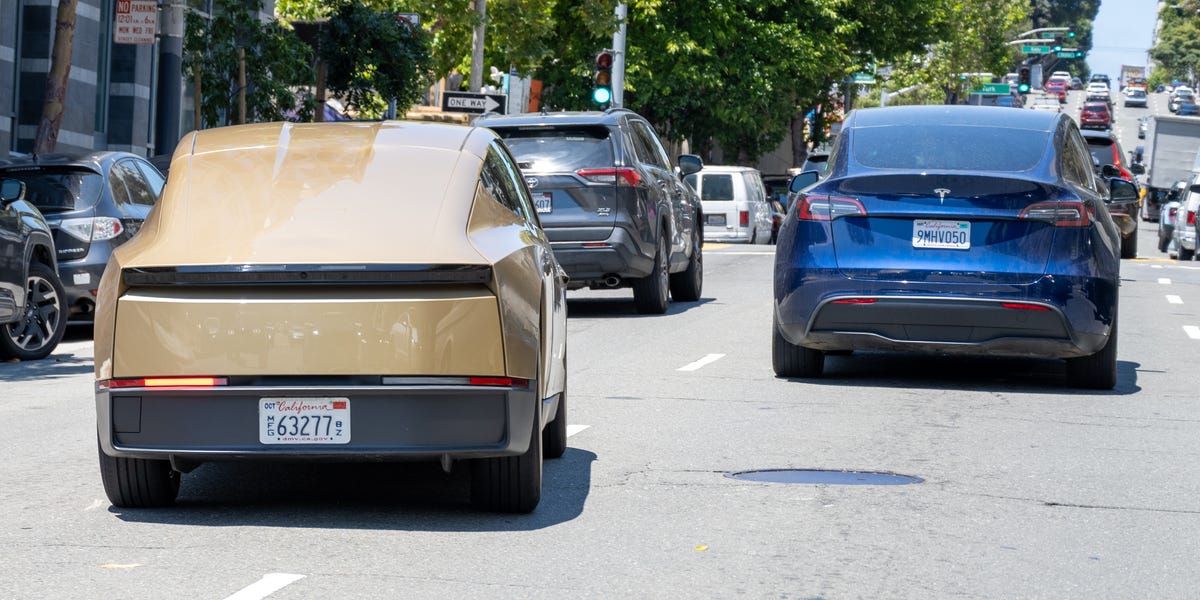
The hardware is as radical as the sales pitch. Two seats. No steering wheel. No pedals. No side-view mirrors. It is a deliberate rejection of the compromise that has defined every driver-assistance system to date, where the human remains a fallback. Tesla is not offering a fallback here.
That is a bold piece of industrial design and an even bolder piece of product liability. The Cybercab is not merely a car with clever software; it is a vehicle whose entire premise depends on the software never being wrong in a way that matters.
The regulatory roadblock
The National Highway Traffic Safety Administration has already asked Tesla how it determined the Cybercab complies with federal motor vehicle safety standards, given the absence of a steering wheel, pedals and mirrors. That is not a routine query. Federal rules were written on the assumption that a human would be at the controls.
Manufacturers can apply to deploy non-compliant vehicles, but such deployments are capped at 2,500 vehicles a year. Zoox was recently granted an exemption to deploy 5,000 autonomous pods over two years, which gives some sense of the scale regulators are currently willing to entertain. NHTSA says it is working to streamline autonomous vehicle rules, and there are signs of movement: the agency has already consulted on a draft that rewrites parts of FMVSS 108 to account for vehicles operating without a human at the controls, as we covered when NHTSA proposed cyan lights to mark self-driving cars in the US.
Until the rulebook catches up, the Cybercab exists in a strange space: a consumer product on sale before its legal basis is fully settled. Rivals are in no hurry to join it there. Rivian plans to fit lidar and a new in-house chip to the R2, building towards eventual self-driving capability rather than launching with it, while GM intends to offer an eyes-off version of Super Cruise on the Cadillac Escalade IQ in 2028, starting on highways with a human still present. Both keep the driver in the loop and the hardware redundant. Tesla’s approach does neither.
The robotaxi income question
The most conspicuous silence in the announcement concerns money. Tesla has said nothing about whether owners will be able to add their Cybercab to the Robotaxi fleet and earn income from it, despite this being one of Musk’s longest-running promises.
Today’s driverless cars are overwhelmingly owned by companies such as Waymo, Zoox and Tesla itself, not by individuals. The idea that a privately owned car could clock on as a taxi while its owner sleeps has been central to the Tesla story for years. Its absence from the launch material is telling, and buyers should treat any future income as speculative rather than baked in.
Musk’s record on autonomy deadlines
Scepticism is warranted, and not because of anything the Cybercab does. Musk has missed self-driving deadlines with remarkable consistency: a million robotaxis by 2020, unsupervised self-driving “pretty much every year since”.
There is friction closer to home too. Musk has most recently said owners’ Model 3s and Model Ys will become autonomous in Q2 next year within Robotaxi service areas, a claim that has landed badly with owners who paid handsomely for Full Self-Driving and are still waiting for the promised capability. Tesla’s habit of announcing a future and selling it in the present is well established. This is the same company that once unveiled a car at a rocket test site and drove it upside down, as we reported when Tesla’s New Roadster Does 0 – 60 in 0.81 Seconds and Drives Upside Down broke cover. Showmanship is not the same as shipping.
What buyers are really being asked to believe
Strip away the price and the launch theatre, and the Cybercab proposition comes down to a single question: will you pay $29,990, plus $299 a month, plus a non-refundable deposit, for a car that only works in seven American metro areas, that federal regulators have not yet cleared for general sale, and that may never earn you a penny as a robotaxi?
Tesla is asking for faith, and it is asking for it in writing. For a certain kind of buyer, that will be enough. For everyone else, the sensible position is to wait until the exemption paperwork is signed, the service map is bigger than a handful of Texan and Floridian cities, and someone independent has confirmed that the thing actually drives. The Cybercab may well be the shape of things to come. It is not yet the shape of something you should put a deposit on.