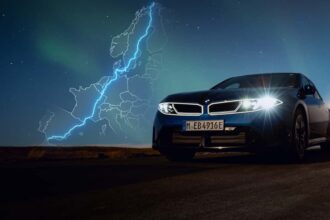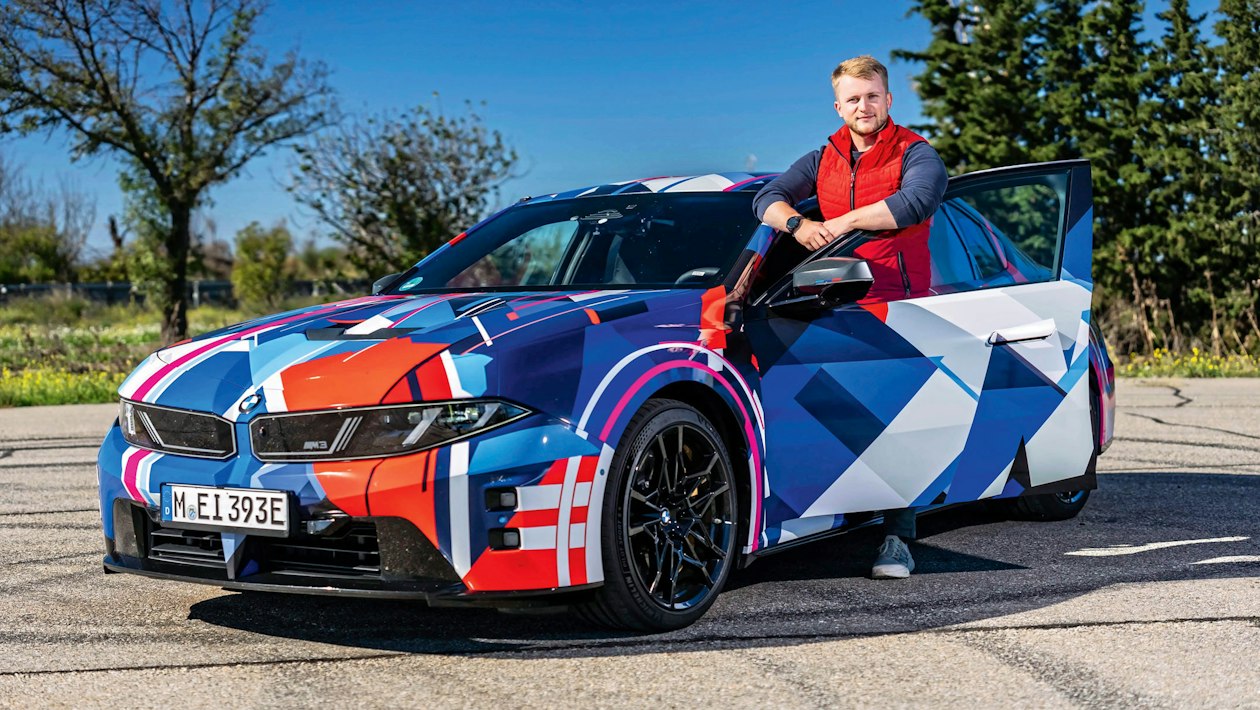
BMW has spent decades teaching its customers that fast M cars mean straight-six engines, turbochargers and a soundtrack built on petrol. Now it is about to turn that logic on its head. The next M3 will be offered with a choice of petrol or electric power, and in a move few saw coming, the electric version arrives first. BMW has confirmed the electric M3 will be revealed “very early in 2027”, with the six-cylinder petrol car following later. Prototype drives are already underway, and the early verdicts suggest the gamble is paying off.
The electric M3 leads the charge
This is the headline that matters most. For the first time in the model’s history, a full-fat M3 will come with two powertrain options, and the battery-powered car is not the supporting act. BMW has confirmed two spearheads of the 3 Series range, one petrol and one electric, and the electric M3 is scheduled to arrive ahead of its six-cylinder counterpart.
That sequencing is a statement of intent. Performance brands have generally hedged their bets, launching electric flagships alongside combustion stalwarts while quietly hoping nobody notices the shift. BMW is doing the opposite by putting the electric car at the front of the queue and letting the petrol version follow in its wake. Buyers will soon be able to choose which powertrain they want in a full-fat M car, a first for the badge.
Nearly 850bhp from four motors
The numbers are serious. BMW’s electric M3 prototype produces almost 850bhp and 1,200Nm of torque, delivered through four electric motors, one for each wheel. That individual wheel control is the technical heart of the car, allowing the electronics to shuffle torque front to back and side to side far faster than any mechanical differential could manage.
Energy comes from a 100kWh battery targeting a WLTP range of just over 400 miles. That is a manufacturer target rather than a tested figure. Interestingly, that pack is smaller than the 108kWh unit fitted to a standard i3, which tells you BMW is prioritising weight and packaging over headline capacity. The range target is ambitious for a car with this much power on tap, and real-world figures will be the ones that matter once deliveries begin.
BMW says it has focused heavily on structural rigidity and battery cooling, two areas that matter enormously in a performance EV. A stiff body keeps the suspension geometry working properly under load, while robust cooling protects both battery and motors during repeated hard use. The brakes are available in steel or carbon-ceramic, and regenerative braking can recover up to 540kW, a figure that hints at just how much energy is flowing through the system under deceleration.
What the prototype is like to drive
The first drives have been encouraging. Auto Express described the prototype as driving spectacularly and called the experience utterly sensational, with the electronics managing the car’s bulk corner by corner and controlling every element down to the millisecond. That millisecond-level intervention is what makes a heavy electric performance car feel agile rather than merely quick.
Weight remains the open question. BMW has not disclosed a figure, and Auto Express estimates the car is likely well over 2.1 tonnes. That is a lot of mass to hustle down a B-road, but the four-motor layout gives the engineers tools that combustion cars simply do not have. The car is also supposedly able to drift, which suggests BMW has left room in the software for the rear axle to play.
The simulated gearbox and its synthesised soundtrack
Perhaps the most divisive element is the fake gearbox. BMW calls the short interruptions in power delivery “stages”, triggered by pulling a paddle. Each shift brings a simulated jolt from the electronics paired with artificial engine sound that mimics an eighties synthesiser. It is an approach that closely resembles Hyundai’s virtual gearbox in the Ioniq 5 N.
Whether buyers embrace this or dismiss it as gimmickry will depend on how convincing the execution feels from behind the wheel. The case for it is straightforward: a single-speed EV delivers acceleration so linear that it can feel oddly undramatic, and staged power delivery restores a sense of occasion. The case against is equally simple, in that some drivers will always prefer their electric cars to be honest about what they are. BMW appears to be betting that M customers want theatre, and it is not alone in that thinking. The direction of travel is clear across the performance car world, from the sold-out run of the Ferrari Luce Sold Out Through 2027 as First Electric Ferrari Defies the Critics to the appetite for ever more extravagant machinery that keeps tuners like Brabus in business with cars such as the Brabus P900 Rocket Edition: 900hp G63 Pickup Revealed.
Design and cabin
The prototype is still wearing camouflage, but the shape beneath it is telling. Flared arches and a chunky diffuser are clearly visible, giving the car the stance an M3 needs. Yellow daytime running lights, now an M signature, show through the disguise, along with extra lighting in the lower bumper.
Inside, the cabin features the Panoramic iDrive display and a high centre console. There is also a new two-spoke steering wheel with red M1 and M2 buttons mounted on the arms, a neat nod to the established M convention of storing two personalised setups for instant recall. It is a detail that will please existing M owners, who know exactly how useful those buttons are on a favourite road.
What it means for M buyers
The significance goes beyond one model. If the electric M3 delivers on its promise, it reframes what a performance saloon can be. Four motors, torque vectoring at every wheel, 540kW of regeneration and a chassis engineered around a heavy battery pack represent a genuinely different engineering philosophy from the turbocharged straight-six that has defined the M3 for generations.
For buyers, the choice becomes real rather than theoretical. Those who want the sound and character of a six-cylinder petrol M3 will still be able to have one, just later. Those willing to embrace the electric car get more power, more torque and what the first drives suggest is a spectacular experience, at the cost of a substantial kerb weight and a synthesised soundtrack that will not suit everyone.
BMW will reveal more when the covers come off very early in 2027, and Auto Express plans a full drive in the spring. The petrol car follows later, meaning the M3’s electric era starts first. It is a bold order of play from Munich, and on the evidence so far, the gamble looks well judged.