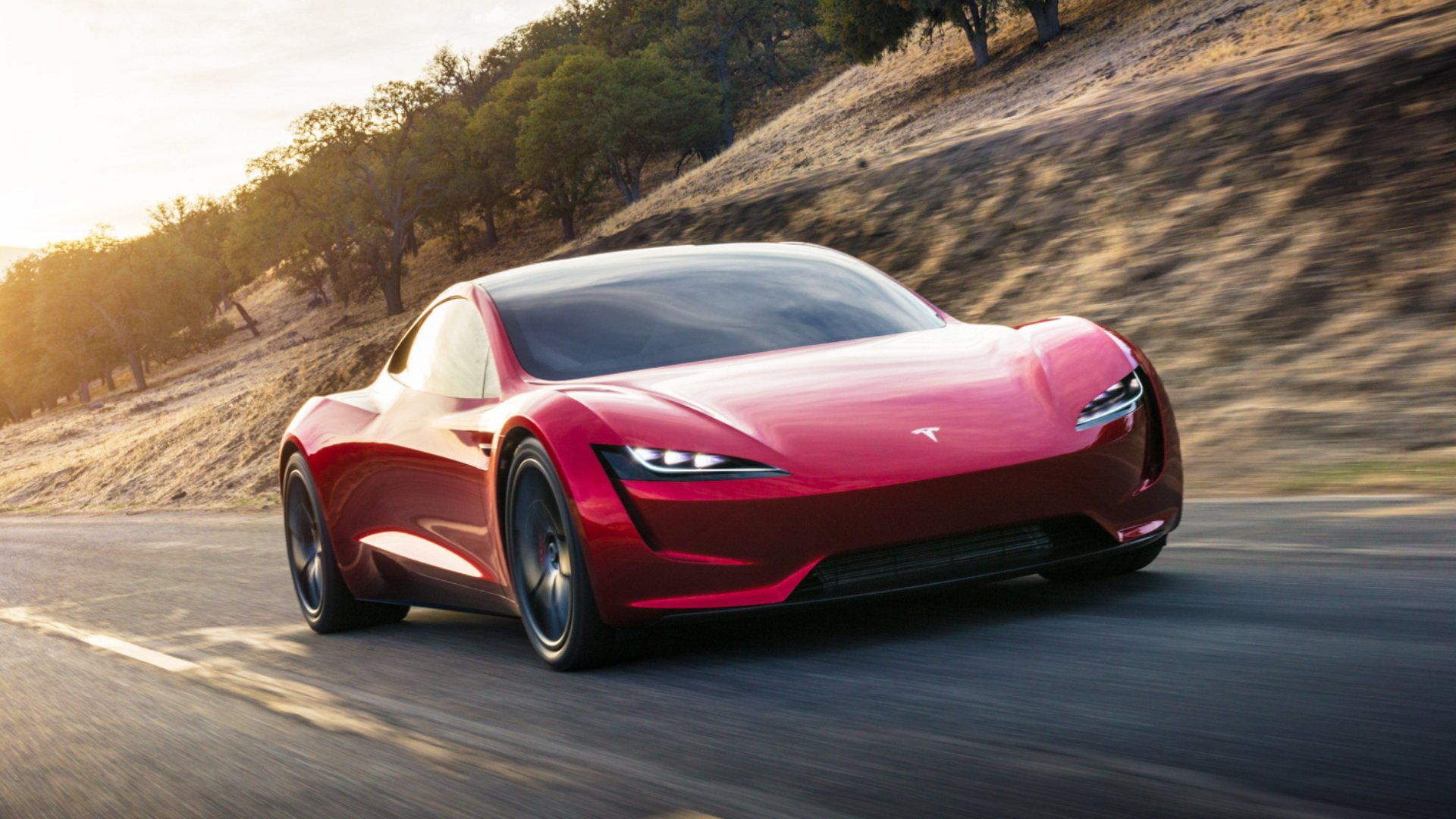
Elon Musk has never been a man for modest reveals, but even by his standards, presenting a car at a rocket test site and then driving it upside down takes some beating. The second-generation Tesla Roadster broke cover at SpaceX’s McGregor facility in Texas, two weeks later than planned after weather delays, with the event livestreamed for anyone who fancied watching a supercar defy gravity in the Texas desert.
0.81 Seconds: The Number That Broke the Barrier
Let’s start with the headline figure, because it is genuinely extraordinary. Tesla claims the Roadster will hit 60mph in 0.81 seconds, and the company demonstrated the sprint live at the event rather than simply flashing a slide on a screen. That comfortably undercuts Musk’s earlier promise of a sub-one-second time, a claim many observers had filed away as classic Elon hyperbole.
For context, the quickest production cars on sale today take somewhere north of two seconds to reach 60mph, while Formula 1 cars manage it in around 2.6 seconds (figures broadly cited in the industry). Note that F1 times are usually quoted for 0 – 100km/h, roughly 62mph, so the benchmarks are close but not identical. The Roadster’s claimed figure sits in territory normally reserved for Top Fuel dragsters, and it comes with more than 2.0 lateral G in corners according to Tesla. To put that in perspective, most performance road cars typically peak somewhere around 1.2 to 1.4 G through a bend. The Roadster is claiming cornering forces that would leave a driver’s neck muscles filing a formal complaint.
Whether those numbers survive independent testing is, of course, the question every sceptic will ask. Tesla has a history of quoting figures measured under ideal conditions, and 0.81 seconds is the sort of claim that invites scrutiny. But demonstrating it live, in front of a crowd and a livestream audience, is a far bolder move than burying it in a press release.
Driving Upside Down: The Stunt That Stole the Show
The acceleration is impressive, but the moment that will dominate social media feeds is the car climbing a ramp and staying there, inverted, held to the surface by an active aero fan system. Musk described the fans as sucking the car up into the road surface, generating enough downforce (or upforce, depending on your perspective) to overcome gravity entirely.
Then came the second act. The car flipped itself back down using attitude control thrusters integrated into the rear diffuser, a piece of engineering lifted straight from the spacecraft playbook. It is the sort of demonstration that reframes what an electric halo car can be. We have grown used to EVs competing on range, charging speed and efficiency. Here is a car competing on physics.
The fan system is a genuinely novel approach to downforce. Conventional supercars rely on wings, diffusers and ground effects to generate grip, all of which create drag and only work above a certain speed. Active fans can generate downforce from a standstill, which is precisely why the Roadster could stick to an inverted surface without needing to be travelling at speed. It is the same principle behind the Chaparral 2J fan car that raced in Formula 1 in 1970 before being banned, and the Brabham BT46B that won a single race in 1978 before meeting the same fate (both are well-documented examples). Tesla has taken a concept outlawed in motorsport and put it on a road car.
Thrusters That Run on Air, Not Fuel
The compressed-air thrusters in the rear diffuser are the detail that separates this from a pure publicity stunt. Because they run on compressed air rather than combustible fuel, Tesla says the thrust capacity can be replenished on the move, with an onboard compressor recharging the air supply so you are not limited to one spectacular launch followed by a hunt for a refill.
Tesla also says the thrusters can be used to boost forward acceleration, which raises the intriguing possibility that the 0.81-second figure relies on them. If so, it is a fair question whether that constitutes a genuine acceleration time or a rocket-assisted one. Either way, it is not something you will find on a Porsche configurator.
This is where the Roadster starts to feel less like a car and more like a statement of intent. The company has been drip-feeding details about thrusters for years, and the production plan has evolved considerably along the way. Seeing them actually work, in the metal, is another matter entirely.
A Coupé Called Roadster, With Doors to Match
Here is the irony: a car named after an open-top tradition is, in fact, a two-seat coupé. The Roadster badge carries enormous history for Tesla, dating back to the original Lotus-derived sports car that proved electric performance was viable. But the new car is a fixed-roof machine with a deployable spoiler and what The Drive memorably described as “billionaire doors,” meaning the dramatic roof-hinged flaps that open upward rather than swinging out on conventional hinges. The name, it seems, is heritage rather than description.
More significant is what Musk confirmed about who, or what, will be driving it. The Roadster will remain human-driven and will be the only Tesla model to do so going forward. That is a remarkable admission from a company that has staked much of its valuation on autonomy. As Tesla’s mainstream lineup marches toward full self-driving, the Roadster becomes a deliberate holdout, a car built for the pleasure of driving rather than the business of being driven.
It is a canny piece of positioning. Buyers spending supercar money generally want to be involved in the experience. A halo car that drives itself would be a strange proposition indeed.
2028 Arrival and a Canyon Jump on the Horizon
Tesla says the Roadster will arrive in 2028. Given that the concept first appeared in 2017, that will make it an eleven-year gestation, which is long even by the standards of low-volume supercars. Those who put money down early will have had a considerable wait for their investment to bear fruit, and the deposit structure has been a story in itself. Early reservation holders in the US were asked for deposits of around $50,000, roughly £40,000 at current exchange rates, and the terms have shifted more than once since.
Tesla is not finished with the demonstrations, either. The company plans further feature showcases, including an attempt at Evel Knievel’s Snake River Canyon jump. That is a reference to the daredevil’s infamous 1974 rocket-powered motorcycle leap, an event that has become shorthand for audacious, slightly unhinged spectacle (a widely documented piece of history). Knievel attempted the jump but did not complete it. If Tesla genuinely attempts it with a production-derived electric supercar, it will be the most talked-about automotive stunt in decades.
The choice of venue for the reveal now makes complete sense. McGregor is not a car factory or a design studio. It is where rockets are tested, and the Roadster was presented as a machine that borrows from that world rather than merely visiting it.
What the Roadster Says About the Next Decade of Electric Performance
Strip away the theatre and something interesting emerges. The Roadster is no longer just a fast electric car, a role the original concept filled convincingly enough in 2017. It is now a testbed for ideas that could filter down: active aero that works from standstill, compressed-air thrusters that recharge on the move, and attitude control systems borrowed from aerospace. Some of these will never reach a Model 3. But the engineering mindset behind them says plenty about how Tesla intends to differentiate its halo products.
The Roadster is a global halo model rather than a UK-specific proposition, and Tesla has not published UK pricing or right-hand-drive details. The scepticism is warranted. Tesla has a long record of ambitious claims delivered late, and 2028 is a date, not a guarantee. The 0.81-second figure will be poked and prodded by independent testers the moment a car is available. The upside-down stunt, spectacular as it was, proves what a car can do on a ramp with a fan system, not what it does on the M25 on a wet Tuesday.
But there is no denying the impact. For a decade, electric performance has been measured in straight-line acceleration and range figures. Tesla has just thrown downforce, thrusters and literal gravity defiance into the conversation. Whether or not the Roadster arrives on schedule, it has already changed what people expect an electric halo car to attempt. And that, more than any single number, is the point.
We covered tesla roadster 81s 60mph in more detail elsewhere.