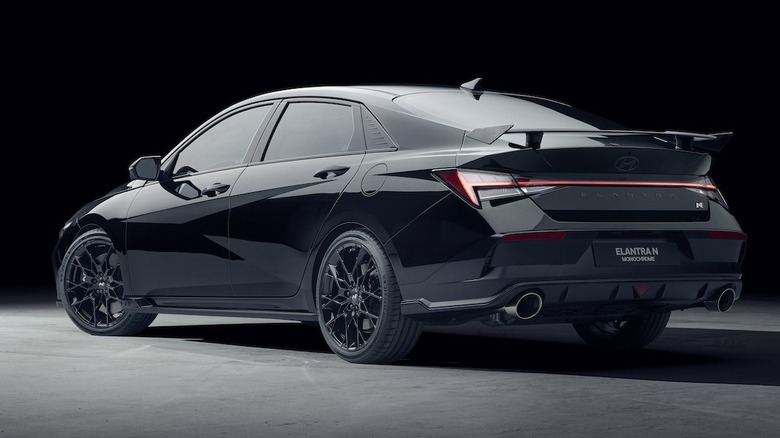
Hyundai’s N division has built its reputation on loud colours, aggressive aero and red detailing that tells anyone within fifty metres exactly what they are looking at. The new Elantra N Monochrome does the opposite. It is a special edition of the performance sedan that strips away the signature red exterior accents in favour of body-coloured trim, and Hyundai is pitching it squarely at buyers who want the pace without the peacocking.
It is a canny move from a brand that has spent the past few years proving its hot hatches and sedans can trade blows with established European rivals. The question is whether a quieter N is still an N worth having, and the answer says a lot about where the division goes next.
What the Monochrome actually is
At its core, the Elantra N Monochrome is the same car enthusiasts already know, minus the visual shouting. Hyundai has replaced the standard Elantra N’s red bumper inserts, red side skirts and red mirror detailing with body-coloured pieces, and the company says the treatment draws “attention away from color and toward the vehicle’s form, proportion, texture and performance-oriented details.”
That is marketing speak for a simple idea: some buyers like the 286 PS turbocharged four-cylinder and the chassis that comes with it, but they would rather not advertise either at the traffic lights. The Monochrome is that car for people who have grown out of the boy-racer look but not out of the fast sedan itself.
Hyundai’s reasoning, in its own words
Joon Park, Vice President and Head of N Management Group at Hyundai, framed the edition as a deliberate answer to customer feedback. The car “captures the essence of Hyundai N’s motorsport history and commitment to high-performance culture in a restrained package,” he said, adding that Hyundai had “listened to customers’ voices for a toned-down high-performance model.”
That last phrase is the important one. Special editions are often dreamed up in a marketing meeting and imposed on buyers. This one, at least according to Hyundai, came from the other direction. It is a small but telling distinction, and it suggests the company is paying attention to the way its N customer base is maturing.
The design changes in detail
The visual edits go further than simply deleting red paint. The Monochrome gets new black-painted forged alloy wheels, with brake calipers finished in matching black rather than the bright red usually found behind them. Front and rear fascias and the side skirts have been revised, and there is more black trim between the front intakes, which simplifies the face considerably.
The overall effect is a car that reads as one solid shape rather than a collection of contrasting parts. Black on black on black can easily look like a car that has been specified by someone who could not be bothered, but Hyundai has been careful to keep enough variation in finish and texture to stop it going flat. The forged wheels in particular give the eye something to work with.
Two colours and a carbon option
Buyers get a choice of just two finishes: Abyss Black Pearl and Performance Blue. Both are, in Hyundai’s careful phrasing, “subject to market availability,” which is worth noting given how the car is being rolled out.
The more interesting option is the Upper Trim package, which adds a carbon fibre rear wing and carbon fibre mirror caps. The wing is deliberately shorter than the one fitted to the Elantra N TCR, so it reads as a subtle ducktail rather than a full touring-car appendage. Carbon fibre on a road car is often pure theatre, but here it fits the brief: a performance part that does not scream for attention.
Inside, it is business class
The cabin gets the most substantial upgrades. Alcantara covers the seats, door cards, steering wheel and central armrest, and there is contrasting light blue stitching throughout. The steering wheel buttons, normally finished in blue, are now black.
It is a more premium-feeling specification than the standard car, and the light blue stitching is a smart touch. It gives the interior a focal point without reintroducing the red that the exterior has just spent so much effort removing. Anyone who has sat in a standard Elantra N will recognise the layout immediately, but the materials move it up a notch.
Under the skin, nothing has changed
There are no performance or chassis upgrades. The Monochrome uses the same turbocharged 2.0-litre four-cylinder as the regular Elantra N, producing up to 286 PS (210 kW) and 289 lb ft of torque. Power goes to the front wheels through either a six-speed manual or an eight-speed dual-clutch automatic, and Hyundai’s published images confirm both gearboxes are offered.
That will disappoint anyone hoping for a sharper chassis or a power bump, but it is also the correct decision. The Elantra N is already one of the more entertaining front-wheel-drive performance sedans on sale, and adding more power without addressing the front tyres would have been a step backwards. The N division has always been about chassis balance and cornering appetite rather than raw output, and a special edition that leaves the mechanical package alone is consistent with that philosophy.
Where and when it goes on sale
The Monochrome launches first in Korea, Canada and Australia. Korea gets it in late October, with pricing still to be announced at the time of writing. Hyundai says it has “plans to expand to other global markets” with “market-specific sales information to be announced separately,” which leaves the door open for further regions without making any promises.
One market that is definitively excluded is the United States. Hyundai N spokesperson Derek Joyce told Carscoops that “the Elantra N Monochrome model will not be offered in the U.S.,” adding that “the newest Elantra N model for our market is the Elantra N TCR Edition.”
Why this car matters more than it looks
The timing is the real story. A new-generation Elantra has already been unveiled in Korea, though the N version remains based on the previous car. A new Elantra N is expected in 2027, and camouflaged prototypes have already been spotted testing. That makes the Monochrome a likely farewell special for the current model, a last run before the platform moves on.
It is also a possible preview of something bigger. Earlier this year, Hyundai President and CEO Jose Munoz outlined plans for a mid-tier “N Lite” line, positioned between full N models and the milder N Line trim. A car that keeps the performance but dials back the visual aggression is exactly what an N Lite would look like, and the Monochrome may be the first public test of that idea.
Importantly, the Monochrome does not replace the regular Elantra N. It sits alongside it, which means buyers who still want the red accents and the full-fat look can have them. Hyundai is broadening the appeal of the car rather than diluting it. The company has form here: it has spent years building a motorsport presence that now includes a WRC calendar with a new United States round from 2027, and that competition programme is precisely the heritage Joon Park is invoking when he talks about a restrained package. The same instinct for reading the market is visible in the way the brand has expanded into other performance segments, as our coverage of the 275hp Polaris RZR Pro R Boost shows.
The verdict: a quiet N with plenty to say
The Elantra N Monochrome is a sensible, well-judged special edition at a moment when sensible is not always the first word associated with Hyundai’s performance arm. By removing the red jewellery and adding genuine interior quality in the form of Alcantara and carbon, Hyundai has built the car that a significant chunk of its customers have apparently been asking for.
As a signal of intent, the Monochrome is more revealing than a louder special edition would have been. It shows Hyundai thinking about the full spectrum of N buyers, from those who want the wing and the stripes to those who would rather have the same chassis in a car that blends into the car park. If the N Lite line does arrive, this is the template it will follow, and on this evidence that is no bad thing. For a brand that has made noise its trademark, learning to whisper may turn out to be the smartest move yet.