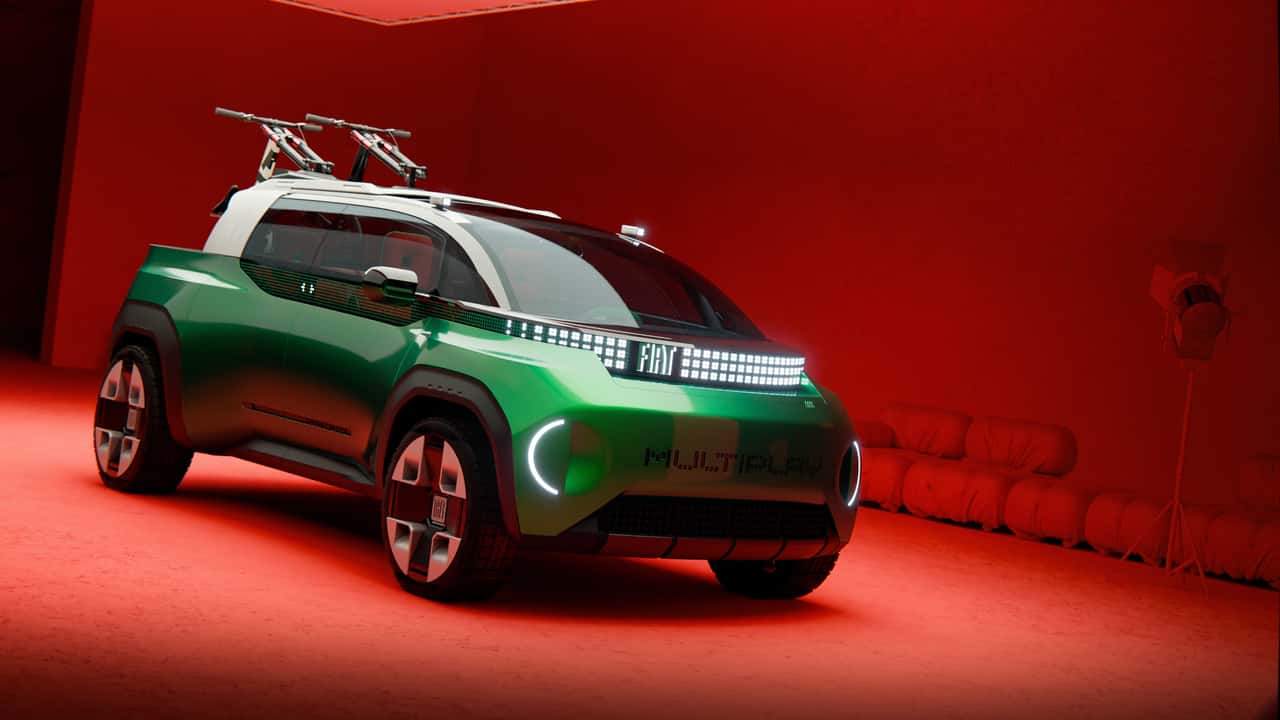
The Paris Motor Show has hosted plenty of concepts that promise to reinvent the car, but few have arrived with quite such a literal interpretation of the word. Fiat’s new Multiplay does not simply suggest versatility through clever packaging or a configurable boot floor. It physically pulls itself apart and puts itself back together again. The roof slides forward, turning a three-row family minivan into a dual-cab pickup in a single mechanical flourish. It also revives one of the most divisive nameplates in motoring history: the Multipla.
Fiat is calling the Multiplay a “3-in-1” concept, and for once the marketing shorthand holds up. The brief, according to the company, was to combine “the space efficiency of an MPV, the character of an SUV and the versatility of a pick-up” for “a family juggling work, school, sport and outdoor activities.” That is a crowded Venn diagram, but the Multiplay attacks it with genuine engineering ambition rather than trim badges and a raised ride height.
The Metamorfosi transformation explained
The party trick sits on what Fiat calls the Metamorfosi architecture, and it is worth walking through slowly because the mechanics are the whole story. The rear roof section slides forward in tandem with the third row of seats, clearing the space behind the second row and exposing a proper cargo bed. What was a six or seven-seat MPV becomes a four-seater pickup with an open load area, without the owner touching a spanner or booking a bodyshop.
Fiat has not stopped at the roof. In pickup form the Multiplay gains a split tailgate for easier loading, a retractable bed cover to keep the weather off whatever is strapped down, and a modular floor system for securing cargo. Then there is the detail that will do the rounds on social media: the roof spoiler rotates to reveal an integrated bike rack for two bicycles. It sounds gimmicky until you remember how many families spend twenty minutes wrestling a tow-bar rack onto a car before every weekend ride.
Compact outside, clever inside
The headline number is the one that raises eyebrows. The Multiplay measures 4.45 m long, which makes it shorter than a Jeep Compass, yet it offers a three-row interior with a 6+1 seating configuration in its minivan guise. That is packaging efficiency of a very high order, and it nods directly to the original 1955 Fiat 600 Multipla, which seated six across three rows in just 3.5 m. The 1998 Multipla that followed managed a two-row, six-seat layout in 3,994 mm.
The “+1” in the modern car is the “Petsenger seat” in the second row, a backless perch trimmed in green upholstery that can either carry a pet or accept a child car seat. Fiat has gone further down the dog-friendly road than most: the outer section of the turquoise base detaches and doubles as a leash, and there is a folding bowl tucked into a door compartment. It is a small, humane touch that says more about Fiat’s family-first thinking than any press release. It also sits in a tradition the brand’s sister marque has already explored, as seen in the Citroën Pawlingo Concept: The Dog-Friendly Berlingo Van That Will Never Be Built.
Design and interior details
The colour scheme is unapologetically playful, and the watermelon theme has been widely shared in coverage of the concept. Fiat describes it as watermelon-inspired: a bright green exterior acting as the rind, with a red-and-pink cabin standing in for the pulp. The interior itself is orange with green dashboard accents, topped by a yoke steering wheel and an ultra-wide display. A hidden dashboard screen stays invisible when the car is switched off, and the front passenger seat folds into a recliner, paired with a cylindrical pillow resting on the dash. It is a cabin designed for waiting at a school gate or catching forty winks between matches.
Outside, the Multiplay wears a horizontal pixelated LED light bar beneath the windscreen, a signature shared with the Grande Panda, along with rounded daytime running lights, generous ground clearance and plastic wheel-arch cladding. Observers have noted it looks like an evolution of the 2024 Fiat Concept Pick-Up, with a shorter bonnet and a revised greenhouse. Citroën, Fiat’s sister marque under Stellantis, has form when it comes to resurrecting heritage with a modern twist, as it showed with the Citroën’s Electric 2CV Concept: A £13k-Style Reinvention of the Deux Chevaux Arrives by 2028.
What powers it? Fiat is staying quiet
Here the trail goes cold. Fiat did not specify the Multiplay’s underpinnings or its powertrain, and given the concept’s role as a design and engineering study, that is not surprising. What is telling is the packaging: there is no room for a combustion engine up front. That layout points squarely at a battery-electric drivetrain if the concept ever approaches production, and the expectation is that any showroom version would be an EV.
That silence is deliberate. Fiat is treating the Multiplay as a technology demonstrator rather than a preview of a specific model, which gives it room to test ideas without committing to a platform, a factory or a price.
Production prospects and the modular-car cautionary tale
Fiat’s official line is that the Multiplay does not preview a specific production model, describing it instead as “a laboratory of solutions for tomorrow’s mobility.” Some features, the company concedes, could reach future models. A production unibody pickup is considered possible, potentially based on Grizzly or Grizzly Fastback underpinnings with Panda-inspired styling, and possibly replacing the Fiat Toro in South America. A separate production version of the 2024 Concept Pick-Up could use the Smart Car architecture, which is compatible with petrol, mild-hybrid and fully electric powertrains. That is a different proposition from the Multiplay itself, whose packaging points to battery-electric power, and it shows how Fiat could hedge its bets across platforms.
The cautionary tale here is instructive, and it sits within Fiat’s own corporate family. The 2003 Citroën C3 Pluriel was a modular two-door city car. It could be configured as a hatchback, a convertible or a roadster pickup. On paper it was every bit as clever as the Multiplay. In practice, its removable roof rails had nowhere to live once removed. The intricate roof mechanism suffered reliability problems and water ingress. Most owners left the rails in place and simply used it as a cabriolet. Modular roofs are hard to get right, and the Multiplay’s sliding rear section will face exactly the same questions about sealing, durability and where the removed parts go.
What the Multiplay says about Fiat’s direction
Strip away the watermelon paint and the rotating spoiler and a clear message emerges. Fiat is betting that practicality, not performance, is where the family car market is heading, and that buyers want genuine flexibility rather than the appearance of it. The 4.45 m footprint shows the company still believes in the small-car thinking that produced the 600 Multipla nearly seventy years ago, while the pickup transformation acknowledges that one vehicle now has to do several jobs.
Whether the Metamorfosi mechanism ever survives the journey from show stand to showroom is another matter. Concepts of this kind rarely arrive intact, and the C3 Pluriel is a reminder of the gap between a clever idea and a car that works in daily use. But the Multiplay is not simply a styling exercise, and the thinking behind it is likely to filter into future Fiats in subtler forms: a folding passenger seat here, a smarter load floor there, a dog-friendly cabin layout somewhere else. Fiat has always been at its best when it solves ordinary problems in unusual ways, and on the evidence of Paris, that instinct is still intact.