
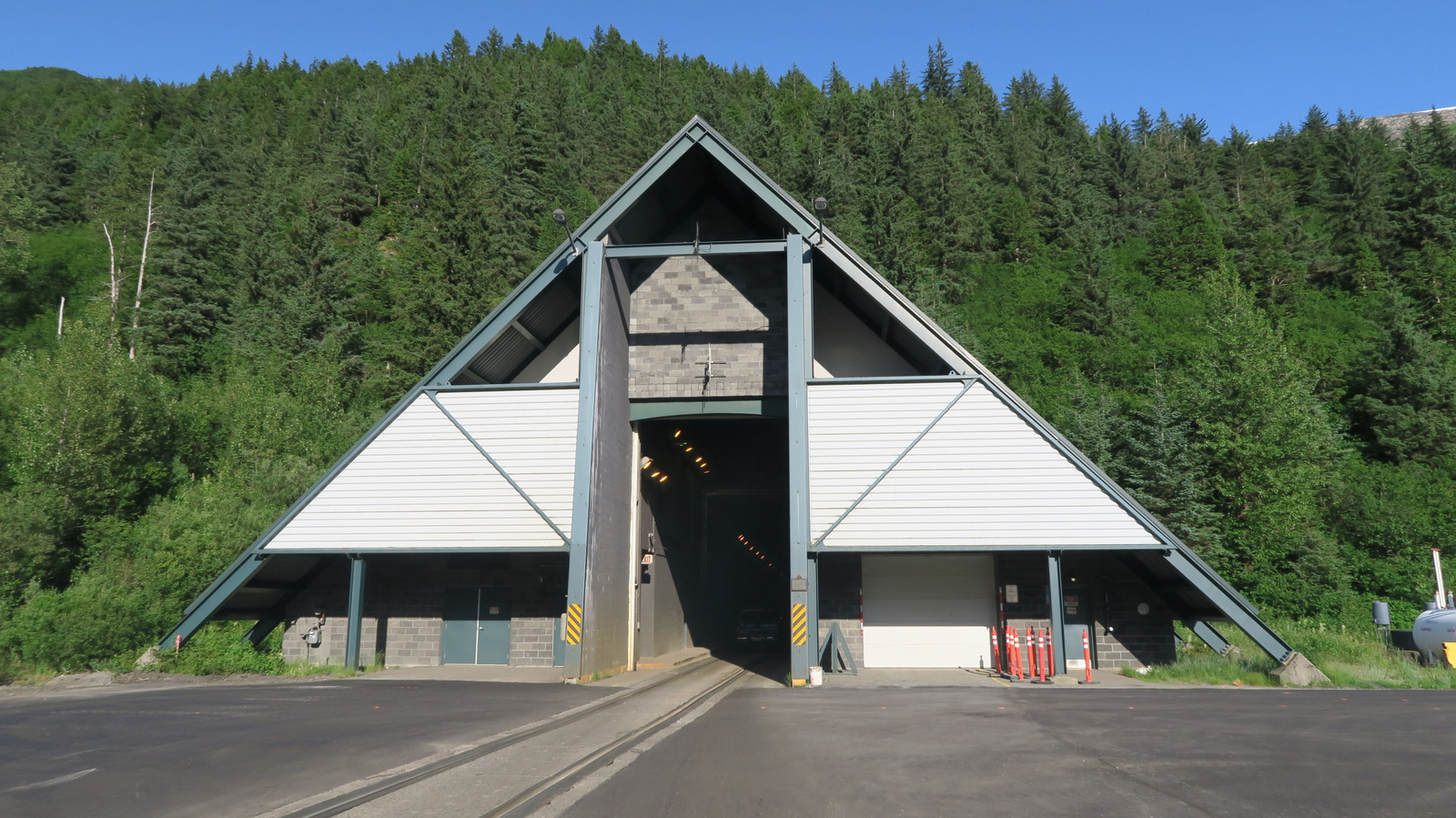
For most drivers, a tunnel is a simple proposition: two directions of traffic, a line of lights and a few minutes of concrete. The Anton Anderson Memorial Tunnel in Alaska ignores all of that. It is a single lane, one way at a time, and the vehicles waiting to use it are not always cars. Trains share the same bore.
At 2.5 miles (roughly 4km), it is the longest highway tunnel in the United States, and arguably the strangest piece of road engineering in the country. It exists because a wartime shortcut through a mountain turned into a permanent lifeline for Whittier, a town that has spent its entire modern history doing things its own way.
A Wartime Shortcut Through the Mountain
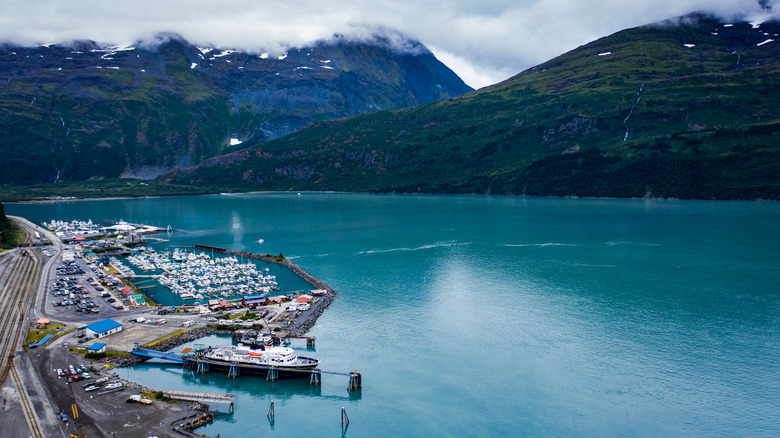
The tunnel’s story begins with the Second World War and the American military’s need to move supplies around Alaska quickly. The U.S. Army selected Whittier as a distribution point, largely because of its geography. The settlement sits between a mountain range and an arm of Prince William Sound, and its deep-water fjord port stays ice-free all year, even while the surrounding area is foggy, cloudy and damp in every season.
An ice-free port is a rare asset that far north, but it is useless without a way to move cargo inland. So the Army began boring straight through the mountain to link a rail line from Whittier to the Alaska Railroad’s main line. The result was a tunnel that turned a sheltered fjord into a working supply hub.
The war effort reshaped the town itself. Whittier’s population swelled to around 1,000, a mix of military and civilian personnel, which was far more people than the existing settlement could house. The answer was to build upwards, and to build everything under one roof.
The Town Under One Roof
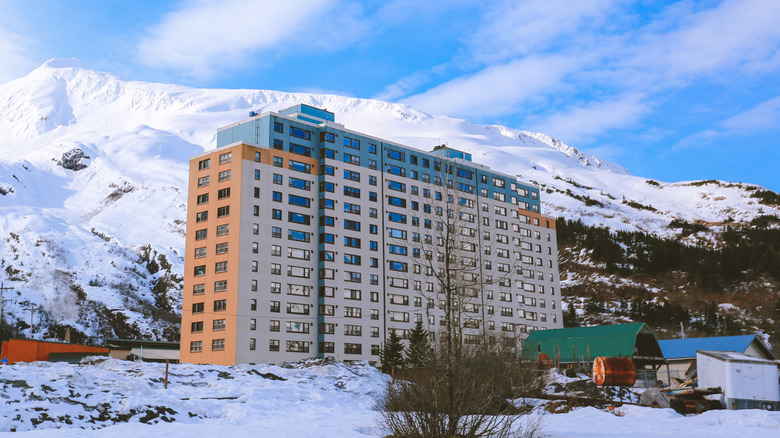
Two multi-storey buildings went up to accommodate the influx: the Buckner Building and Hodge Towers. Completed in 1953, they were self-contained communities rather than mere accommodation. Between them they contained movie theatres, a bowling alley, a chapel and even a small jail. Residents could, in theory, live out an entire Alaskan winter without stepping outside.
That arrangement did not last. The military began withdrawing a few years later, and the Buckner Building was decommissioned in 1966. It still stands today, empty of people and occupied instead by bears, a detail that says everything about how quickly Whittier’s fortunes turned.
The town adapted rather than disappeared. In 1972 the city bought the remaining habitable building and renamed it the Begich Towers. It still houses a majority of Whittier’s full-time residents, a population that has hovered around the 250 mark in recent years, and it continues to function as the town’s indoor high street. Under that single roof you will find a post office, a general store, a laundromat and a small Baptist church. For much of the year, that is Whittier: one building, one community, one address.
From Rail-Only to Road-and-Rail
For decades, the tunnel carried trains and nothing else. If you wanted to get a car to Whittier, you loaded it onto a train at Portage, Alaska, and rode along with it. It worked, but it was expensive and inefficient, and it put a hard limit on how many visitors could reach the town by road.
By the 1990s, Alaska had a decision to make. Options on the table included building a highway over the mountain, or adding a separate highway bore alongside the existing tunnel. Both were rejected in favour of something far more unusual: reconfiguring the tunnel that already existed so that it could accept cars and trains.
The plan was approved in 1995 and the work was completed in 2000. Rather than duplicating the tunnel, engineers found a way to make one bore do two jobs, which is why the Anton Anderson Memorial Tunnel remains such an oddity among the world’s road tunnels. There is no second tube to duck into and no central divider to keep the two modes apart. There is simply a schedule, and everyone sticks to it.
What It’s Like to Drive
Driving the tunnel takes between 20 and 30 minutes, and the experience is unlike any other road journey. Traffic runs one way only, in alternating blocks. Depending on which side you are on, departures leave either on the hour or on the half hour, so the tunnel effectively operates as a timed convoy rather than a road. The posted limit inside is 25mph, and the surface is the original rail track bed rather than a conventional tarmac carriageway, so the ride is rougher and noisier than most drivers expect. There is no lighting for much of the bore, which means headlights are mandatory and the walls stay mostly dark.
The other detail that catches first-timers out is the ventilation. After every trip, large fans blow the tunnel clean, clearing the air before the next group of vehicles or the next train is allowed through. It is a neat solution to a problem most tunnels never have to think about, because most tunnels are not expected to handle diesel locomotives and family cars in the same space.
The whole system depends on discipline. Miss your slot and you wait for the next one. But the payoff is a drive through a mountain that would otherwise be impassable by car, and it has become a genuine attraction in its own right rather than just a means of getting somewhere.
A Growing Gateway to Prince William Sound
The numbers show how well the arrangement has worked. In 2019, the Whittier Tunnel carried about 278,000 vehicles, and that figure has only risen as the area has grown more popular. What was once a military supply route is now a tourist gateway.
Whittier has become a jumping-off point for cruises, fishing trips, glacier tours and other adventures on Prince William Sound. Jet skiing is on the menu too, with dry suits available to rent for those willing to take on the cold water. The tunnel is the reason any of it is reachable by road, and the town’s single-building living arrangement is the reason visitors find it so memorable once they arrive.
There is something appealing about infrastructure that solves a problem by refusing to follow convention. A single bore handling both trains and cars should not work as well as this one does, yet it has been running that way since 2000 and carrying more traffic every year.
It is also a reminder that unusual engineering is not the exclusive property of supercars and concept vehicles. Sometimes the most interesting machine in motoring is the one you drive through, built for a very specific job and still doing it decades later.