
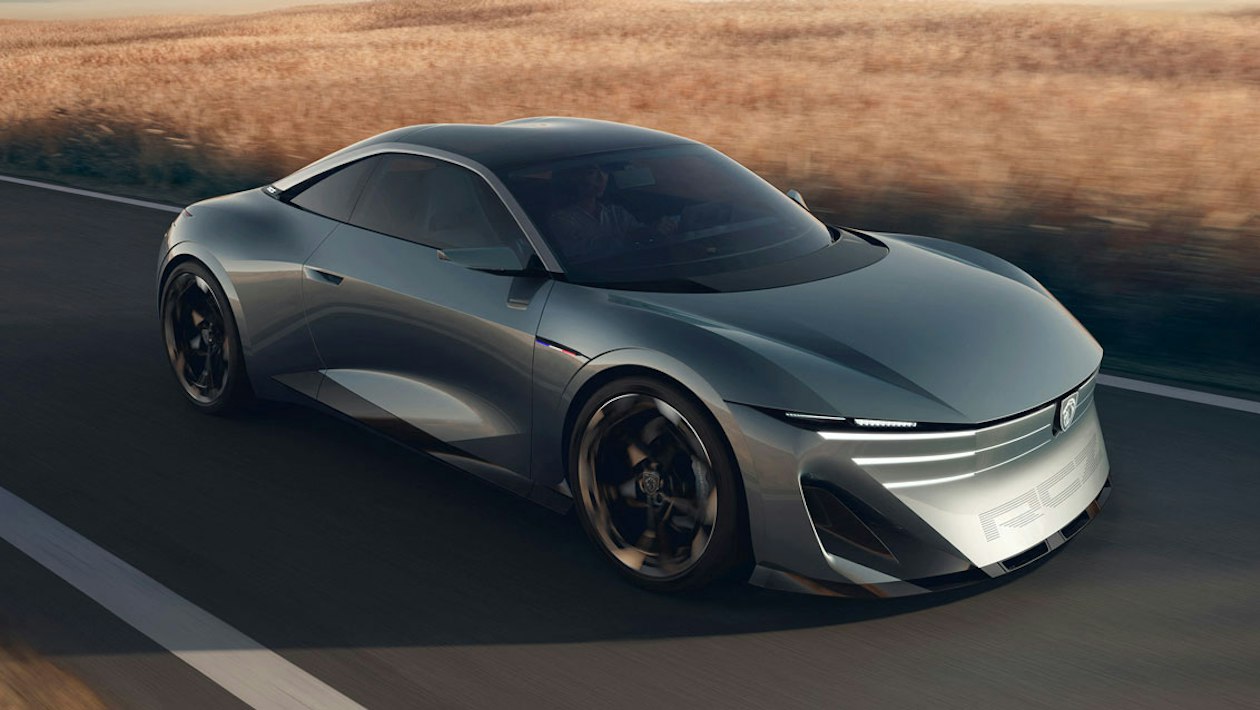
Peugeot has a habit of building concepts that feel like they were designed to be remembered rather than produced. The RCZ Vision, revealed this week, is the latest example: a two-door electric coupé that revives one of the company’s most distinctive nameplates, packs solid-state battery technology and a 372-mile range.
That tension sits at the heart of the car. Peugeot describes the two-door coupé market as shrinking and has given no indication it intends to re-enter it. What the RCZ Vision actually represents is a rolling testbed for the technologies that will define the next generation of Peugeots, wrapped in a body that happens to be far more interesting than a crossover.
Peugeot RCZ Vision: The Headlines
The RCZ Vision is the first expression of Peugeot’s new “Feline Future” design language, arriving alongside the new E-T16 concept. It brings back a badge last seen in 2015, but does so in fully electric form.
The headline numbers are substantial. A 372-mile range, 5.4-mile-per-kWh efficiency, 493bhp and a 1,000V architecture capable of charging from 10 to 80 per cent in under 10 minutes. Underneath sits Stellantis’ all-new STLA One platform and a solid-state battery, a chemistry not yet used on any production car across any of the group’s brands.
Peugeot says the car will help shape its future in both design and technology. What it will not say is whether it will build it.
A Nameplate Reborn: From 2009 to Now
The original RCZ ran for a single generation between 2009 and 2015. It was an unusual car for Peugeot: a low, wide two-door with an aluminium roof structure and that signature double-bubble rear window, built in limited numbers and never replaced.
The Vision keeps the parts that made the original recognisable. The double-bubble roof survives, now made from glass and flowing down into the bootlid. The driver-focused cabin remains central to the layout. What it ditches is everything mechanical. There are no combustion engines, and as a pure EV there are no front air intakes at all, leaving the nose clean where the old RCZ wore a broad grille.
Design Deep Dive: Feline Future and Three-Claw Lighting
The most visible change is the lighting. The RCZ Vision introduces a new three-claw signature at both ends, with the elements wrapping around the bodywork rather than sitting flush within it. It is a more sculptural treatment than Peugeot’s current production cars use, and it establishes a motif the brand intends to carry forward.
The stance is deliberately aggressive. The concept runs staggered wheels: 21-inch rims at the front and 22-inch at the rear, a setup that emphasises the rear-drive proportions even though Peugeot has not confirmed the drivetrain layout. Small triangular details on the rims reference the original RCZ’s wheel design. Peugeot notes, with some confidence, that “connoisseurs will appreciate” the nod.
The glass double-bubble roof remains the defining feature. It flows continuously from the windscreen into the bootlid, giving the car a single unbroken arc from front to rear and freeing up headroom in the back that a conventional coupé roofline would not allow.
The RCZ Vision is not the only heritage badge being used to signal a technology direction. Renault has taken a similar approach with the Renault Gordini 8 Concept: The Electric Reinvention of a Rally Legend, and Citroën has shown how far a concept can drift from production reality with the Citroën Pawlingo Concept: The Dog-Friendly Berlingo Van That Will Never Be Built.
Under the Skin: STLA One and Solid-State Power
The technical substance here matters more than the styling. The RCZ Vision is built on STLA One, Stellantis’ all-new platform, and it is the first car in the group to use a solid-state battery.
That is a significant step. Solid-state chemistry has been promised by manufacturers for years without reaching production, and no car across any Stellantis brand currently uses it. Peugeot is not stating a timeline for when that changes, but the Vision is being used to demonstrate that the packaging and thermal management work.
The 1,000V architecture is the enabler for the charging claim. A 10 to 80 per cent top-up in under 10 minutes puts the RCZ Vision in the same conversation as the fastest-charging cars on sale, and it is the kind of figure that only makes sense with a high-voltage system and a battery capable of absorbing that rate without cooking itself.
The efficiency claim of 5.4 miles per kWh is equally notable. Most EVs manage somewhere between 3 and 4 miles per kWh, so this edges ahead of the Mercedes CLA’s five miles per kWh on the WLTP cycle, a car built specifically around efficiency. Range stands at 372 miles.
Performance and Context: 493bhp in a Shrinking Segment
At 493bhp, the RCZ Vision sits well below the 816bhp E-T16 concept but a long way above the old RCZ. The most powerful version of the combustion-engined car, in THP trim, produced 270bhp. Peugeot has not revealed the motor layout, so whether this is single or dual motor remains unclear.
The more awkward question is what segment the car would compete in. Peugeot is blunt that the two-door coupé market is shrinking, and it is not alone in that assessment. Audi has abandoned the segment, and the list of manufacturers still building affordable two-door coupés grows shorter every year.
That context explains the company’s caution. Building a low-volume electric coupé is expensive at the best of times, and doing so in a category that is contracting rather than growing is a hard case to make to a board. The RCZ Vision’s job is to prove the technology, not the business model.
There is also a supply chain dimension to Stellantis’ electric plans. The group’s shifting demand has already had knock-on effects, as covered in our report on how Nidec Eyes Exit from EV Motor Business as Stellantis Demand Falters. Scaling new battery chemistry while supplier relationships are in flux is a live challenge.
Inside the i-Cockpit: Hypersquare, Steer-by-Wire and Brake-by-Wire
The cabin showcases Peugeot’s next-generation i-Cockpit layout, which is set to arrive on the all-new E-208 next year. That makes the RCZ Vision a preview of technology heading to a mainstream production car, not a flight of fancy.
Central to it is the Hypersquare, a rectangular steering controller linked to steer-by-wire. There is no physical connection between the wheel and the front wheels. That allows a variable steering ratio: sharper response at low speed for manoeuvring, and less correction required at motorway speeds. The Hypersquare was previously tried on 2025’s Polygon concept and has appeared on the E-T16 show car, so this is a system Peugeot has been developing in public for some time.
The RCZ Vision also debuts brake-by-wire, a first for Peugeot. The brake pedal has a distinctive shape, and the company says the system provides more precise control along with seamless integration of regenerative braking, which is where most blended brake setups still feel inconsistent.
The i-Cockpit display sits above the steering wheel, as it does in current Peugeots, but here it is transparent. Peugeot says this reduces visual distractions compared with the E-T16’s solid display.
The interior is not purely a technology showcase. The front seats are asymmetrical, a deliberate choice intended to create what Peugeot calls a “Grand Touring atmosphere”. The rear seats can accommodate two adults, helped by the extra headroom the double-bubble roof provides.
Peugeot says the cabin illustrates “what the cabin of a future Peugeot flagship could look like”. That phrasing is telling. It points to a large, expensive model rather than a compact coupé, and it suggests the RCZ Vision’s interior is doing double duty as a design study for something further up the range.
What Happens Next
What the RCZ Vision tells us is where Peugeot is heading. Solid-state batteries, 1,000V charging, steer-by-wire and brake-by-wire are all technologies the company intends to deploy. The next-generation i-Cockpit arrives on the all-new E-208 next year, which gives a near-term reference point for how much of this trickles down.
The realistic expectation is that the RCZ Vision’s individual pieces appear across Peugeot’s range over the coming years, while the two-door body itself remains a one-off. That would be a familiar outcome for a concept car, and a slightly bittersweet one for anyone who remembers the original. Peugeot has built a convincing case that it still knows how to make an interesting coupé. It just has not decided whether it wants to sell one.





One Comment