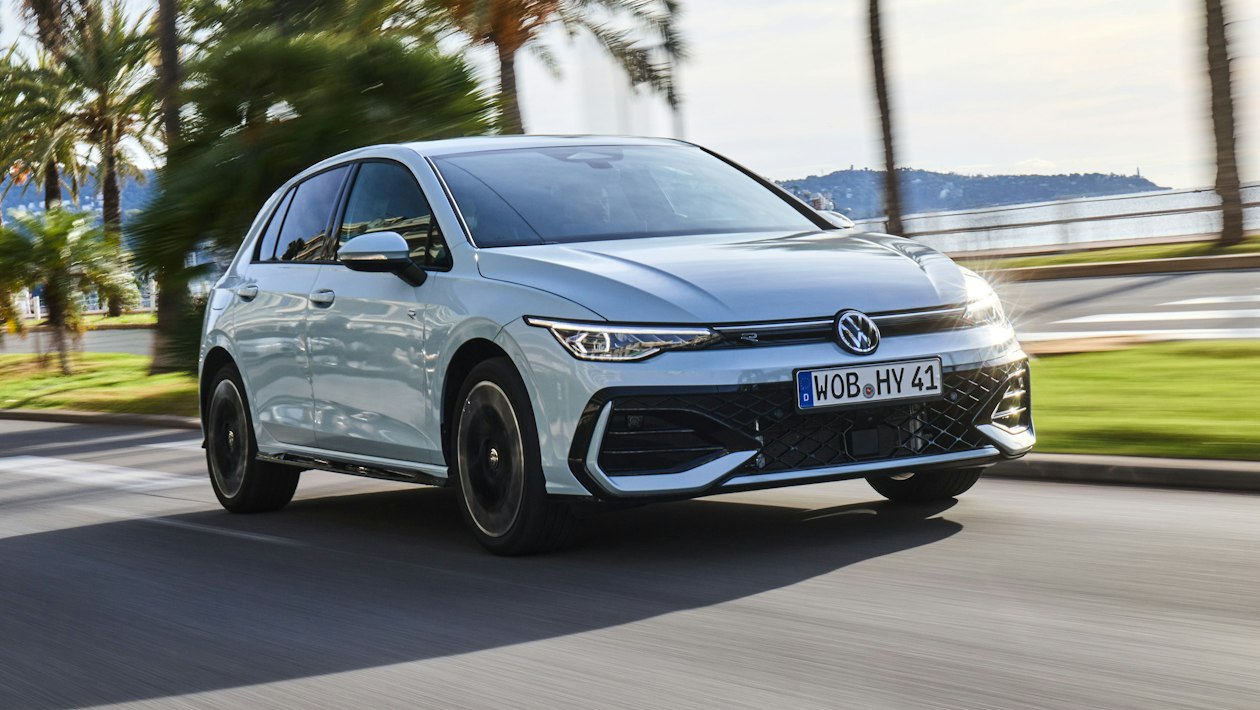
Volkswagen has done something it rarely does. Rather than wait for the Mk9, it has engineered a completely new full-hybrid drivetrain for the ageing Mk8 Golf, and the layout it has chosen will look familiar to anyone who has driven a modern Honda. The really interesting part is not the electric hardware but the gearbox, and we will get to that shortly.
The new Golf Hybrid slots between the 148bhp eTSI mild hybrid and the 201bhp eHybrid plug-in hybrid, giving buyers a third way into electrified Golf ownership. It is a proper hybrid rather than a 48V helper, and crucially it needs no plug, no wallbox and no change of habit.
What’s actually under the bonnet
The combustion side is familiar: Volkswagen’s 148bhp 1.5-litre TSI Evo four-cylinder, an engine that has been doing service across the range for years. What is new is everything bolted to it. Two electric motors provide up to 44kW of drivetrain boost, fed by a 1.6kWh gross nickel manganese cobalt battery with 0.64kWh usable.
That is a tiny pack by plug-in standards, and VW quotes no electric-only range. What it will do is run on electricity alone at up to 37mph for as long as there is charge in the buffer, which in stop-start traffic is most of the time that matters.
A senior engineer on the project was candid about where the inspiration came from, describing the powertrain as most similar to Honda’s i-MMD arrangement. That is a notable admission from a company that has spent the last decade building its reputation on DSG gearboxes and turbocharged small capacity engines.
Three modes, one clutch
The system switches between three states without the driver needing to think about any of them.
In electric mode the TSI is off entirely and the larger propulsion motor drives the car. In series hybrid mode the petrol engine runs but is disconnected from the wheels, instead turning a generator motor that tops up the battery feeding the propulsion motor. Think of it as a petrol-powered generator feeding an electric car.
Then, above 37mph or under hard acceleration, a clutch links the TSI directly to the driven wheels in parallel hybrid mode, with the electric motor adding boost. It is a sensible, efficient arrangement, and one that explains why the car feels so quiet around town.
The transmission is the interesting bit
Here is where the Golf Hybrid departs from expectation. The gearbox is neither a single-speed EV reduction gear nor a CVT. It is, in effect, a fixed sixth gear lifted from a regular gearbox, with the engine limited to 4,500rpm and a top speed of 112mph.
That has consequences. Under full acceleration the power delivery does not have the stepped, almost theatrical quality of VW’s DSG transmissions. There are no gear changes to punctuate the experience, just a single, linear build of speed. Whether that reads as smooth or characterless will depend on what you are used to.
Performance and efficiency
Two system outputs will be offered: 134bhp and 168bhp. In the stronger form the combined system produces 310Nm, enough for 0-62mph in 7.5 seconds.
Efficiency is the headline. Volkswagen quotes the 148bhp eTSI Golf R-Line mild hybrid at 53.8mpg and 120g/km, and the full hybrid comfortably beats that with CO2 of 104 to 117g/km depending on specification. For company car drivers watching benefit-in-kind, that band matters a great deal.
Weight, trims and what you pay for it
The hybrid hardware adds 48kg, taking the R-Line’s kerb weight to 1,484kg. That is a modest penalty for a car with this much electrical assistance, and it shows in the way the Golf conducts itself on the road.
Volkswagen is expected to offer the Hybrid in Style and Match trims alongside R-Line, which should mean a sensible entry point and a well-equipped mid-ranger rather than a single loaded specification. UK pricing has not been announced.
What it’s like from the driver’s seat
Around town the TSI shuts off frequently, and the car moves quietly on electric power with the sort of refinement that makes a mild hybrid feel crude by comparison. The weighting of the major controls drew praise, as did ride comfort on cars fitted with Dynamic Chassis Control.
It is not a hot hatch and does not pretend to be. The appeal is the easy, unstrained way it goes about everyday driving, with the engine fading in and out of the picture rather than announcing itself at every junction.
Who should be considering one
The target buyer is specific. This is for the commuter doing urban and suburban miles who wants more electric running than the eTSI offers but cannot charge a plug-in hybrid at home. No driveway, no wallbox, no charging routine: the Golf Hybrid simply does the hybrid thing by itself.
Volkswagen is also clearly aiming this powertrain at fleet users, and the CO2 figures make the commercial case without much argument. Company car lists have been waiting for a credible non-plug-in hybrid Golf for years.
The bigger picture
What makes this genuinely unusual is the timing. Volkswagen does not normally invest in an entirely new drivetrain for a model nearing the end of its life, and the Mk8 Golf, launched in 2019, is well into its run. The reason is cost: the same hardware is being deployed in the newer second-generation T-Roc crossover, spreading the development bill across two high-volume models.
It may not stop there. The engineering is expected to be adaptable to other group products, with the Skoda Octavia the obvious candidate. That is how Volkswagen Group has always worked, and it makes the business case stack up in a way a Golf-only programme would not.
The wider context is a company under pressure to demonstrate that it still knows how to build the cars its customers actually buy. As our coverage of VW Group’s Small EV Gamble: ID. Polo, Cupra Raval and Skoda Epiq Set for 2026 sets out, the headlines have not been kind to Volkswagen of late. A well-executed hybrid for the mainstream buyer is a useful reminder of what the brand does well.
Volkswagen’s answer to an industry busy hedging its powertrain bets is less dramatic than most but arguably more relevant to driveways up and down the country: a hybrid that asks nothing of its owner beyond filling it with petrol.
Verdict: polished, capable, and easy to recommend
The Golf Hybrid does everything asked of it well. It is refined, economical and easy to live with, and for many buyers it will be the most sensible Golf in the range. The electric running around town is genuinely useful, the ride is comfortable and the efficiency figures are strong enough to justify the premium over an eTSI.
The caveat is character. The single-speed transmission removes some of the texture that made Golfs of the past feel more substantial than their rivals, and there is little here to remember once you have handed the keys back. It is an excellent tool rather than an engaging companion.
As a piece of engineering delivered to an ageing model line, though, it deserves credit. Volkswagen has read the market correctly: plenty of drivers want electrification without the commitment of a plug. Rated 4.0 out of 5.