
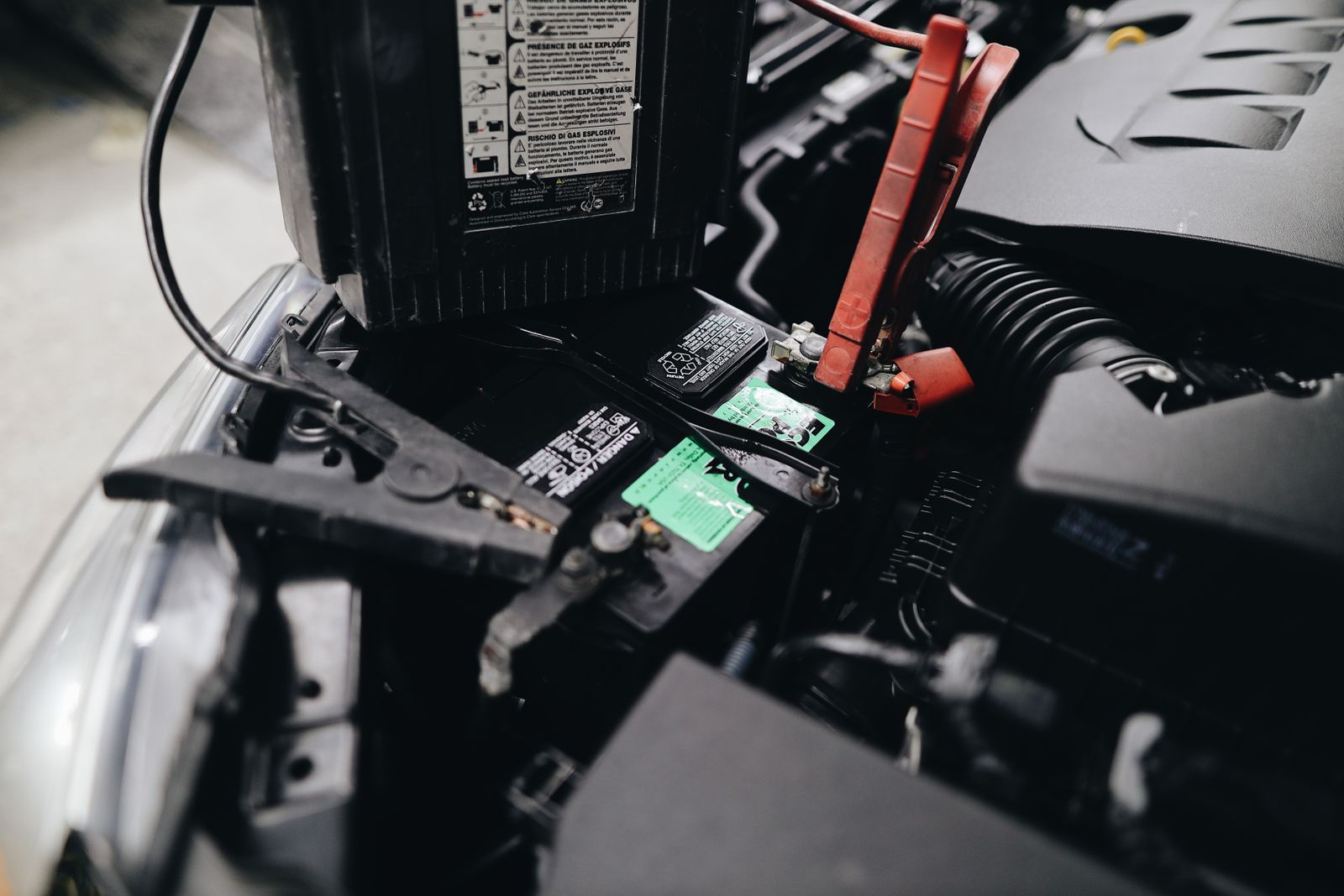
Many batteries that get replaced did not need replacing. They were flat. A car left standing for a few weeks, a run of short town trips, a cold snap that finished off a weak charge: these are common culprits, and a slow charge over several hours will often bring the thing back to life. So before anyone hands over money for a new unit, it is worth knowing what actually fails, what the numbers on the label mean, and why the battery you buy has to match more than the physical space under the bonnet.
Diagnose before you buy
A battery drained by lack of use, whether over several weeks or several months, usually needs charging rather than replacing. That is the single most useful fact in this whole subject. If the car turns over sluggishly after a holiday, or the dash lights dim when you crank it, charge it first and see how it behaves.
The exceptions are worth knowing. A battery that will not hold a charge after a proper top-up, one that is visibly swollen, or one that is several years old and struggling in the cold is a genuine replacement case. So is a battery that keeps going flat despite regular long runs, which points to a charging system fault rather than the battery itself. Diagnose the cause, then spend.
Finding the correct battery
Start with the owner’s manual. It lists the original battery’s physical size, specifications and ratings, and that is the specification your car was engineered around. Motor factor catalogues and online registration lookups can cross-check it, but the manual is the reference point.
Physical size groups matter because a battery that does not fit the tray and clamp properly is not a safe or sensible purchase. The four-digit codes you will see on UK shelves, such as 063, 096 and 027, are the European grouping system, and they are the ones to quote when you order. The US uses a different set of numbered groups, so a guide written for that market will not translate directly:
- UK European codes (063, 096, 027 and similar) are what British factors and accessory shops stock and what your manual or a registration lookup will quote.
- US size 24/24F (top terminal) fits many US-market Honda, Acura, Toyota, Lexus, Nissan and Infiniti models.
- US size 35 (top terminal) covers many other Japanese vehicles sold in the US, including recent Toyotas, Nissans, Hondas and Subarus.
- US size 48H6 (top terminal) is common across European and American vehicles in that market.
Almost all cars run a 12-volt sealed lead-acid (SLA) battery, with a handful of high-performance models using lithium-ion. Check the dimensions, terminal layout and hold-down arrangement against the old unit before buying anything.
Battery types compared
Sealed lead-acid (SLA) is the default 12V unit and the sensible baseline for most cars.
AGM (absorbent glass mat) is now the norm for modern cars. It uses similar chemistry to SLA but is more durable and claimed to withstand more charge cycles. If your car came with AGM, fit AGM.
Gel-cell batteries are best for deep discharging, but they can struggle in extreme heat or cold. They suit specialist applications more than everyday motoring.
Wet-cell units are still available and remain the budget option, mainly for older models. They are unlikely to be offered in the right sizes or specifications for a modern car, so treat them as a niche choice rather than a saving.
What the numbers mean
Cranking amps (CA) and cold-cranking amps (CCA) both measure the current a battery can deliver for 30 seconds, CA at 0°C and CCA at minus 18°C. A higher figure is better, and it matters most in cold weather, precisely when batteries are at their weakest. Buy at or above the manufacturer’s CCA figure, never below it.
Reserve capacity tells you how long the battery can power lights and accessories with the engine off, or keep the car running if the charging system fails. It is usually quoted in minutes at a 25-amp draw. Around 90 minutes is decent and 120 minutes is better. It is the figure that buys you time on a dark hard shoulder.
Warranty deserves as much attention as the spec sheet. Look for at least three years of full replacement cover, sometimes with a prorated refund afterwards. Be aware that manufacturer warranties are often not honoured when parts are bought online from large retailers. Buying from a factor or garage with a clear warranty route is worth a few pounds extra.
Fitting and coding
Most batteries sit under the bonnet and swap over easily with a couple of spanners. Some are mounted in the boot or tucked behind trim, which makes access harder but not impossible.
The order of work is not negotiable: the negative terminal comes off first and goes back on last. That sequence keeps the spanner away from a live positive post and the bodywork around it.
The bigger issue on modern cars is coding. Some brands, BMW among them, require a new battery to be digitally mated to the car or it will not charge correctly. That needs brand-specific OBD-II software, which many independent specialists now carry as well as main dealers, so it is worth asking around before assuming you have to pay dealership rates. Fit a battery without coding it and you may find you have simply bought a new problem.
DIY replacement is not difficult, and some shops offer free installation when you buy the battery from them. As with any job where a modest outlay now prevents a much larger bill later, such as Car Underseal: Does Your Vehicle Need It and What Does It Cost?, it pays to know when to hand over the spanners.
Costs and disposal
Budget roughly £80 to £320 for a new battery (the US equivalent is about $100 to $400). Lower-performing SLAs sit at the bottom of that range, while stronger, longer-lasting AGMs sit near the top. The spread is driven by chemistry, cranking performance, reserve capacity and warranty length rather than badge alone.
A garage fitting the battery will dispose of the old one for you. If you fit it yourself, return the old unit to the retailer for recycling to avoid a core charge, which is a deposit refunded when the old battery comes back. Compare old and new side by side before fitting to confirm the size matches, and keep the receipt.
Charging without removing the battery
Chargers range from under £40 to over £160 (about $50 to $200 in the US) and work slowly over several hours. Follow the manufacturer’s instructions rather than improvising.
First, find the battery. On many newer cars it hides under a plastic cover, and in some models it lives in the boot. Once located, plug the charger in and switch it off. Connect the red lead to the positive terminal and the black lead to the negative terminal. On a fully drained battery, connecting the negative lead directly to the terminal is generally safe.
The safer method is to connect the black lead to the chassis instead. In almost all modern vehicles the negative terminal connects directly to the car’s chassis, so earthing to the bodywork does the same job while avoiding a spark at the battery post and, unlikely though it is, an explosion.
Alternatives exist. A portable jump-start pack costs more but starts the car immediately. A trickle charger suits cars that are not driven often, and advanced versions can stay connected indefinitely, monitoring natural discharge and topping up as needed. One option worth considering is a two-bank maintainer, which keeps a pair of vehicles healthy at once.
The battery checklist
The essentials, in order:
- Charge first. A battery flattened by lack of use usually recovers. Give it several hours on a charger before condemning it.
- Check the manual. Match physical size, terminal layout, CCA and reserve capacity to the original specification.
- Match the chemistry. AGM for a car that came with AGM; SLA as the default; gel and wet-cell only where they genuinely suit the application.
- Disconnect in order. Negative off first, negative on last.
- Code it if required. BMW and some other brands need the new battery mated to the car.
- Recycle the old unit. Return it to the retailer to avoid a core charge.
Treat the battery as a consumable that responds well to a little attention, and many of the ones written off each winter will keep going for years. The same principle of looking after what you already own runs through our Used Lotus Emira Buyer’s Guide: V6 vs AMG Four-Cylinder, Prices and What to Check, and a good charger earns its place in the garage alongside the kit in our round-up of Car Gifts for Mechanics and Drivers: What the Experts Actually Recommend.