Jeep has spent decades telling anyone who will listen that the Wrangler’s formula is sacred. Solid axles, a ladder frame, doors that come off and a face that has barely changed since the Cold War. Then it built a concept that tears up that rulebook and lights the pieces on fire. The Wrangler Scrambler SRT Concept is a two-door pickup with an integrated bed, independent front suspension and the strong suggestion of a supercharged Hellcat V8 under the bonnet. Jeep confirmed a production two-door Scrambler pickup at its May investor day, then showed this concept at the 2026 SEMA Show in Las Vegas. It is the most deliberately impure off-roader Jeep has put its name to in years.
What the Scrambler SRT Concept is, and why it matters
Strip away the show-car theatre and the concept is a statement of intent. Jeep used its May investor relations day to confirm that a production two-door Wrangler Scrambler pickup is planned, with an SRT version sitting at the top of the range. The concept previews that idea in its most extreme form.
That matters because Jeep is not a company known for dismantling its own traditions. The Wrangler’s appeal rests on continuity, and the prospect of an independent-front-suspension Wrangler would once have been heresy in Toledo. The Scrambler SRT Concept does it anyway, then adds a pickup bed, a roll cage and competition-grade suspension for good measure. It is a Wrangler built against the grain of everything the badge has stood for, and Jeep knows exactly what it is doing.
The original Scrambler formula, reimagined for the desert
The name is not plucked from thin air. The original CJ-8 Scrambler of the 1980s took the CJ-7, stretched the wheelbase and bolted a pickup bed onto the back. It was a commercial oddity at the time and has since become one of the most collectible Jeeps of its era.
This concept applies the same logic with a very different set of priorities. Where the original was a utilitarian workhorse, the Scrambler SRT Concept is built around speed across open terrain. The brief has shifted from hauling to hunting, and the hardware reflects it.
Independent front suspension: a Wrangler first
The headline technical change is the independent front suspension, the first ever fitted to a Wrangler-branded vehicle. It is a bespoke high-travel setup developed with Casey Currie, the Dakar-winning off-road racer whose name carries real weight in desert-racing circles.
Jeep claims the arrangement improves steering precision, wheel control and high-speed stability, which is exactly what you would expect from ditching a solid front axle in favour of something that can keep each wheel planted independently. It is paired with a Trophy Truck-inspired rear axle, heavy-duty wheels and a suite of desert-racing components.
The architecture is not entirely new. It first appeared on the Jeep Striker Concept and was validated by Currie in a custom Gladiator, also badged Striker, at the NORRA 500. That competition outing gives the setup a credibility that a static show stand never could.
Despite the Wrangler base, the concept is not dimensionally similar to a factory JL-generation model. It runs longer doors, custom rear bodywork, a redesigned tailgate, unique wheel-arch flares and a structural roll cage. This is a rebody as much as a rework, and it explains why the proportions look so much more purposeful than a standard Wrangler with the roof chopped off.
Design details: sharknose grille, Punk’n orange and a modular bed
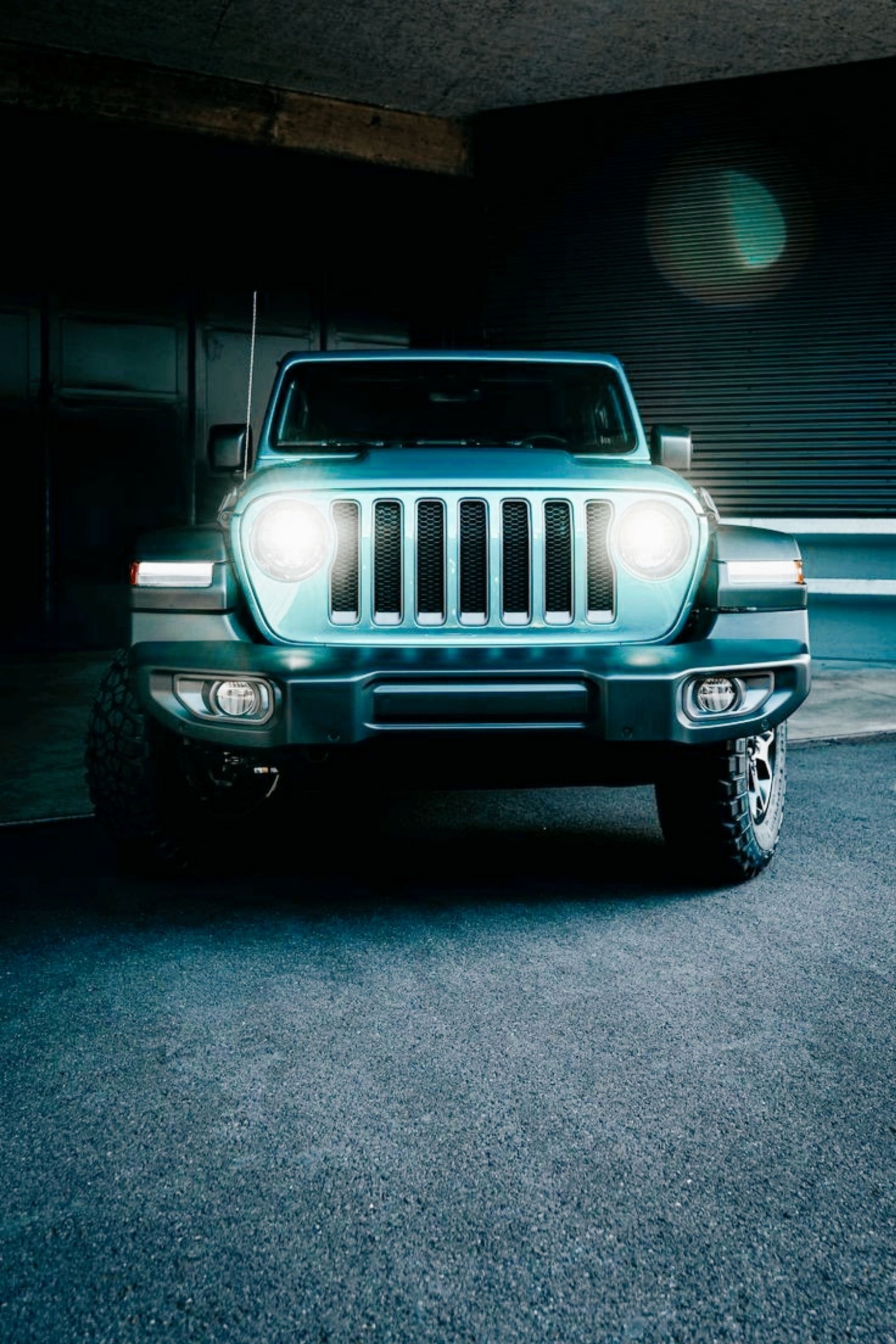
The front end adopts the sharknose treatment already seen on the Gladiator, with a slightly retro grille that carries an overbite, a prominent bonnet scoop and oversized wheel-arch flares. Finished in Punk’n orange with bronze-painted beadlock wheels, it looks fast standing still, which is rather the point of a SEMA build.
Inside, Dark Graphite leather is broken up with orange inserts, contrast stitching, bronze accents and SRT embroidery. The clever part is the rear. The seats clip into floor-mounted hooks and can be removed entirely or rotated to create rear-facing seating, and pulling them out frees space for camping gear, motorcycles and just about anything else that fits. It is a neat piece of packaging thinking on a vehicle that could easily have been all show and no substance.
Powertrain: V8 power expected, but Jeep stays tight-lipped
Here is where Jeep gets coy. No engine has been confirmed and no power figures have been released. What the company will say is that the concept “honors the original Scrambler” by imagining its formula pushed with “V-8 power, desert-racing hardware, and SRT performance development.”
Both Car and Driver and Road & Track expect a V8, with the supercharged 6.2-litre Hellcat unit the likeliest candidate and the 6.4-litre 392 also in the frame. Given that SRT is in the concept’s name and Hellcat engines are the division’s signature, the supercharged route feels almost inevitable. Until Jeep says otherwise, though, treat the output as speculation, however well informed.
SEMA has a long history of manufacturers using show cars to test public reaction before committing to production, and not every concept survives the journey. A one-off show car built for the Las Vegas floor can generate enormous attention without ever nearing a dealership. The difference here is that Jeep has already confirmed a production Scrambler pickup, which gives this concept a clearer path to reality than most.
Production plans: two-door Scrambler pickup confirmed, SRT flagship to follow
The production two-door Wrangler Scrambler pickup is confirmed, with the SRT derivative positioned as the flagship of the range. Beyond that, Jeep has said nothing about timing, styling or mechanical specification. Car and Driver expects the production model could arrive in 2028.
That leaves plenty of room for the concept’s wilder elements to be diluted. The independent front suspension may or may not survive into showroom form, and the Hellcat engine is far from guaranteed given tightening emissions rules in the United States and other markets. What seems certain is that the two-door pickup body is happening, and that an SRT-badged performance variant will sit above the standard truck.
The concept’s desert-racing brief also fits a pattern visible elsewhere in the industry, where manufacturers are increasingly building machines that answer to no particular rulebook and lean hard into a single, vivid use case rather than trying to be all things to all buyers. The Scrambler SRT is aimed squarely at people who think a pickup should be able to outrun a sports car across a dry lake bed.
What Tim Kuniskis says about breaking the rules
Kuniskis, who heads American Brands, SRT Performance and Direct Connection at Stellantis North America, is not a man given to understatement, and his framing of the concept leans into the rule-breaking angle deliberately.
“The original Scrambler became an icon because it broke the rules,” he said. “It looked different, worked differently and represented a certain kind of freedom that resonated with enthusiasts then and still does today.”
He went further: “We asked ourselves a more provocative question: what happens when SRT stops treating the trail as the limit and builds the ultimate open-air desert weapon? The Wrangler Scrambler SRT Concept is our answer.”
And on the engineering philosophy: “It is overbuilt and engineered around the idea that the desert can be every bit as demanding as a racetrack. It is unapologetic by design.”
That last line is the giveaway. Jeep is not pitching this as a rival to a luxury SUV or a sensible lifestyle pickup. It is pitching it as a machine with a single, clearly defined purpose, and everything else is secondary.
The pickup we want to see built
Jeep has built plenty of concepts that never went anywhere, and there is every chance the independent front suspension and the Hellcat engine both fall by the wayside before production. But the core idea, a two-door Wrangler pickup with an SRT flagship above it, is already signed off. That alone makes this one of the more consequential SEMA reveals in years.
The appeal is not complicated. It is a vehicle that refuses to be sensible, and the market for that sort of thing is larger than the purists would like to admit. If Jeep can carry even half of this concept’s attitude into the showroom, it will have built something genuinely rare: a pickup with a personality strong enough to justify the compromises.
Whether the independent front suspension survives is the question that will define the production truck. If it does, the Wrangler as we know it changes for good. If it does not, we still get a two-door Scrambler with an SRT badge, and that is hardly a disappointing outcome. Either way, Jeep has made its position clear. The rulebook was there to be torn up.
For more on this, see youtuber uses fix jeep.