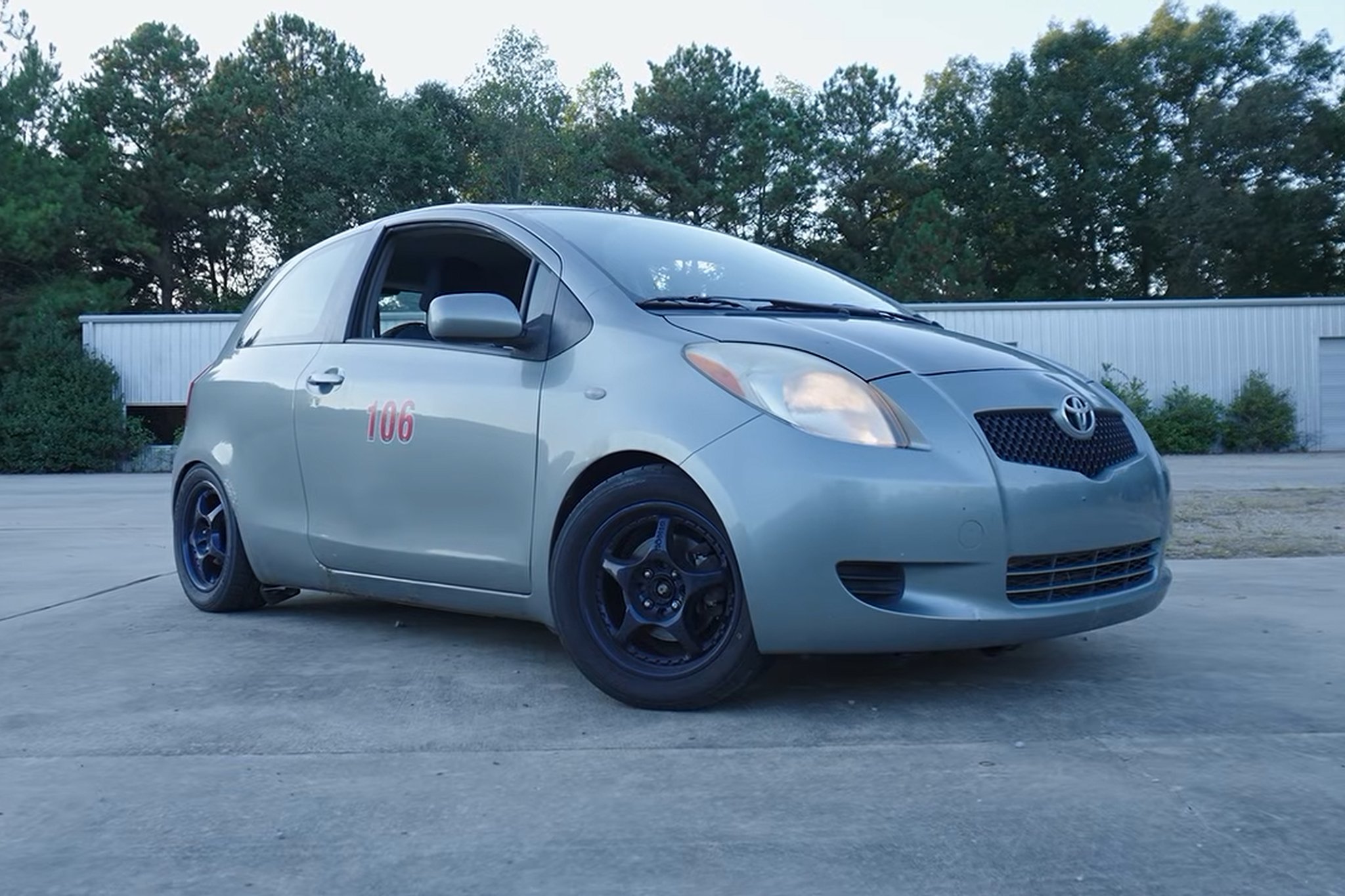
You want to drive on a racetrack. You do not own a track car. The rental agreement says no circuit use, so you buy a cheap second car instead, because that has to work out cheaper than renting, right?
That is the theory. A producer for The Drive, Joey, put it to the test on a three-week road trip around the Midwest that finished with track time at Virginia International Raceway. He bought a 2007 Toyota Yaris five-speed hatchback for $2,300, sourced from a friend’s shop in Kentucky. What he got was a lesson in why the cheapest track car is rarely the cheapest way to go racing. All prices here are US dollars.
Why rental rules push enthusiasts towards buying
Rental firms tend to prohibit track use, which is enough to push many enthusiasts toward buying instead. That leaves the track day regular with two options: a dedicated car, or a friend with a very understanding attitude to liability.
Buying seems like the sensible answer. A cheap hatchback costs less than a season of rentals, you can thrash it without reading a clause, and when something breaks you own the problem rather than explaining it to a claims handler. The maths looks beautifully simple at the point of purchase. It is everything after the purchase that gets complicated.
The $2,300 deal that looked too good to pass up
The Yaris came from a friend’s shop, which is exactly the kind of provenance that makes a cheap car feel like a safe bet. The pitch was straightforward: $2,300, which was $300 less than a round-trip rental would have cost for the trip. On paper, Joey was already ahead.
There was one detail. The car had been sitting in a field. Not for a weekend, either. Field cars come with a particular set of problems: perished rubber, seized fasteners, fluids that have given up on being fluids, and electrics that have developed opinions. The $300 saved went straight back into repairs before the car had covered any meaningful distance.
This is the first rule of cheap track cars. The purchase price is an entry fee, not a total. A car that has been stationary for months will always need something, and the something is rarely cheap.
The parts hunt: several hundred miles of keeping it alive
Getting the Yaris roadworthy meant driving several hundred miles around the Midwest sourcing components. That is fuel, time and mileage on whatever you are driving to collect the parts, plus the inevitable second trip when the first part turns out to be the wrong one.
An old econobox is mechanically simple, which is part of the appeal, but simple does not mean free. Consumables wear faster on a car that is being used hard. Brakes, tyres, fluids, filters, belts and bushes all have a lifespan that shortens dramatically once you add track sessions to the mix. Factor in recovery costs for the day something lets go mid-session and the budget starts to look less like a bargain and more like a subscription.
The plan: runabout and time attack car in one
Joey’s longer-term ambition was to use the Yaris as a regional runabout and a time attack car. That single sentence contains the contradiction at the heart of every cheap track build.
A runabout needs to be reliable between venues. It needs to start on a cold morning, sit in traffic without overheating and carry your helmet, tools and a change of clothes without complaint. A time attack car needs to be durable enough to be run hard, session after session, without shedding parts or boiling its brake fluid.
Those two requirements pull in opposite directions. Stiffen the car for the track and you ruin it on the road. Soften it for daily duty and it rolls through the corners. Every modification is a compromise, and every compromise costs money. The car that does both jobs adequately will always cost more than the car that does one job well.
The VIR test: one session, one failure
The test at Virginia International Raceway lasted a single session. A finicky clutch slave cylinder leaked its fluid on track, which left Joey unable to change gear. That is not a slow puncture or a warning light you can ignore until the next services. That is your session over.
What followed was a tow off track and an improvised fix using bonnet bolts as replacements, which got the car driveable again for more laps and the remaining miles of the road trip. It is a genuinely resourceful bit of trackside engineering, and it is exactly the kind of story that makes cheap track cars so appealing to the people who love them.
It is also a reminder of what you are signing up for. A modern performance car with a manufacturer behind it would have been recovered under warranty and repaired by someone else. A $2,300 Yaris gets fixed with whatever is in the toolbox, and the fix holds until it does not. If you enjoy that, buy the project. If you do not, the rental counter starts to look very reasonable.
The wider track day industry is leaning into this appetite for organised, well-run circuit time. Porsche, for instance, has built 911 GT3-only track programmes around its own machinery at Barber Motorsports Park, for the buyers who would rather pay for preparation than spanner work. Different budget entirely, same underlying question: what are you actually paying for?
The verdict: not cheaper, but more
Total spend came to considerably more than the original budget. By the numbers, this Yaris was not cheaper than a rental car. It was more expensive, and it needed rescuing from a racetrack to finish the trip.
But that framing misses what Joey actually bought. He spent more to get more: a car to drive home at the end of the trip, plus the basis of a new project that will keep giving for as long as he wants it to. A rental returns nothing but a receipt. The Yaris is still his.
The distinction matters because it is the difference between a false economy and a fair one. Buying a cheap car to save money on rentals is a false economy, because the hidden costs eat the saving and then some. Buying a cheap car because you want to build, maintain and race something of your own is a fair economy, provided you go in with your eyes open about what it will cost.
What this tells you about buying a cheap track car
If you are weighing up a cheap track car, the lessons are straightforward.
- Budget for the car twice. Once for the purchase, once for everything it needs to be safe and reliable. Field finds and long-sitters always need more than the seller says.
- Price the consumables properly. Tyres, pads, discs, fluids and belts are not one-off costs on a car that sees track use. They are a running expense, and the cheaper the car, the higher the proportion of its value they represent.
- Include recovery in the plan. A track day that ends on a tow truck is not a disaster, it is a probability. Know who you are calling and what it costs before you need them.
- Count your time. Parts runs, evenings in the garage and weekends spent chasing a rattle are real costs, even if they never appear on a receipt.
- Be honest about why you are buying. If you want cheap transport to a track day, a rental or a well-maintained performance car will almost always work out better value. If you want a project, a car to learn on and something to tinker with between events, a cheap Yaris is a brilliant place to start. Just do not tell yourself it is saving you money. It is buying you something else entirely, and that is a perfectly good reason to spend it.