From Workhorses to Speed Machines
The Rhino and the Mule established the template: utilitarian, modestly powered, built to be abused. Performance variants followed, then proper sport side-by-sides, and the class split in two. At the top end you now have machines that are, functionally, off-road sports cars with a cage and a pair of seats, and the buyers spending serious money on them compare spec sheets the way they once compared hot hatches. A 1.0-litre three-cylinder no longer cuts it at the pointy end.
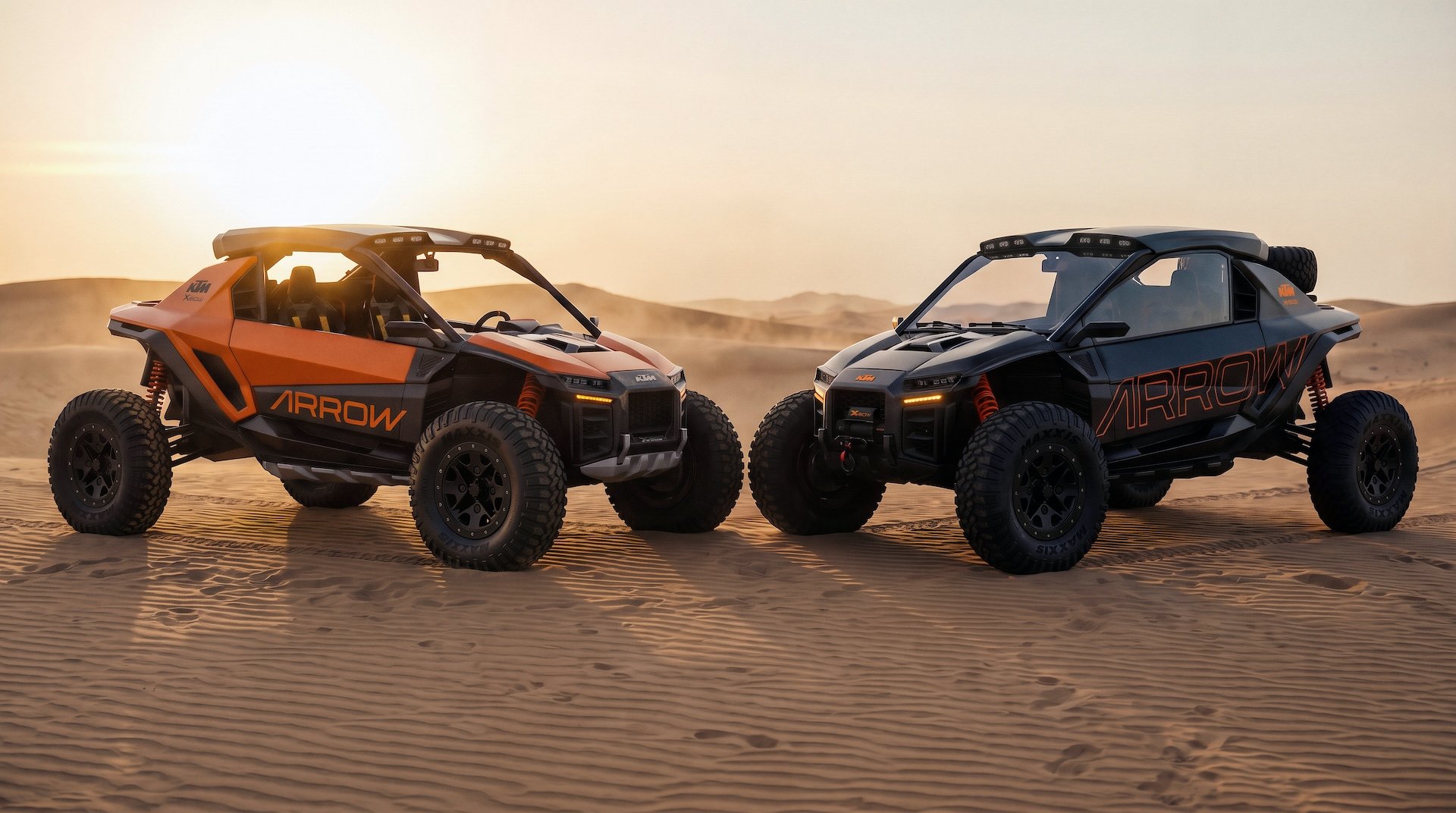
KTM X-Bow Arrow: Audi Power, Car Manners
The clearest proof that car engines belong here is the KTM X-Bow Arrow, which uses an Audi 2.0-litre turbo four-cylinder. In its lower tune it makes 280hp; the Arrow Black Limited Edition pushes that to 330hp. This is not a UTV engine detuned for a buggy. It is a Volkswagen Group production four-cylinder, with the refinement and parts commonality that implies.
KTM’s relationship with Audi engines runs deep. The Austrian firm has used them in its track cars for years, and that experience shows in how the X-Bow drives. The brand’s road-car ambitions have also expanded recently, with the KTM X-Bow GT-XA opening for US orders at $490,000 (as reported in our previous coverage), a reminder that KTM is comfortable operating at the expensive end of low-volume performance machinery.
The Arrow Black Limited Edition carries a US price of $98,600. That is a lot for a side-by-side, and it is precisely the point: the segment has a customer base willing to pay it.
Polaris RZR Pro R: The Segment First That Started It
Polaris deserves credit for getting there first at volume. The RZR Pro R launched with a 225hp naturally aspirated 2.0-litre lifted from the Slingshot, and it was a genuine segment first: a car-derived four-cylinder in a mainstream performance side-by-side. It is a US-market machine, with UK availability unconfirmed.
Polaris builds its ProStar 2.0-litre in-house rather than buying it in, which gives the company control over supply and tuning. That has paid off. The addition of a 60mm Garrett turbo has raised output to 275hp, and the result is a machine that has moved the goalposts for the whole class. Our coverage of the 275hp Polaris RZR Pro R Boost sets out just how far the bar has moved.
The significance is not only the number. It is that a major manufacturer has demonstrated, at scale, that a car engine architecture works in this application, with the durability and serviceability that comes with it.
Toyota’s UTV Concept: A Tacoma Under the Skin
If Polaris showed the concept works, Toyota has shown how far it can be taken. The company’s UTV concept uses a Tacoma TRD Pro powertrain: a turbocharged 2.4-litre hybrid paired with an eight-speed automatic, producing 326hp and 465lb ft of torque (about 630Nm). It is a US-market concept, with UK availability unconfirmed.
That is more torque than a great many diesel pickups deliver, and it arrives through a torque-converter automatic rather than a belt-driven continuously variable transmission. It is a completely different engineering philosophy from the small-capacity, high-revving approach that has defined performance UTVs.
Toyota has not confirmed the concept for production, but the company is understood to be strongly considering it. Given the direction of travel, that consideration looks less like a design study and more like a preview.
Who Else Could Follow
Look across the remaining players and the pieces are already sitting on the shelf.
Honda is the most obvious candidate. It is the only one of Can-Am, Honda, Kawasaki and Yamaha with a clear in-house car engine supply, and the idea of a Talon running a Civic Si or Civic Type R engine is not fantasy. Honda already builds both the chassis expertise and the engines, and the Civic Type R’s 2.0-litre turbo is one of the finest four-cylinders in production.
Can-Am’s parent BRP has the largest engine across its brands in a 1.63-litre Rotax three-cylinder from Ski-Doo, producing 350hp. Kawasaki has a supercharged 1.5-litre four-cylinder jet ski engine making 310hp that could plausibly transfer. Yamaha has a supercharged 1.8-litre four for personal watercraft and a track record of developing large-displacement engines for Toyota sports cars.
None of these are confirmed. All of them are technically credible, and that is the story.
The Cost Equation
The economics have flipped. A decade ago, dropping a car engine into a UTV made little sense: the unit cost was high, volumes were low and buyers would not pay the premium. Now, top-shelf side-by-sides already command prices that would buy a decent hatchback, and the customers coming into the segment are arriving from performance cars with the budgets to match. Buyers with deep pockets are entering the segment, and car engines that were once cost-prohibitive are becoming viable as top-shelf pricing gains acceptance. As top-shelf side-by-side prices climb, a premium model with a proven 300hp turbo four becomes easier to justify.
Safety at Speed
There is a warning attached to all of this, and it deserves to be taken seriously. Performance is rising faster than the driver aids and safety systems around it. A 326hp side-by-side with 465lb ft and a cage is not a car, and the people driving it are not protected by the same crash standards as car occupants.
The industry needs stability control, traction management and rollover mitigation to develop at the same pace as the powertrains. Otherwise the segment’s biggest engineering achievement becomes its biggest liability.
The Car Engine Is the Next Chapter
The performance UTV has spent two decades escaping its agricultural origins, and it has now reached the point where the engine is the limiting factor. KTM has proved the Audi route works, Polaris has proved it works at volume, and Toyota has shown what a modern hybrid pickup powertrain looks like in a side-by-side. Honda, Kawasaki, Yamaha and Can-Am all have credible hardware waiting in the wings.
The next generation of high-performance UTVs will not be defined by how cleverly a small engine is tuned. It will be defined by which car engine sits behind the seats. The segment is now shopping in the same parts bin as the rest of the industry.