Why Aston Martin is going rally-raid racing
The Dakar programme sits alongside Formula 1 and Aston Martin’s endurance racing efforts, and it is a genuine factory commitment rather than a badging exercise. The car has been developed in partnership with Prodrive, the Banbury engineering firm that already works with Aston Martin in GT racing.
Adrian Hallmark, Aston Martin’s CEO, framed the project in characteristically grand terms: “Aston Martin Dreadnought was conceived to dominate any terrain, under the most extreme circumstances and come through it all to deliver on its mission. Now along with our engineering partner, Prodrive, we will challenge this vision in the most extreme competitive environment in global motorsport, the Dakar 2027.”
It is a striking piece of brand positioning. Dakar reaches an enormous global audience and rewards exactly the qualities a performance luxury marque likes to sell: toughness, engineering credibility and a sense of adventure. Aston Martin has always raced to prove something, a heritage that stretches back through its sports cars and into popular culture, as explored in our look at James Bond Cars: From the DB5 to Bond 26 – What 007 Might Drive Next.
The Dreadnought: a video game car made real
The Dreadnought’s origin story is unusual even by modern motorsport standards. It began life as a digital-only armoured vehicle designed for Call of Duty: Modern Warfare 4 and has since been turned into a physical off-road racer.
The production car carries several cues straight from the game: octagonal front lights that echo the virtual vehicle’s square pixel lighting, spare wheels tucked into the bodywork behind the rear doors, a slatted roof, a tall ducktail spoiler and intricate LED rear lighting. It is a brutal, blocky thing, closer in spirit to a military fast attack vehicle than to a traditional rally-raid buggy.
That is deliberate. Dakar cars have been moving towards aggressive, manufacturer-flavoured silhouettes for years, and the Dreadnought leans into the trend. The question is whether the engineering underneath matches the drama of the bodywork.
Prodrive’s desert pedigree
If any organisation knows how to win at Dakar, it is Prodrive. The firm’s earliest off-road work was preparing the Porsche 959 for the desert classic in the 1980s, and it has been in and out of rally-raid ever since.
More recently, Prodrive built and ran the BRX Hunter between 2021 and 2024, with a best finish of second. Then came the Dacia Sandrider, which won the 2026 Dakar. The Dreadnought is understood to be the latest iteration of that same prototype.
The commercial path to Aston Martin is revealing. After the Renault Group pulled out of cross-country rallying following its 2026 win with Nasser Al-Attiyah, Prodrive held talks with several manufacturers, including Ford and Toyota, before agreeing a deal with Aston Martin. David Richards CBE, Prodrive’s chairman, was blunt about the scale of the task: “There are few challenges in motorsport greater than Dakar. Aston Martin’s ambition for this programme has been clear from the outset: to create a car capable of competing at the front of the world’s toughest motorsport event.”
Alonso’s double duty
Fernando Alonso’s Dakar record is short but respectable. His debut in 2020, in a Toyota Hilux, brought 13th overall and second place on Stage 8, a result that hinted at genuine aptitude for navigation-heavy desert racing.
Now 45, he will combine the Dakar with a full 24-race Formula 1 season, having recently extended his Aston Martin contract. His navigator will be fellow Spaniard Marc Coma, a five-time Dakar winner in the motorcycle category. That is about as good a co-driver as money can buy.
Alonso was clear-eyed about the decision. “After deciding to continue racing in Formula 1 with Aston Martin, I thought carefully about Dakar. In the end, the decision became simple. I wanted to embrace the challenge completely and take on both Formula 1 and the Dakar Rally in the same year.” He added: “Formula 1 remains my priority. But I am a racing driver, and challenges like this are why I love competing.”
He is understood to have tested a prototype version of the car in Morocco in October. Juggling a Grand Prix calendar with Dakar preparation is a logistical puzzle in itself, and the fitness demands of two weeks in the desert are not trivial for a driver in his mid-forties.
Loeb’s unfinished business
Sébastien Loeb brings the opposite kind of motivation. The nine-time world rally champion has finished second on the Dakar three times and is contesting his 11th edition, still chasing a first win. He has driven Prodrive machinery since 2021, first the BRX Hunter and then the Dacia, so he knows the team and the car’s lineage intimately.
“Winning the Dakar is very important to me,” Loeb said. “We have come close several times, and the motivation is there to keep working until we achieve it. I would feel very proud to help it win the Dakar for the first time.”
Completing the line-up is Lucas Moraes, the reigning FIA world rally raid champion from 2025, whose best Dakar result is third. It is a three-car squad blending a rookie-to-desert F1 star, the most decorated rally driver of his generation and one of the discipline’s fastest rising talents.
Route and dates: Loulé to Marrakesh
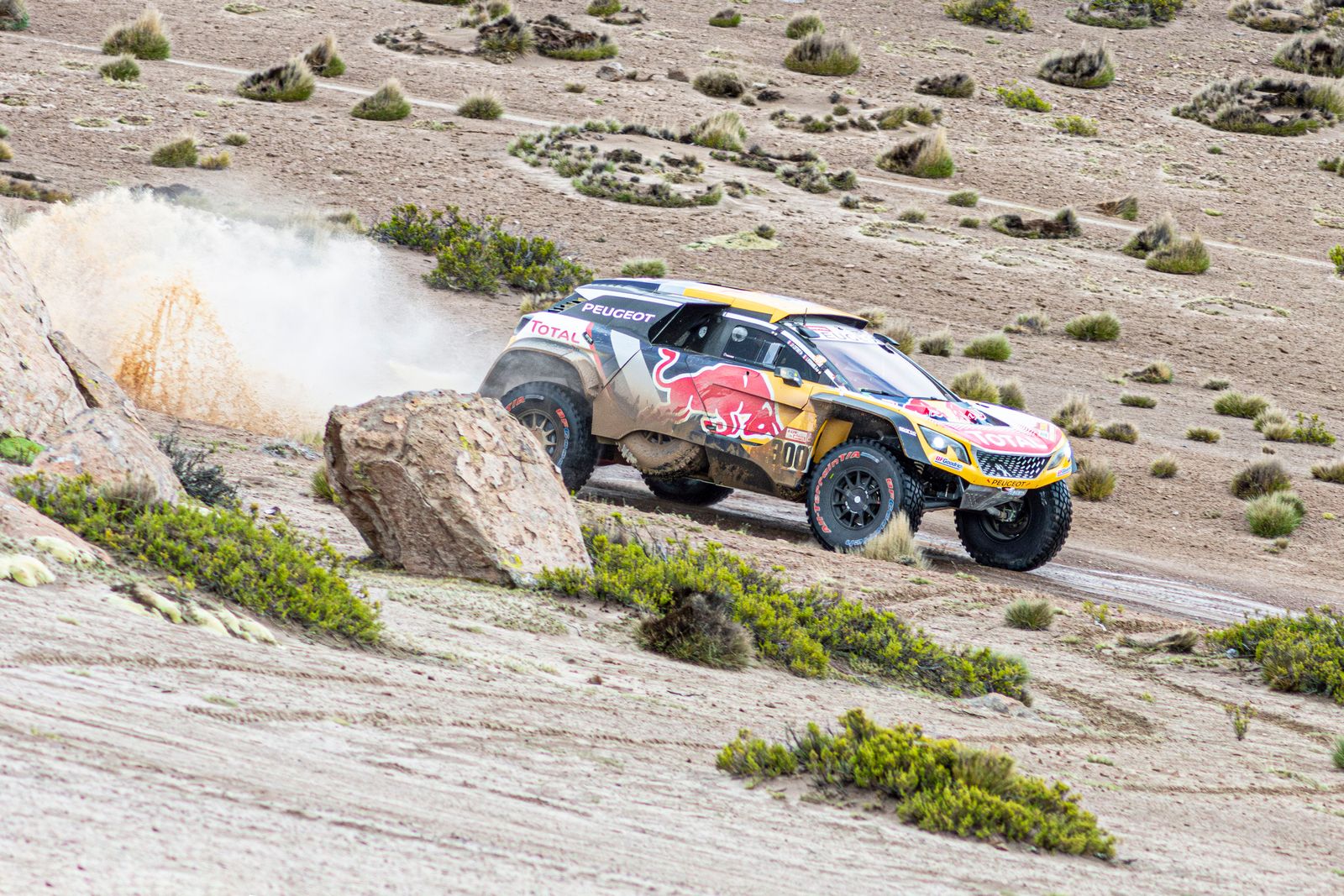
The 49th Dakar runs from 9 to 23 January 2027, over 12 stages, starting in Loulé in Portugal and finishing in Marrakesh, Morocco. Total distance is about 6,800km (roughly 4,228 miles), of which about 4,200km (roughly 2,600 miles) are timed special stages.
The relocation from Saudi Arabia is significant. A return to North Africa and a European start will feel familiar to followers of the event’s older editions, and the Moroccan terrain offers a very different mix of dunes, rocky tracks and fast gravel.
What we still don’t know
Aston Martin and Prodrive have released no technical details. Prodrive’s previous cars used a Ford twin-turbo 3.5-litre V6 in the BRX Hunter and a Nissan twin-turbo 3.0-litre V6 in the Dacia Sandrider, and a Mercedes-Benz V6 has been speculated for the Dreadnought, but nothing is confirmed. Dakar’s top category features experienced manufacturers and privateer outfits running proven machinery, and a first-time factory entry faces a steep learning curve on reliability, navigation and strategy.
The verdict
This looks like a credible front-running effort rather than a marketing exercise. Prodrive’s Sandrider won the 2026 Dakar and the Dreadnought is understood to be its descendant, so the baseline is genuinely promising. Alonso’s attempt to combine a 24-race F1 campaign with two weeks in the desert is the headline act, Loeb’s pursuit of the one major prize missing from his CV gives the programme its emotional pull, and Moraes supplies the youthful speed. The questions between now and the start in Loulé are technical: does the Dreadnought have the pace and the durability to run at the front? For a marque more used to pit lanes than bivouacs, it is a compelling new chapter. And for anyone following the wider motorsport silly season, our report that Christian Lundgaard Signs Multi-Year Chip Ganassi Racing Deal for 2027 IndyCar Season shows 2027 is shaping up as a year of significant moves across every discipline.