
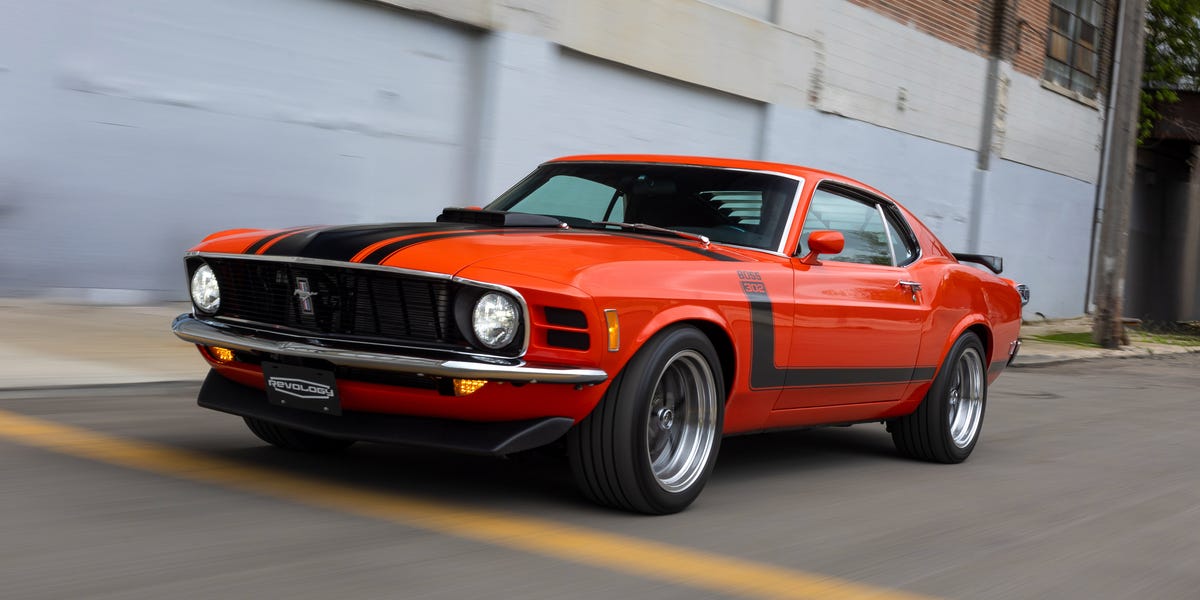
Revology Boss 302: the £300k Mustang restomod Britain cannot have
Imagine a 1970 Ford Mustang Boss 302 that has never seen a rusted sill in its life. Not a restoration. Not a replica. A brand new car, hand-built in Florida, wearing 1970 bodywork and hiding a modern 5.0-litre V8 under the bonnet. That is the Revology Mustang Boss 302, and Car and Driver calls it “an absolute ripper.”
It is also, for British readers, a car you will almost certainly never own. Revology is a US company, the car is left-hand drive, and there is no confirmed UK availability, pricing or homologation. Everything below is US-market detail from US sources, so treat the figures as a window into someone else’s playground rather than a shopping list. Even so, it is a fascinating one, because it sits at the exact point where modern performance collides with deliberate, period-correct compromise.
What exactly is a Revology Mustang?
The word for it is restomod, but that undersells what is going on. A traditional restoration takes an original car, strips it back and rebuilds it, usually with a mix of refurbished and new parts. A Revology is a ground-up new build. No original vintage parts are used anywhere in the car. The company, founded by former Ford man Tom Scarpello, hand-builds each one in Florida, styled to look like a 1970 Mustang Boss 302 but engineered from scratch.
That distinction matters. You are not buying a slice of 1970 with all the fragility that implies. You are buying a new car that happens to look like a slice of 1970, with modern metallurgy, modern brakes and a modern drivetrain underneath. The restomod scene has grown steadily on both sides of the Atlantic, and the same instinct to wrap new hardware in nostalgic clothing shows up in projects like the Renault 8 Gordini Concept: Electric Reinvention of a French Rally Icon, which applies the same logic to a rear-engined French rally legend.
Price and specification (US market)
This is where the numbers get serious. Revology quotes approximately $300,000 to $400,000 to build a car to this standard, with one review citing a flat “cool $400K” as the figure to keep in mind. Those are US dollars. For a rough sense of scale, $400,000 converts to approximately £310,000 at current exchange rates, though that is an indicative conversion only and not a UK price. There is no confirmed UK price, because there is no confirmed UK car.
Standard transmission is Ford’s 10-speed automatic. The Tremec T-56 six-speed manual is an optional extra at $4,500, which, against a build cost of this size, is the cheapest decision you will ever make.
Powertrain and performance
Under the bonnet sits Ford’s fourth-generation Coyote 5.0-litre V8, producing 460 hp and 420 lb-ft of torque, with a 7,500 rpm redline. The test car, steel-bodied, weighed 3,845 lb, or roughly 1,744 kg.
The results are startling for something wearing 1970 styling. Zero to 60 mph takes 3.9 seconds. The quarter-mile falls in 12.2 seconds at 118 mph. Third gear is good for roughly 120 mph, and the speedometer, handily, reads to around the same figure.
Now set that against the original. A 1970 Boss 302 took 6.5 seconds to reach 60 mph and needed nearly 15 seconds for the quarter-mile. The restomod is not marginally quicker. It is in a different performance universe, and a 3.9-second sprint puts it in the same territory as a current Porsche 911 Carrera. These are manufacturer and test figures from a US publication, measured in US conditions, so read them as indicative rather than gospel.
Chassis, brakes and handling
The engineering underneath is where the money clearly went. Up front, a cast-aluminium engine cradle from Detroit Speed anchors the control arms, coil-over dampers and anti-roll bars. At the rear, the leaf springs are gone entirely, replaced by a Ford 8.8-inch axle located by three links, a Panhard rod and a torque arm, running on coil-overs. A robust subframe-connection system stiffens the structure, and a carbon-fibre driveshaft handles the torque.
Braking comes from Wilwood, and here is the period compromise: there is no anti-lock assist. Stopping from 70 mph takes 175 feet, or about 53 metres, which Car and Driver describes as “positively modern” given the absence of ABS. Grip on the skidpad measures 0.92 g, on 275/40ZR-17 Michelin Pilot Sport All Season 4 tyres, with the reviewer noting the grip becomes genuinely notable above 30 mph.
Steering has real heft at a standstill but lightens as speed builds. It is not over-assisted, which is exactly the point.
Interior and equipment
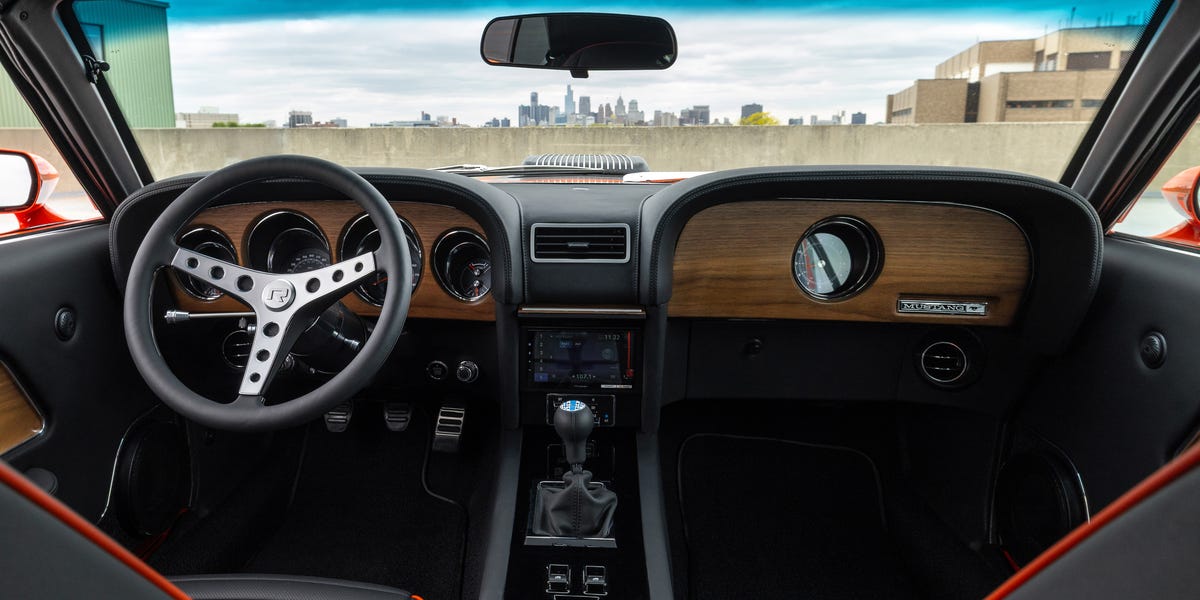
Open the door and the compromises become very deliberate indeed. There are no airbags. There are no headrests. Both are period-correct choices, and both would be non-starters for a car sold new in the UK, where safety regulation and type approval simply would not permit it.
The dash is walnut veneer, with physical gauges recessed into it and small hidden screens supplying extra information, so the instruments are partially digital without looking it. Climate control uses vintage-feeling sliders rather than modern dials. Hidden behind a flip-up panel is a Pioneer touchscreen with Android Auto and Apple CarPlay, which is a neat trick until you try to use it: the volume control apparently demands “a distracting level of precision.”
The clutch weight is comparable to a modern sports car and the throttle is easy to modulate, so the driving experience is not needlessly punishing. The ergonomics, though, are a reminder that you are sitting in a shape designed more than half a century ago.
Living with it: noise, ride and quality
Measured noise is 81 decibels at a 70 mph cruise and 99 decibels under wide-open throttle. The first figure is tolerable for a long run. The second is a wall of V8 sound that no modern turbocharged car can replicate.
The ride, notably, is comfortable without wallowing over motorway surfaces, which suggests the chassis work is more than just stiff springs and wishful thinking. The test car did have a fault, though: the driver’s-side window never fully sealed and whistled above 40 mph. Car and Driver frames small-batch quality quirks like this as consistent with the car’s period-faithful character, which is a generous way of putting it. At $400,000, most buyers would expect a window that shuts.
What this means for British buyers
Here is the hard truth for anyone in the UK reading this with a calculator out. The Revology Mustang Boss 302 is a US-market car, built in left-hand drive, without the safety equipment that UK type approval requires. No airbags and no headrests alone would stop it from being registered as a new car here. There is no confirmed UK availability, no confirmed UK price and no homologation programme announced. It is not coming, and no amount of enthusiasm will change that.
That does not make the restomod scene irrelevant to Britain. The UK has its own specialists building modernised classics, and continuation cars from established marques occupy similar territory, blending heritage styling with contemporary engineering. The appeal is identical: the look of a golden era with the reliability and performance of today. Where Revology differs is in going all the way, building entirely new cars rather than rejuvenating originals, and charging accordingly.
If you want a fast classic-flavoured Mustang in Britain, the realistic routes are an imported and individually approved older car, a UK-built restomod from a domestic specialist, or simply a modern Mustang, which will be quicker, safer, cheaper and far easier to live with. It just will not have a walnut dash and a Pioneer screen hiding behind a flap.
The Revology Boss 302 is a fascinating artefact precisely because it refuses to compromise on the things that make old cars charming, even when those things are objectively worse. No ABS. No airbags. No headrests. A whistling window. And 3.9 seconds to 60 mph. It is a car built for people who want the 1970 experience with none of the 1970 decay, and who are willing to pay roughly the price of a small house to get it.
For UK readers, it remains a curiosity rather than a prospect, and that is fine. Some cars are more interesting precisely because you cannot have one.




4 Comments