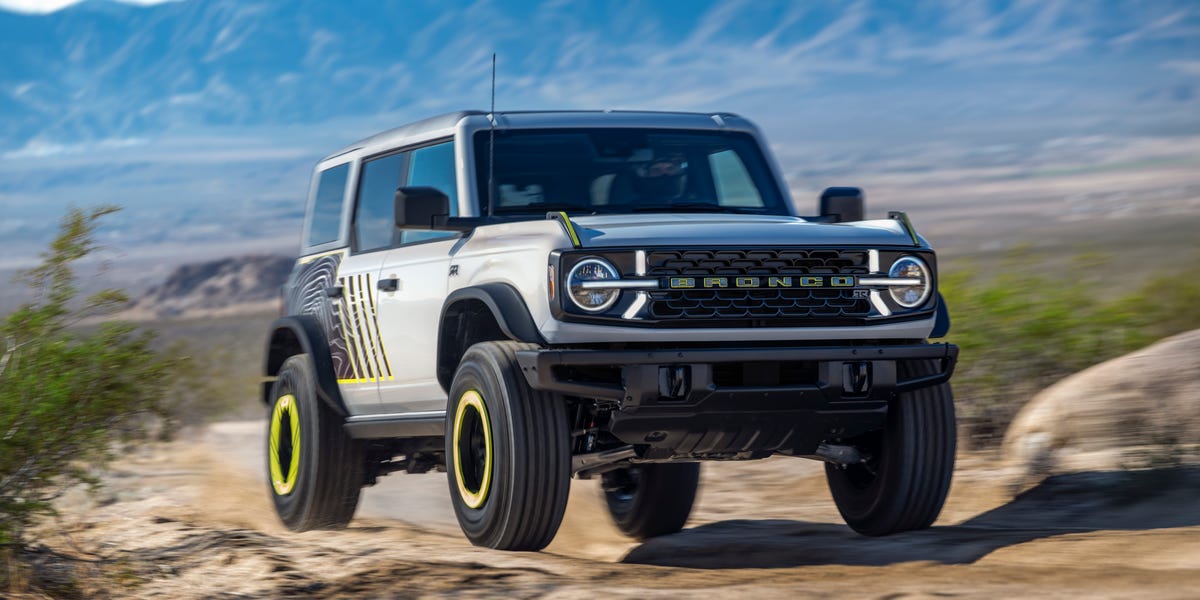
All figures below are US pricing for the US market. The 2027 Bronco RTR will start at just over US$50,000 before destination and delivery when it reaches US dealers in a few months, and a fully loaded example lands at just under US$60,000. Add the 2027 Bronco’s US$1,995 destination charge and you are looking at roughly US$52,000 to around US$61,000 depending on how deep you go on the options list.
That is the headline, and it is a significant one. The Bronco Raptor currently sits above US$80,000, so the RTR carves out a space roughly US$20,000 below Ford’s flagship off-roader while borrowing some of its hardware. For buyers who want serious capability without the flagship price tag, this is the trim Ford has been missing.
What the US$10,000 Premium Buys
The jump from a base RTR to a fully optioned one is about US$10,000, and Ford has been clear about where that money goes. The premium adds the Sasquatch Package with RTR Suspension, the RTR Appearance Graphics package and the Hyper Lime appearance package.
It is worth putting that in context. A base RTR at just over US$50,000 sits just above a 2026 Badlands, which means the entry point into RTR ownership is not much beyond an existing upper-mid Bronco trim. The Sasquatch-equipped RTR, meanwhile, still undercuts the Bronco Raptor by a wide margin. Ford is effectively offering two routes into the RTR: a value-focused entry model and a fully kitted version that closes much of the capability gap to the Raptor without closing the price gap.
The Mechanical Package from the January Reveal
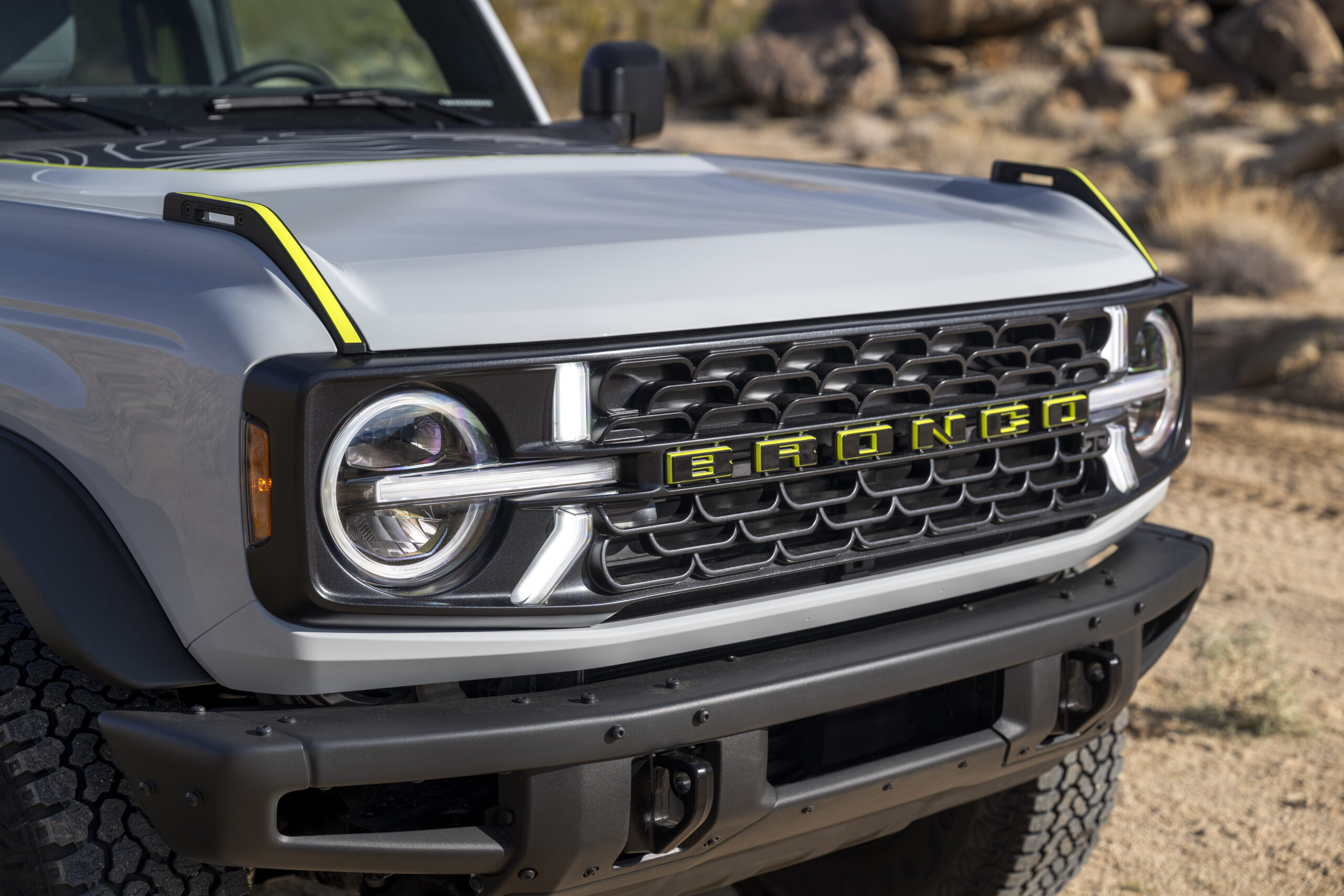
Ford pulled the wraps off the Bronco RTR in January 2026, and the mechanical story has not changed since. The standard engine is a 2.3-litre EcoBoost four-cylinder with anti-lag and upgraded engine cooling. Crucially, those cooling components are shared with the Bronco Raptor, which matters for anyone planning sustained high-speed off-road running in heat or sand.
The base model runs a wide-track HOSS 1.0 suspension setup on 33-inch tyres, wrapped around unique 17-inch beadlock-capable wheels. Ford also developed bespoke suspension tuning with RTR founders Vaughn Gittin Jr. and Loren Healy. That collaboration is not a marketing line: Gittin Jr. founded RTR, short for Ready to Rock, and has spent years building and drifting Fords, a background we looked at in our review of the 2026 Ford Mustang RTR. Healy brings a competitive off-road racing pedigree to the table, and between them they have shaped how this Bronco behaves when the surface stops being tarmac.
Sasquatch Upgrades Take It Further
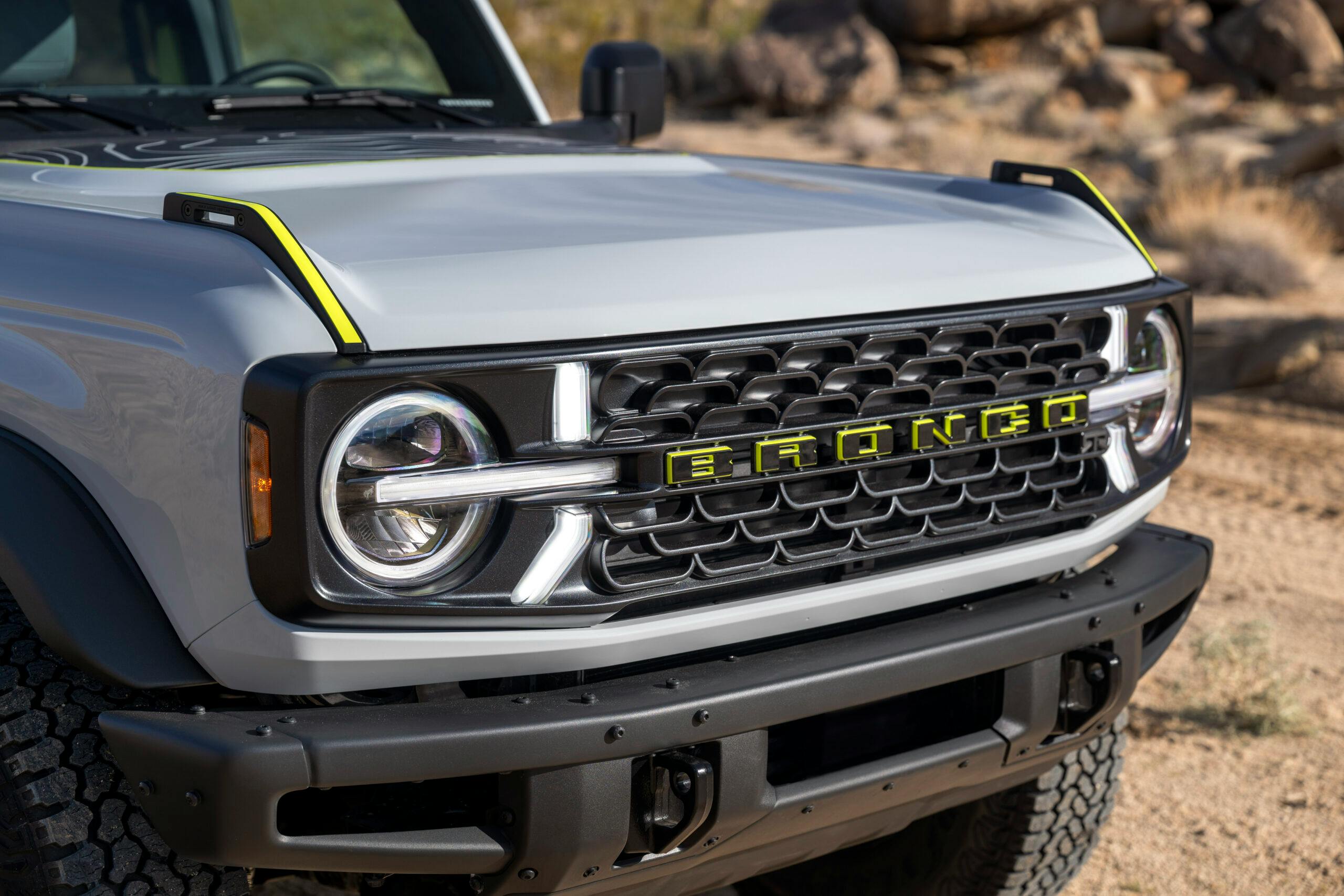
Step up to the Sasquatch Package and the hardware changes meaningfully. You get HOSS 3.0 Fox internal bypass dampers, 35-inch tyres and a heavy-duty modular front bumper. That combination pushes the RTR into genuinely serious territory: the bigger rubber and bypass dampers are the sort of kit that transforms how a vehicle handles rough ground at speed.
Ford positions the RTR as a more affordable alternative to the Bronco Raptor, aimed at trail capability plus high-speed off-road fun in sand. That is a deliberate niche. The Raptor is the ultimate expression of the Bronco formula, but the RTR targets buyers who want most of the thrills for a lot less money, and the Sasquatch package is how you get closest to that without paying Raptor money.
The wider off-road market is heating up in parallel. Jeep has revived the Cherokee nameplate for 2027 with a Trailhawk variant that pairs hybrid power with a low-range transfer case, a locking rear axle and a suspension lift, as we covered in our look at the 2027 Jeep Cherokee Trailhawk. Where the Jeep leans on electrified torque and a traditional low-range box, the Bronco RTR stays with a turbocharged four-cylinder and a more aggressive damping setup, so the two chase overlapping buyers from opposite directions.
Inside the Hyper Lime Cabin
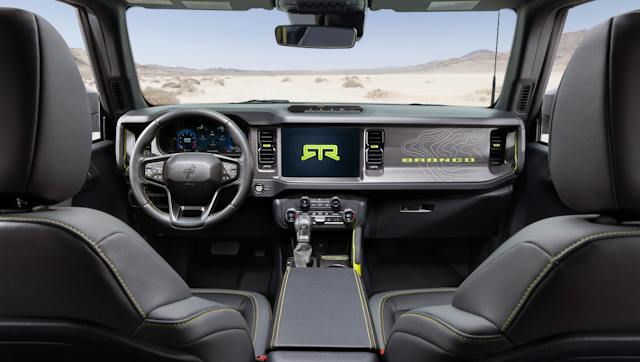
Ford has now revealed the interior, and it leans hard into the RTR identity. Hyper Lime accents run through the seatbelts, stitching, grab handles, air vents and instrument panel. The seats carry RTR logos, and the screens feature unique RTR startup and welcome animations.
It is a bold treatment, but it is consistent with the exterior graphics package that defines the RTR visually. The colour appears in places you actually interact with, from the belts you pull across your chest to the handles you grab when the trail gets steep.
The Designer’s Take on the Interior
Kellie Walters, Bronco Colour and Materials Designer, explained the thinking behind the cabin.
“For the cabin, we took the functional design and usability customers expect in a Bronco and paired it with the vibrant touches that differentiate the Bronco RTR exterior to make sure that every commute reminds you of weekends off the map,” she said.
“You see it in the unique seatbelts, in the stitching, in the grab handles, and in the instrument panel accents. Those elements are more than pops of colour. They create rhythm and identity throughout the interior and give the vehicle a sense of attitude the moment you climb in.”
That last point is the interesting one. The RTR treatment is not confined to a badge on the tailgate or a stripe down the flank. Ford has carried the theme through the cabin so the ownership experience feels distinct every time you get in, not just when someone else sees you drive past.
Where the RTR Fits in the Bronco Line-up and What Comes Next
The Bronco RTR is the first Bronco trim covered in Ford’s “Everything You Need to Know” series on Ford From The Road, which suggests the company sees it as a significant addition rather than a niche special. The Filson Edition is expected to be the next Bronco variant featured in that series, so there is more Bronco news in the pipeline.
The RTR formula has already proven it can work on Ford’s other models, and the Bronco was always the most natural home for it. A 2.3-litre EcoBoost with anti-lag, Raptor-shared cooling, RTR-tuned suspension and a cabin that reminds you why you bought the thing: that is a coherent package, and it lands in US showrooms in a few months. Anyone cross-shopping a mid-range Bronco against a Raptor now has a third option that splits the difference on price while giving away far less than the US$20,000 gap might suggest.