Why the Tiguan badge is moving onto an electric SUV
The Tiguan name is not being borrowed lightly. Since 2017 it has been Volkswagen’s best-selling car globally, a familiar sight on driveways and motorway lanes alike. Putting that badge on an electric SUV is a statement of intent: this is not a niche product, it is the family car the brand expects to sell in volume.
To be clear about the naming, the ID. Tiguan is a new electric model that inherits the badge from the combustion-engined Tiguan SUV, which continues in the range as a separate petrol and diesel car. The two share a name and little else.
The ID.4, by contrast, never quite earned that affection. It was competent, roomy and quietly popular, but it carried the awkward styling and ergonomic missteps that defined Volkswagen’s first wave of EVs. Retiring the ID.4 name and reviving Tiguan gives the car a fresh start with an audience that already trusts the badge.
A sharper look built on the ‘Pure Positive’ language
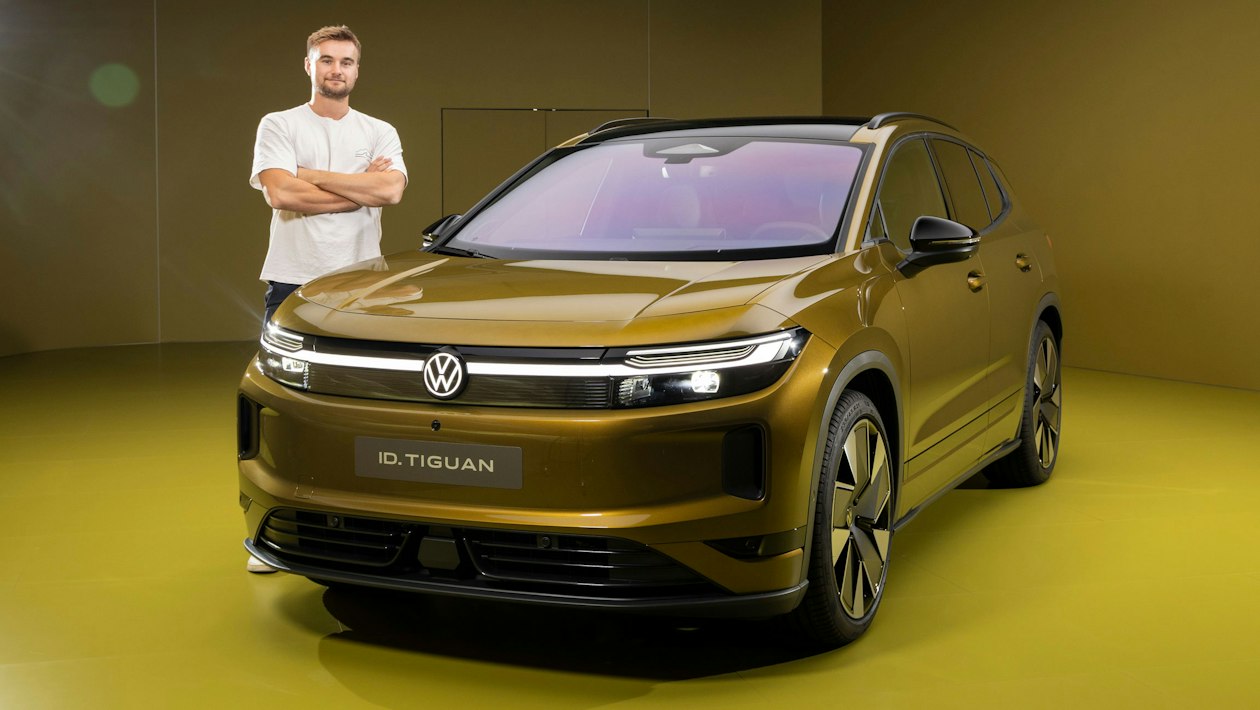
The ID. Tiguan adopts Volkswagen’s new ‘Pure Positive’ design language, already seen on the new ID. Polo and ID.3 Neo. It keeps the ID.4’s basic proportions but directly addresses criticism of what was widely described as a blobby design.
Up front, a new full-width LED light strip runs across the nose, broken up by an illuminated Volkswagen badge. The lower bumper has been reshaped and gains new side air curtains, which help cut the drag coefficient from 0.27 to 0.26. That is a small but meaningful gain for an SUV, and it feeds directly into the range improvements further down.
At the rear there is new lighting with an illuminated badge in the centre, plus a bumper with more horizontal lines to widen the car visually. Traditional door handles also return, replacing the flush items that frustrated owners in cold weather. Volkswagen says the design gives the car a muscular stance on the road.
R-Line replaces the GTX at the top
The range is now topped by an R-Line version, which effectively takes the place of the old GTX. Volkswagen has confirmed the GTX badge will not be renewed.
R-Line brings sportier front and rear bumpers, R badging and 21-inch wheels, up from the 19- and 20-inch designs offered elsewhere in the range. It is a familiar formula, but it gives the ID. Tiguan a range-topper that leans on appearance rather than outright performance.
Inside, physical controls finally make a comeback
The most significant changes are inside, where Volkswagen says it has returned to its True Volkswagen philosophy. In plain terms, the company has admitted that removing buttons was a mistake.
A new steering wheel, taken from the ID. Polo, uses physical controls instead of the ID.4’s piano black touch buttons. The main display grows to a 15-inch touchscreen, as already seen on the Passat and the combustion-engined Tiguan, running the latest infotainment software.
The touch-sensitive sliders at the bottom of the screen are gone. In their place is a bank of physical climate controls in the middle of the dash. A rotary dial in the centre console switches between volume and driving modes, and four individual switches on the driver’s door replace the single touch button for front and rear window control.
Only the gear lever and the wiper and indicator stalk carry over unchanged. Every other frequently used control has been replaced, which tells you how far Volkswagen was willing to go.
Retro screens and a passenger display
There is a playful side too. A retro menu, shared with the ID. Polo, lets the main screen mimic six different Volkswagen models, spanning various Golf generations to the Tiguan, Race Touareg and Beetle. The twin dials on the driver’s display echo a Mk4 Golf, with the rev counter reflecting power output rather than engine speed.
Passengers get an optional 12-inch display, the same unit found in the latest Audi Q4 e-tron. It uses privacy mode pixel technology so the driver cannot see it, and supports apps including Spotify, the Vivaldi browser and gaming features. It is a neat solution to the distraction problem that has dogged passenger screens.
R-Line cabin adds the premium touches
Step up to R-Line and the cabin gains premium sport seats with massage functions, R badging on the seats, door sills and doors, a 12 o’clock marker on the steering wheel and heated rear seats. It is a more convincing effort than the old GTX interior, which relied heavily on blue accents and not much else.
Range climbs, but not to the top of the class
Battery options carry over, but efficiency gains and the lower drag figure have lifted range across the board. The base 58kWh model climbs from 265 miles to 279 miles. Above it, the 77kWh unit is available with single-motor rear-wheel drive or all-wheel drive, and reaches up to 372 miles, up from the ID.4’s best of 351 miles.
That is a solid improvement, but the ID. Tiguan is not best in class. On WLTP figures, the Renault Scenic recently gained a new battery to reach 392 miles, while the Tesla Model Y Long Range quotes 378 miles, though Tesla’s own cycles are not directly comparable with the European WLTP test. The Nissan Ariya offers 329 miles.
The Scenic and the Ariya are among the car’s main rivals, alongside the Toyota bZ4X, and on paper at least, the Renault has the edge on range. The Model Y remains the benchmark the whole segment is measured against.
It is worth remembering that range figures rarely tell the whole story. Real-world efficiency and charging speed matter far more than a headline number, and those are exactly the areas we cannot yet judge.
What we still don’t know
Performance, charging and pricing details were not available in the source material, so those figures remain unconfirmed. Given the ID.4’s successor positioning, we would expect a familiar spread of power outputs and DC charging rates, but nothing has been announced.
The wider electric SUV market is moving quickly, and the ID. Tiguan will arrive into a much more crowded segment than the ID.4 did. Buyers cross-shopping coupe-styled alternatives may also be watching the 2027 BMW iX4: Everything We Know About the 428-Mile Coupe-SUV EV, which promises a very different take on the electric family car. And for anyone trying to make sense of how the major brands are arranging their electric ranges, our guide to The Electric Car Line-Up Explained: Audi, BMW, Cadillac and Chevrolet’s EV Ranges is a useful primer.
The ID. Tiguan is a reset, not a revolution
Volkswagen has done something quietly brave here. Rather than persist with a name that never landed, it has retired the ID.4 and handed its electric family SUV the most trusted badge in its showrooms. The design is sharper, the drag figure is lower, the range is meaningfully better and the interior finally undoes the ergonomic damage of the past few years.
The ID. Tiguan will not win on range alone. The Renault Scenic and Tesla Model Y both quote more miles, and rivals are improving fast. But Volkswagen’s pitch is broader than a single statistic: it is about a car that feels like a Volkswagen again, with buttons where your hand expects them and a name your neighbour already recognises.
If the pricing and charging figures land sensibly when they are confirmed, the ID. Tiguan could be the electric family SUV Volkswagen should have built first time around.