Jeep has spent more than eight decades building its reputation on mud, gradients and the sort of terrain that makes a satnav give up. Now the brand is asking a rather different question: can it conquer a multi-storey car park in central Paris? The answer, if a concept revealed at the Mondial de l’Auto is anything to go by, involves looking 85 years into the past for inspiration.
Jeep’s Willys-Inspired Concept: What Was Announced in Paris
At the Mondial de l’Auto, Xavier Peugeot, who had taken charge of Jeep in Europe less than two months earlier, lifted the lid on an idea rather than a car. The proposal is for a small, electrified SUV inspired by the Willys Jeep MB, the military 4×4 that helped define the brand during the Second World War.
It is worth being clear about how early this is. The model has not been approved for production, and if it does get the green light, it would not arrive in showrooms until after 2030.
What Jeep does have is a rationale. Peugeot framed the concept as an attempt to translate the company’s heritage into something relevant to modern European cities.
“We’ve got a strong heritage, which started more than 85 years ago,” he said. “But the world is changing, and we have to consider what Jeep stands for without betraying our values, but also being able to reinterpret them for the future.”
He was candid about the pressures shaping the idea. “Spaces will be even more precious than before. Ecologically responsible answers will be expected more than ever,” he said. “We also expect to be able to explain that being smaller will not mean getting less. It will mean being more smart, and that’s what we expect to do. We expect every centimetre in our product to work harder.”
Size and Positioning: Slotting In Below the Avenger
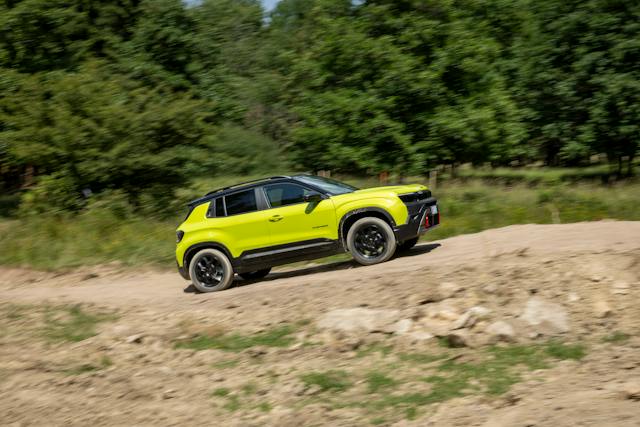
The teaser image shown to Auto Express suggested the new model could be roughly the same size as the original Willys, which measured just 3.3 metres long. That would make it smaller than the Jeep Avenger, currently the brand’s most compact offering in Europe at 4.1 metres.
Hagerty has suggested an entry-level model could stretch between 3.6 and 3.8 metres, which is genuine city-car territory, a segment Jeep has never competed in. The Avenger, by contrast, sits on the same platform as the Peugeot 208, Fiat 600 and Alfa Romeo Junior, and is offered with either a turbocharged three-cylinder engine or an electric drivetrain. It is the best-selling Jeep in several European markets, including France, Italy and Germany.
The logic behind going smaller is straightforward. Several European cities levy weight-based taxes, and a growing number restrict access to low-emissions zones. A compact, electrified Jeep would sidestep both problems at once, while still wearing the badge that buyers associate with adventure. The wider shift towards smaller, more efficient electric models is one of the themes running through our 2026 Automotive Preview: Revived Icons, Electric Extremes, and the EV Sweet Spot.
The Design Question: Crossover or Shrunken Wrangler?
Jeep has not settled on what this thing would actually look like. The two live possibilities are a crossover wearing Willys-inspired styling cues, or a scaled-down Wrangler. The teaser image, which appeared to show the shadow of a boxy crossover behind the soft-top original, leans towards the former.
That distinction matters commercially. A shrunken Wrangler would be a niche proposition, appealing to enthusiasts but compromised on packaging and aerodynamics. A crossover with retro flourishes would be far easier to sell in volume, particularly to urban buyers who want the Jeep look without the Jeep running costs.
Peugeot’s language hinted at the balancing act. “Our responsibility is to be able to translate Jeep’s original DNA into concrete and strong answers for European customers,” he said. “The key word for Jeep in Europe is, of course, freedom. It’s also adventure, it’s authenticity, and it’s passion.”
Four-Wheel Drive Stays
One thing Peugeot was firm about: every new Jeep will be available with four-wheel drive, which he described as a key part of the brand’s DNA. That is a notable commitment for a small electric model, where packaging a second motor and the associated hardware into a 3.3-metre footprint presents real engineering challenges.
It also raises questions about cost and range. Dual-motor electric vehicles are heavier and thirstier than their single-motor equivalents, and weight is precisely what the concept is trying to avoid. How Jeep squares that circle, if it ever has to, remains to be seen.
Jeep’s Wider European Push
The Willys concept is one of four European models in the pipeline. Alongside it sits an all-new Renegade due by 2030, a D-segment SUV developed with Chinese firm Dongfeng scheduled to debut in 2028, and the off-road-focused Recon 4×4, which has already gone on sale in the United States.
With those four models, Jeep hopes to cover around 90 per cent of the SUV market in Europe, up from roughly 50 per cent today with just the compact Avenger and mid-size Compass on sale.
“Our ambition is simple and clear. First of all, we would like to strengthen our presence across the key SUV segments. That’s where our business is, and we will continue to do so,” Peugeot said.
There is also an unresolved question about the Wrangler, which has been axed in the UK and other markets because it no longer complies with European emissions or safety regulations. Peugeot would not be drawn on a potential return. And it is not yet known whether the Willys-inspired SUV and its larger siblings will be sold in the United States at all.
The broader direction of travel is familiar. Rivals are making similar moves, with the VW ID. Tiguan confirmed: electric SUV to replace ID.4 and ID.5 from 2027 demonstrating how volume brands are consolidating their line-ups around electrification. Jeep is following a similar playbook, albeit with a heavier dose of nostalgia.
What Happens Next
For now, the honest answer is: not much, quickly. There is no production green light, no confirmed name, no price and no specifications. The earliest possible on-sale date is after 2030, and the whole project could yet be shelved.
What the Paris announcement does reveal is how Jeep’s European leadership is thinking. The brand’s future on this side of the Atlantic depends on getting smaller, cheaper and electric, while convincing buyers that none of that dilutes what a Jeep is supposed to be. Peugeot’s pledge that every new model will offer four-wheel drive, and his insistence that “being smaller will not mean getting less”, amount to a promise that the compromise will be in the dimensions rather than the character.
Whether that promise survives contact with engineering budgets, battery costs and European regulators is the real test. Jeep has 85 years of heritage to draw on, but heritage does not pay for a platform. The Willys-inspired city SUV is a compelling idea. It is also, for the moment, just an idea.
For more on this, see electric motorcycle novus one.