
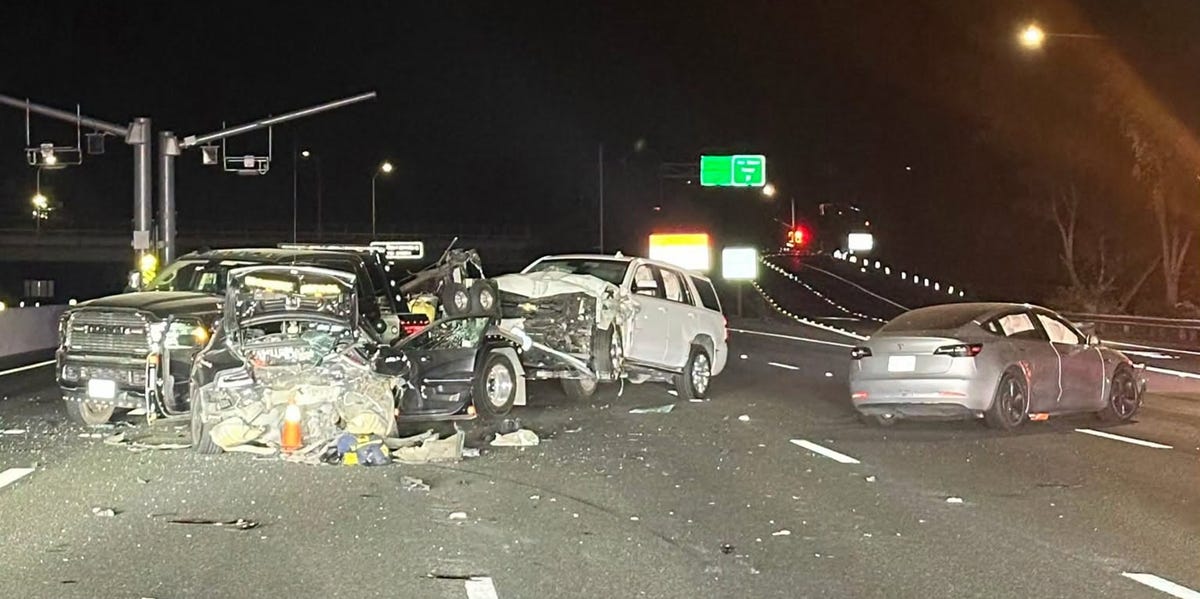
Just before midnight on Tuesday, 13 October, a Tesla travelling at highway speed drove straight through a closure of flares and cones on eastbound Interstate 80 in Fairfield, California, and into an occupied California Highway Patrol patrol car. Both officers inside suffered serious injuries, though they have since been released from hospital. The driver, a 22-year-old from Sacramento, walked away with minor injuries.
What he told investigators afterwards is the part that matters: he was asleep at the wheel, with Tesla’s Full Self-Driving engaged.
What Happened on Interstate 80
The Tesla struck a Dodge Charger patrol car that was being used as a buffer at the scene of an earlier, fatal collision. About an hour before, a 19-year-old from San Pablo had lost control of his Honda Civic and was struck by a Chevrolet Tahoe. He did not survive.
Four lanes had already been shut behind flares and cones when the Tesla arrived, according to CHP. It drove through the closure and into the Charger, with both officers still inside. Dashcam footage of the impact was released on Thursday, captured by cameras on the Charger and on another vehicle at the scene. Both crashes remain under investigation.
The Driver’s Account and What Is Still Unproven
The driver’s statement that FSD was active is, for now, the only evidence that it was. CHP has not released the Tesla’s model or the software version involved, and Tesla’s vehicle logs would be the definitive record of what the system was doing in the seconds before impact.
That gap matters. It means the central claim in the story, that a car drove itself into a police cordon while its occupant slept, currently rests on the word of the person who was asleep. Investigations into crashes involving driver-assistance systems routinely turn on telemetry, and this one will too.
How FSD Is Meant to Work, and How It Can Be Defeated
Full Self-Driving remains an SAE Level 2 driver-assistance system. That classification is not marketing small print; it means the human at the wheel is legally responsible for the vehicle at all times, must remain alert, and must be ready to take over instantly.
Tesla’s own design reflects that. FSD (Supervised) uses the cabin camera to monitor whether the driver is watching the road, and is built to nag, then disengage, if attention wanders. On paper, a sleeping driver should trigger exactly that sequence.
In practice, the monitoring has been getting looser, not tighter. Electrek has reported that Tesla has relaxed driver monitoring rather than strengthened it, and that the system is straightforward to defeat. A banknote placed in front of the cabin camera is enough to nullify it. Whether the driver in this case had been asleep for seconds or minutes, and whether the camera failed to detect him, is not yet known. What is clear is that the safeguard designed to prevent precisely this scenario did not prevent it.
CHP’s Response
The force’s public statement was pointed and brief. In its social media post about the crash, CHP said: “Technology does not relieve drivers of their responsibility to safely operate their vehicles.”
That framing places the incident squarely in the driver-responsibility column, even as the investigation continues. It is a position California’s highway patrol has had reason to rehearse. Officers working roadside closures are among the most exposed people on any motorway, and they have been hit by Teslas before.
A Pattern Regulators Have Seen Before
In August 2021, NHTSA opened an investigation after a series of Teslas running Autopilot crashed into stopped police cars and fire trucks, many of them at night with flares, cones and flashing lights on scene. That probe ended with Tesla’s December 2023 recall of more than 2 million vehicles, remedied by an over-the-air update that added more driver-attention alerts.
The pattern repeated in June 2024, when a Tesla on FSD hit a parked Fullerton police car while officers were dealing with a fatal crash. That driver admitted to being on his phone at the time.
The common thread is not a particular software version or model year. It is a stationary, brightly lit obstacle at the edge of a closed road, and a driver who has stopped supervising a system that is not capable of supervising itself.
The Naming Question and the Liability Question
Tesla has already conceded part of the argument in one market. According to Reuters, the company has agreed to rename FSD “Tesla Assisted Driving” in Europe, an acknowledgement that the technology still requires constant human supervision. The change followed German regulators calling “Full Self-Driving” misleading, and it now appears on Tesla’s sites in Spain, Germany, Sweden and the Netherlands, with owner’s manuals updated to match. The old German Full Self-Driving web address redirects to a fresh page under the new name, as covered in our report on Tesla Renames Full Self-Driving to ‘Tesla Assisted Driving’ in Europe After German Pressure.
That rebrand sits awkwardly beside the company’s public messaging elsewhere. On 5 December 2024, Elon Musk claimed FSD drivers can now text and drive “depending on context of surrounding traffic.” Texting while driving is illegal in California.
The legal picture is no cleaner. Florida’s $243 million Autopilot verdict, roughly £190 million at recent exchange rates, assigned a third of the blame to Tesla, establishing that driver fault and manufacturer fault are not mutually exclusive propositions. The Katy, Texas FSD crash in April was cited as showing a similar complacency trap, in which a system competent enough to lull its user into disengagement is also, by definition, not competent enough to be left alone.
Tesla’s longer-running habit of announcing products years before they exist has been well documented, from the Tesla Roadster Reveal: Nine Years of Promises Meet the Texas Desert to the more recent talk of Tesla Roadster Returns: 2028 Production, Thrusters and All. Autonomy has followed a similar arc: perpetually imminent, never quite arrived. The difference is that a delayed sports car costs nobody an officer’s career, and a system pitched as nearly self-driving while remaining Level 2 creates exactly the ambiguity now playing out in Fairfield.
Where Responsibility Sits When Nobody Is Watching
The uncomfortable question raised by this crash is not whether the driver was negligent. On his own account, he was asleep in a moving vehicle, which is difficult to characterise as anything else. The harder question is what happens when a manufacturer markets a system as Full Self-Driving, relaxes the monitoring that keeps drivers honest, and suggests they can text behind the wheel, then points to the driver when the arrangement fails. CHP’s statement is legally sound and morally straightforward, but it does not resolve the design problem underneath it. A monitoring system that a banknote can defeat is not really a monitoring system.
Tesla’s vehicle logs will eventually establish whether FSD was engaged on I-80 that night. Whatever they show, the wider issue will remain: a Level 2 system with a Level 5 name, sold on the promise that supervision is temporary, will keep producing drivers who stop supervising. Until the naming, the monitoring and the liability all point the same way, the next cordon may not be so lucky.
Related: golden steering wheel skoda.
One Comment