What the 12Cilindri Manuale Actually Is
The new variant of the front-engine V-12 12Cilindri adds two things the standard car does not have: a third pedal and an open-gate shifter. Underneath, it is the same car, with the same eight-speed dual-clutch rear transaxle, the same hardware and the same V-12 up front. Nothing mechanical has been swapped out. What Ferrari has done is rework the existing transmission’s software and control logic so that it behaves, and more importantly feels, like a manual.
Ferrari calls it “a contemporary reinterpretation of the analogue gear-shifting experience.” That is a careful piece of wording, and it is worth reading twice. It is not a claim that the car is analogue. It is a claim that it is an interpretation of analogue, which is a different proposition altogether. Car and Driver refers to the car as a 2027 model year machine, a US-market designation. Ferrari has not confirmed build numbers or pricing, so whether you can order one, and at what cost, remains an open question.
The result is a grand tourer that looks, from the driver’s seat, like something from a previous era, and behaves like something from this one wearing a very good costume.
How the Shifter Works
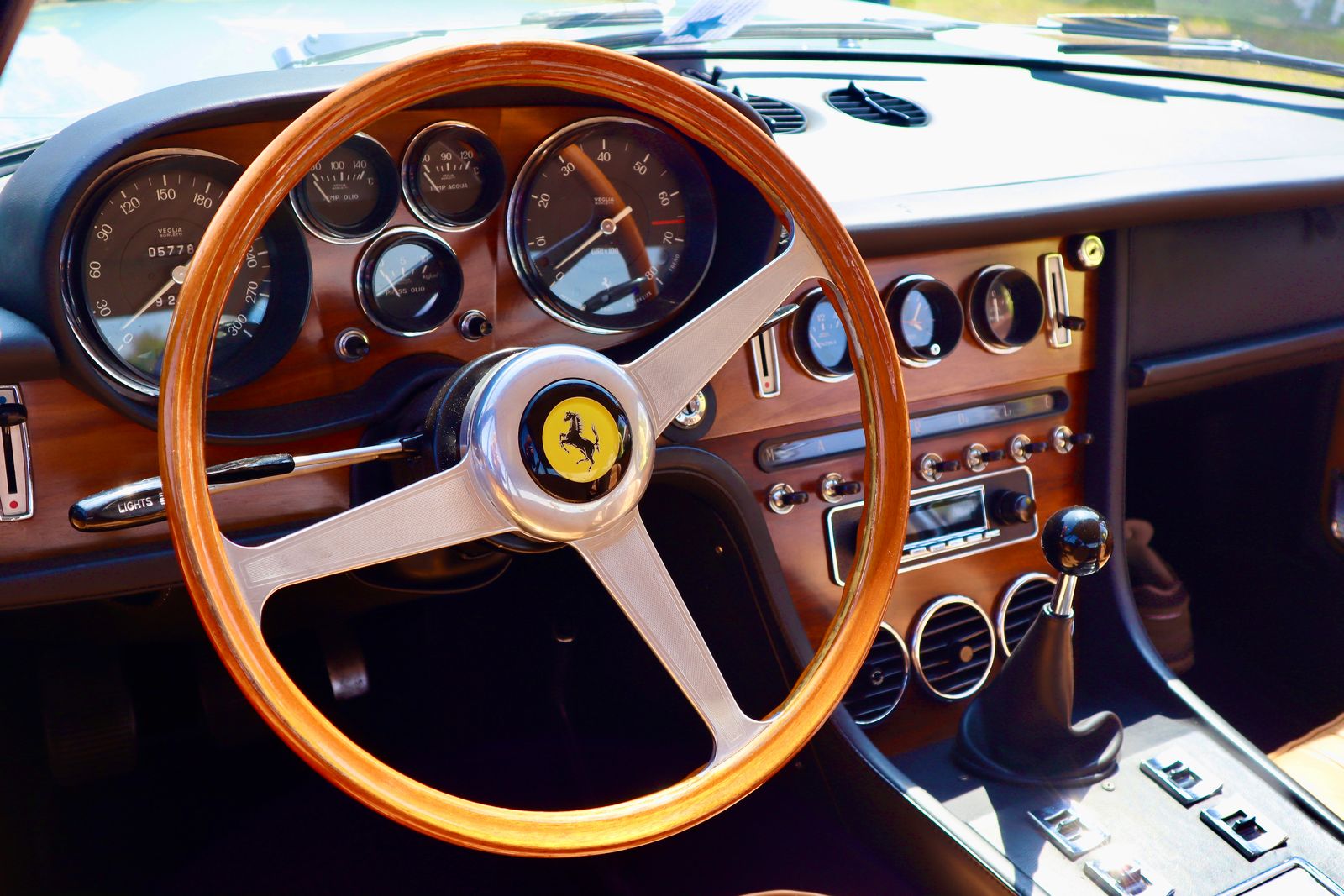
The lever sits in an open gate with a bulbous knob marked in a double-H pattern covering six gears. Reverse is left and forward, as it should be. Seventh and eighth ratios are inhibited in manual mode, which means the gate tops out where a traditional six-speed would, and the car never asks you to find a gear the gate does not offer.
The most striking detail is what has been removed. This is the first Ferrari since 2012 without steering-wheel paddles. Even the Luce, the company’s electric car, keeps paddles for regenerative braking and torque delivery. In the 12Cilindri Manuale, the wheel is clean, and every ratio change goes through the lever.
There is no mechanical connection between the lever and the gearbox. Position is read by electronic switches. A solenoid-activated lock prevents the selection of impossible gears, so you cannot ask for a ratio that is too low for the engine’s current speed, cannot engage reverse while rolling forward, and cannot slot a gear without pressing the clutch. The gate will not let you do anything a real gearbox would have refused.
The Hardware Beneath the Gate
The illusion is not only electronic. Beneath the gate sits a pivoting plate machined from solid alloy steel, mounted in a frame located by precision bearings. An actuation arm works against a weight matched to the resistance of a true manual, and a cam profile increases the force required toward the end of the throw. That last part matters more than it sounds. A real manual gearbox resists most firmly as the synchros bite and the gear engages, and replicating that rising effort is what separates a convincing shifter from a video-game joystick.
The clutch pedal follows the same philosophy. It is sprung for natural weighting, so it loads up under your left foot the way a hydraulic clutch would, but it sends only a position-angle signal to the powertrain electronics. There is no friction plate on the other end of that signal.
Why Ferrari Built It
Ferrari did not build this car because the engineering was irresistible. It built it because it got the market wrong, and it has had a long time to think about it.
For years, customers negotiating for a 360 Modena, an F430 or a 575M Maranello were warned that choosing the “F1” automated single-clutch option was essential for residual values. The message was consistent and it worked. The last true manual Ferrari was produced in 2012. Only around one in 10 F430s left Maranello with a gated shifter and three pedals, and those cars are now worth roughly twice as much as F1 versions, like for like.
The rarer the car, the bigger the gap. Just 30 manual 599 GTBs were built, and some owners have gone as far as converting original F1 cars to manuals to capture the difference. The wider market has noticed the same pattern in other corners of the collector world, where a Ferrari 550 Maranello sold for about $2.7m, roughly £2.1m, more than double its estimate (reported separately on AutoPulse).
Ferrari’s version of that reversal is more elaborate, because Ferrari cannot simply bolt a different engine or gearbox into the 12Cilindri. But the motive is recognisable: the market said one thing, the company said another, and the market was right.
The Engineering Case Against a True Manual
So why not build the real thing? Ferrari’s answers are practical rather than romantic.
First, there was no readily available manual gearbox to replace the rear-mounted eight-speed dual-clutch transaxle. Building one from scratch for a low-volume variant is an expensive way to sell a few hundred cars. Second, integrating a conventional manual with the 12Cilindri’s complex dynamic control systems is not a trivial exercise. The car’s behaviour depends on the transmission’s ability to act faster than a human, and a clutch pedal interrupts that conversation.
Third, and most bluntly, a true manual would reintroduce mechanical risk. The concern, described by Ferrari as the “money shift,” is the missed downshift that takes an engine past its safe speed and turns a V-12 into a very expensive sculpture. Ferrari’s customers have not had to worry about that since 2012, and the company appears to have no appetite for reintroducing it.
The 12Cilindri Manuale gives you the ritual without the jeopardy. Whether that is a fair trade is the question the whole car hangs on.
What It Is Like to Drive
The launch drive took place at the Alfa Romeo handling track at the Stellantis-owned Balocco Proving Ground, with extra chicanes added to the longer straights. A circuit of that length gives you room to use the gate repeatedly, and the chicanes force the sort of downshift, turn-in, upshift sequence where a shifter either convinces or it does not.
The verdict from those who have driven it is that the mechanism is genuinely good, and that most drivers will be slower shifting for themselves than the dual-clutch would have been on its own. That is not a criticism so much as an admission. The eight-speed is quicker, smoother and more efficient in every measurable way. The gate exists for a different set of measurements entirely.
A Careful Choice of Words
The car is available in 25 colours, and the example photographed is Rosso Rubino, a deep burgundy that suits the front-engined proportions rather than shouting about them. It is a restrained specification for a car making a very loud point.
That restraint is consistent with Ferrari’s framing. This is not a car the company presents as a return to the past. It is presented as a contemporary reinterpretation of the analogue experience, which is an honest description of a machine with a clutch pedal that sends a signal, a shifter with no linkage, and a solenoid that stops you doing something stupid.
Ferrari spent years telling buyers that the F1 gearbox was the sensible choice, and the resale market has spent years proving the opposite. The 12Cilindri Manuale is the company’s response, and it is a strange, expensive, deeply considered one: a car that reproduces the feel of a manual because it cannot, or will not, build one.
It is easy to be cynical about that. It is harder to be cynical about the engineering, which is thorough in a way that suggests Ferrari took the brief seriously. The machined plate, the cam profile, the weighted arm and the solenoid lock are not the work of a company going through the motions.
The real lesson is in the timing. The last manual Ferrari was built in 2012, and the premiums on those cars have been visible for years. The 12Cilindri Manuale arrives long after the evidence was in, which makes it less a correction than a commemoration. It is a very good imitation of something Ferrari could have kept selling all along, and the fact that it exists at all is an admission that the company’s advice to buyers was wrong. The gate is convincing. The hindsight is impeccable.