What GM announced
The plan runs in stages. First comes eyes-off highway driving: the person in the driver’s seat can stop monitoring the road on defined motorways while the car handles the task. GM then intends to spread the platform across its highest-volume models, including petrol-powered full-size SUVs and pickups, three-row crossovers and its fourth-generation electric vehicles. The next Chevrolet Silverado was named as a recipient. These applications are confirmed for the US, where the updated Cadillac Escalade IQ arrives in 2028.
Only after that does Mission Mode enter the picture, extending the same underlying technology beyond the motorway so a vehicle can be sent to collect laundry or groceries with nobody aboard. Sebastian Bauer, GM’s head of human interface design, framed the pitch as a question of time: “With more time, more freedom, more space in your day, what will you do?” The company’s stated vision is “to build vehicles that can drive themselves or their occupants anywhere they need to be.”
GM says it is not building Level 3. The definition disagrees
Sterling Anderson, GM’s chief product officer, told the event that the company is “not developing L3 autonomy”, arguing the SAE levels are not a continuous spectrum. “There’s a valley, and we are skipping over the valley,” he said.
The trouble is that the SAE scale is a definition, not a marketing position. Level 3 is conditional automation: the car drives itself on certain roads, the driver may legally take their eyes off and do something else, and the system handles the task until it asks for intervention. An Escalade IQ that lets you watch a film on the motorway while it drives is, by that definition, a Level 3 vehicle. GM can decline the label, but the label does not require GM’s consent.
It is familiar industry choreography. Autonomy has long been sold as a single climb towards one destination, when in reality each level is a distinct legal and engineering problem with its own failure modes. Skipping the valley is a fine slogan. It does not change what the car does or what the regulations will call it.
The 2028 Escalade IQ and the film on the motorway
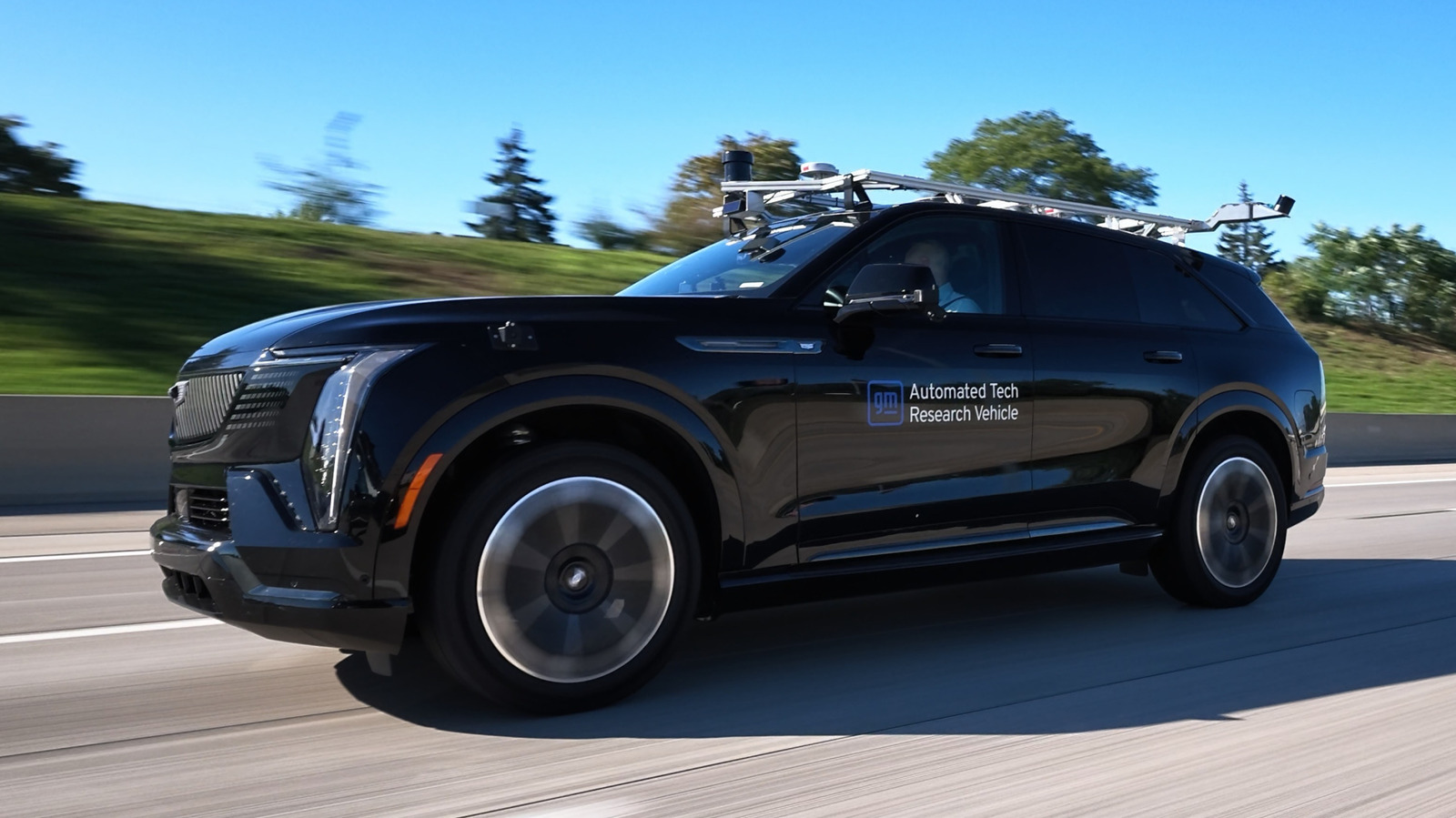
The first consumer application defines what GM means by eyes-off. In the updated Escalade IQ, the driver can legally stop monitoring the road on certain highways and watch video instead. That is a meaningful step beyond today’s Super Cruise, which is an SAE Level 2 hands-free system: it steers and maintains distance, but driver-facing cameras watch for eyes on the road and the human remains responsible at all times. Ford’s BlueCruise and Tesla’s Full Self Driving sit in the same category, a distinction that matters enormously when the marketing gets loose. The consequences of that gap were laid out in stark terms in our report on a Tesla Driver Asleep at the Wheel: FSD Crash Seriously Injures Two CHP Officers, a reminder of what happens when a Level 2 system is treated as something more.
The eyes-off system has not been given an official name. It builds on Super Cruise’s foundations but adds the hardware needed to take legal responsibility away from the driver, at least on defined roads.
Lidar, a 40x computer and a turquoise light strip
The hardware shows how far GM is prepared to go. Level 3 requires Lidar, which the camera and radar based Super Cruise does not use. The new cars get a liquid-cooled central compute unit that replaces multiple control units, runs autonomy, safety and propulsion, and is roughly 40 times more powerful than anything in today’s cars and trucks. GM says it has headroom to grow, which is the sort of claim every automaker makes and few can prove until the software arrives.
Then there is the human interface. A turquoise light strip across the dashboard signals when it is safe to disengage, following the colour convention the industry has settled on for automated driving states. GM has also considered lights in the door-mirror housings to warn other drivers what the car is doing, but legislation in some states does not currently permit them.
Three billion virtual miles a day
GM’s safety case rests on three piles of data. The first is simulation: its test stacks cover more than 3 billion virtual miles every day. GM frames that as the equivalent of 2.5 million vehicles each covering 1,200 miles around the clock, which is arithmetic rather than evidence: 2.5 million multiplied by 1,200 comes to 3 billion. The 50 mph average speed behind that conversion is GM’s own modelling assumption, not a measured figure. The second pile is real-world experience: Super Cruise has logged over 1.2 billion hands-free miles across nearly 750,000 vehicles since launching in 2017. The third is customer data, volunteered by thousands of owners who have opted in, used to build training models.
That is a substantial dataset, and the Super Cruise mileage in particular is a genuine asset. Virtual miles are still virtual miles, though, and the industry’s recent history is littered with systems that performed beautifully in simulation and then met a closed lane and a broken-down van at midnight.
No price, and a cautionary tale from Mercedes and BMW
Two caveats hang over the whole plan. The first is money: GM has not said what the system will cost buyers or users, whether as an option, a subscription or something else. Eyes-off driving needs Lidar, a far more powerful computer and redundant systems, and none of that is cheap. The second is demand. Only Mercedes and BMW have offered Level 3 assistance, and both have since reverted to hands-off, eyes-on systems, citing high cost and weak demand. If two of the world’s most engineering-led premium brands could not make Level 3 pay, GM’s plan to roll it into Chevrolet Silverados and three-row crossovers is a considerably bolder bet.
The wider context does not make it easier. GM has been retrenching on electric vehicles, as our report on how GM Shuts Detroit Battery Plant as EV Retreat Deepens set out, and a 2028 launch date for the flagship system leaves plenty of room for priorities to shift. The regulatory climate is moving too. In Europe, pressure from German authorities pushed Tesla into renaming its driver-assist software, a story we covered when Tesla Renames Full Self-Driving to ‘Tesla Assisted Driving’ in Europe After German Pressure. Names get scrutinised when the stakes are this high.
What to watch before 2028
GM deserves credit for committing to a date and a sequence rather than a concept video. The Escalade IQ’s eyes-off highway function is a concrete, checkable promise, and the compute and sensor hardware described is the real thing rather than a slide. But the company’s refusal to call its own system Level 3 should be read as positioning, not engineering. What matters between now and 2028 is whether GM publishes the operational domain where eyes-off is permitted, how it handles the handover when the car needs the driver back, what it charges, and whether regulators agree with its reading of the rules. Until then, the slogan and the statute book are two different documents, and only one of them will decide what the car is allowed to do.
We covered whittier tunnel alaskan highway in more detail elsewhere.