The powertrain: modest gains, meaningful efficiency
Under the bonnet sits an Atkinson-cycle 2.5-litre flat-four producing 162 hp (121 kW) and 209 Nm on its own, paired with two motor-generator units housed in the CVT. One handles stop-start duties and charging, while the second, rated at 118 hp (88 kW) and 270 Nm, drives the wheels and manages regenerative braking. Combined output is 194 hp (145 kW), a mere 14 hp up on the non-hybrid Wilderness.
The battery is a modest 1.1 kWh lithium-ion pack, tucked into the space where the spare tyre used to live. That preserves the same rear cargo volume as a regular Forester, but it does mean there is no spare wheel. Subaru’s symmetrical all-wheel drive retains a mechanical connection between the front and rear axles, a point of difference from some hybrid rivals that rely on a separate electric motor for the rear wheels.
Subaru has also revised the hybrid system across the whole 2027 Forester Hybrid range, adding drive-motor torque and smoothing the traction-control interventions. The headline figures are where the case for the hybrid is strongest. On US EPA testing it returns 33 mpg city, 29 mpg highway and 31 mpg combined, improvements of 9, 1 and 5 mpg respectively over the non-hybrid Wilderness. Expected range rises from 432 miles to 515 miles.
Off-road hardware that hasn’t been watered down
The Wilderness formula is intact. Ground clearance stands at 236 mm, the same as the petrol version, and the car rides on 235/60R17 Yokohama Geolandar all-terrain tyres. Raised roof rails are rated to 363 kg, and redesigned front and rear bumpers improve approach, departure and breakover angles.
X-Mode offers Snow/Dirt and Deep Snow/Mud settings, with hill-descent control engaged automatically when X-Mode is activated. Subaru says the system will hold descents of up to a 30 percent gradient without fuss. There is no locking rear differential, so the Wilderness relies on its electronics and traction rather than brute mechanical lockers. For a family SUV with genuine trail ability, that has always been a sensible compromise.
Cabin and equipment
Subaru has used the hybrid launch to improve standard kit. The heated steering wheel and heated outboard rear seats, previously extra-cost options, are now fitted as standard. There is an updated wireless phone charger that actually grips the phone, an 11.6-inch central touchscreen, a panoramic sunroof with a manually operated shade, and a camera button by the parking brake that calls up a front-facing view alongside X-Mode. The cabin also gets topographical-design door panels and a Wilderness crest on the headrests.
Not everything earns praise. The central screen is the same laggy, low-resolution unit found across the Forester range, the sunroof shade is awkward to reach, and the camera feed is low in resolution and prone to overexposure in bright light. These are familiar Forester complaints rather than new ones, but at this price they are harder to overlook.
On the road and off it
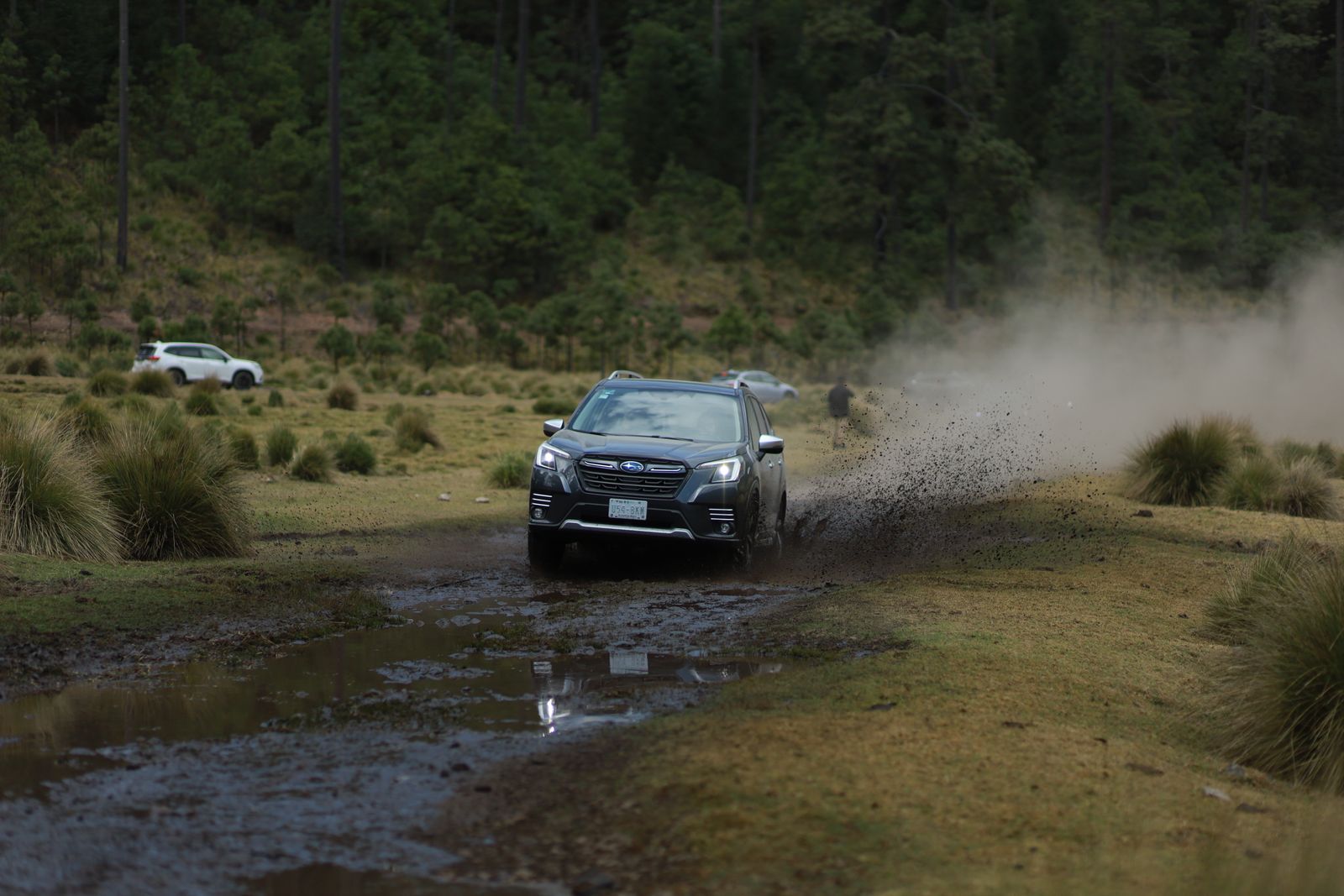
The traction motor is the star of the show when the going gets steep. It behaves like a winch on serious climbs, delivering torque instantly and letting the car creep up gradients with far less drama than a petrol-only model. Loose gravel and steep descents are handled with the same composure.
The brake blend between regeneration and friction braking is seamless, although the pedal is over-eager at the top of its travel. On tarmac, the low-speed torque boost is genuinely useful, but the sense of extra pace fades once you reach higher speeds. The engine note under load is grating, a reminder that this is a CVT-based hybrid rather than a silky inline-six. Ride quality is smooth, the seats are well padded if lightly bolstered, and visibility remains excellent.
Pricing and rivals
In the United States, the Forester Wilderness Hybrid starts at $42,020, a $1,000 premium over the non-hybrid Wilderness. Subaru claims that premium is recovered in about two years, or roughly 30,000 miles of driving, through fuel savings. That is a credible calculation given the 5 mpg combined improvement.
The obvious rival is the Toyota RAV4 Woodland at $42,250. It counters with 35 hp more and 38 mpg combined against the Subaru’s 31 mpg, so on paper the Toyota wins both the power and efficiency arguments. What it lacks is the Subaru’s mechanical all-wheel drive connection, and for buyers who take the off-road brief seriously, that matters. The market for ruggedised family transport is getting crowded, with the likes of the 2027 Mini Countryman Electric Gets Rugged Untamed Trim: Everything You Need to Know showing how far the styling-led end of the segment has spread.
Verdict: niche, but a good one
The Forester Wilderness Hybrid is not the obvious choice for everyone. If you want maximum efficiency from a Forester, the standard hybrid makes more sense, and if you want maximum power from a rugged compact SUV, the Toyota RAV4 Woodland has the edge. The Wilderness Hybrid exists for a narrower buyer: someone who genuinely uses the all-terrain tyres, the 236 mm of clearance and the X-Mode settings, but who also resents filling up every week.
For that buyer, the $1,000 premium is easy to justify. The fuel savings claim is credible, the off-road hardware is untouched, and the newly standard heated seats and steering wheel add real value. The weaknesses are inherited rather than introduced: a dated infotainment system, a noisy engine under load, and the loss of a spare tyre. None of them undermine the core proposition.
Subaru has built an off-roader that is noticeably more efficient than before, and in doing so has made the Wilderness trim easier to live with every day. The gains are modest, but they are in exactly the right places.