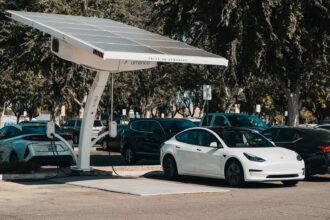
Ford has spent the past few years learning an expensive lesson about electric pickups: building a brilliant one is not the same as building an affordable one. The F-150 Lightning arrived to genuine acclaim and then ran into a wall of cost, demand and production reality. So the Blue Oval is taking a different route with its next battery-powered truck. The Ford Fathom will start at $28,350 when it goes on sale in the United States in the fourth quarter of 2027, and it pitches itself at buyers who might otherwise spend similar money on a three-year-old used Tesla Model Y. Those are US prices for a US launch, and Ford has not confirmed any UK availability. The strategy is pointed all the same. Most new EVs compete with other new EVs. The Fathom is going after the second-hand market instead.
Ford Fathom pricing: under $30,000, all the way to the high $30,000s
The headline figure keeps the Fathom among the cheapest EVs on sale in the US. Add the $1,595 delivery fee and the entry price still lands below $30,000. Ford is not treating that number as a loss-leader curiosity either. Andrew Frick, president of Ford Blue and Model e, was clear that the range extends upward without breaking the $40,000 barrier.
“The starting price of the $28,350 is just that,” he said. “We’ll have a range that goes to the high $30,000 range. And we’ll have a couple of different offerings within that.”
What Ford has not confirmed is whether the high $30,000s refers to the starting price of upper trims or a fully loaded truck. The company says more detail will follow closer to launch, which leaves room for the usual trim-level surprises. Battery sizes, range figures and charging speeds are all still under wraps. For a truck whose entire pitch rests on affordability, the range number will matter enormously: a cheap EV that cannot comfortably cover a long highway run is a hard sell to anyone trading in a diesel.
Launch timing and the UEV platform
Jim Farley has confirmed the Fathom remains on track for a Q4 2027 launch. Pre-orders open in early 2027, with first deliveries due late in the same year. Ford has not yet given specific months for either. That timeline makes it the first production vehicle on Ford’s Universal Electric Vehicle platform, a dedicated architecture designed from the outset to bring costs down rather than adapt an existing combustion chassis.
The UEV programme is the technical heart of the affordability story. Ford has been candid that its first-generation EVs were engineered expensively, and the Fathom is the corrective. If the platform delivers on its cost targets, it will underpin a family of cheaper Fords rather than a single halo model. We have covered the background in more depth in our guide to the Ford Fathom: Everything We Know About Ford’s Sub-$30,000 Electric Pickup.
What the Fathom actually is
Strip away the pricing and the Fathom is a midsize electric pickup, not a full-size one. Ford claims it offers more interior space than a Toyota RAV4, excluding the frunk and the truck bed, which suggests a cab-forward design that makes the most of a compact footprint. That is a sensible play in a market where the Cybertruck and Lightning have both struggled to convert size into sales momentum. The wider picture is covered in our Electric Pickup Reality Check: Tesla Cybertruck Leads as US Sales Stall.
Under the skin, Ford is using a zonal electrical architecture and a 48-volt system to cut cost and complexity. Fewer wiring harnesses, fewer ECUs and simpler assembly all feed into the sticker price. It is unglamorous engineering, but it is exactly the kind of unglamorous engineering that decides whether a cheap EV is genuinely cheap or merely subsidised.
Charging, tech and the NACS decision
The Fathom will use an NACS charging port, and a prototype has already been spotted at a Tesla Supercharger. Adopting Tesla’s connector removes the need for an adapter and opens up the largest rapid charging network in the US. Bidirectional charging is also confirmed, allowing the truck to power a home during an outage or offset energy costs. For buyers weighing up a used Model Y, that home-backup capability is a genuine differentiator rather than a spec-sheet nicety.
Inside, Ford is promising a large touchscreen with simple navigation, though the interior has not been revealed. Every Fathom will be BlueCruise-capable, meaning hands-free driving on mapped highways is available across the range rather than reserved for top trims. Apple CarPlay and Android Auto are standard, and Apple Maps will be embedded directly into the navigation system. Farley described the Apple Maps integration as “a game changer for any EV,” a notable compliment given how often carmakers try to lock owners into their own software.
Farley’s verdict
Chief executives are paid to be enthusiastic about their own products, so Farley’s praise is best read as colour rather than evidence. Even so, his account of driving a Fathom prototype is unusually specific. He said the truck “completely blew me away,” citing 0-60mph performance, interior room and the hands-free driver assistance experience as “something I’ve never experienced.”
He went further, calling the Fathom a “breakthrough product” that is highly capable and affordable, with an MSRP under $30,000 and running costs suited to the current market. The acceleration claim is the one to watch. Electric pickups have a habit of being quick in a straight line, but quick and cheap rarely arrive together. If Ford has managed both at this price, the Fathom will deserve the label.
The subscription question hanging over the Fathom
Ford is not hiding where it sees future revenue. Farley called the digital suite, embedded Apple Maps included, “the most exciting upsell opportunity” and “really the long-term subscription and digital experience for the customer.” Ford already has 1.7 million customers paying for subscriptions across Ford Pro, BlueCruise and other digital services, up 40 per cent year on year. Farley also noted that retail customer retention can be up to 9 percentage points higher when a software subscription is part of the relationship.
The open question is how much of the Fathom’s technology is included in the purchase price and how much is billed monthly. BlueCruise-capable is not the same as BlueCruise-included. Buyers tempted by the entry price should read the small print on what switches off after the trial period, because a cheap truck with a long list of monthly add-ons stops being cheap fairly quickly.
What the used Model Y comparison means for buyers
Ford’s central claim is that the Fathom will cost less to own over five years than a three-year-old used Tesla Model Y. That is a deliberately awkward comparison for the competition. A used Model Y is the default entry point into electric motoring for a lot of buyers who cannot stretch to a new EV, and Ford is arguing that a new truck with a full warranty, a fresh battery and home-backup capability beats a second-hand crossover with an ageing pack.
The claim is plausible on paper but impossible to verify yet. Five-year ownership costs depend on residuals, insurance, servicing and electricity prices, none of which are settled for a vehicle that has not been built. The comparison also assumes buyers are cross-shopping a pickup against a crossover, which is not always how people shop. Ford’s argument is strongest on warranty and battery health, and weakest on the assumption that the two vehicles sit in the same consideration set. Treat the five-year figure as a marketing target until independent cost data exists.
The Fathom lands in a US market where electric pickups have yet to deliver on their promise. Ford’s bet is that affordability, not novelty, is what finally cracks the segment. On the evidence so far, that is a more credible strategy than another six-figure flagship. The real-world range figure will decide whether the Fathom is remembered as the truck that made electric motoring ordinary or just another promising concept with a deposit button.
Related: ford fathom electric pickup.