
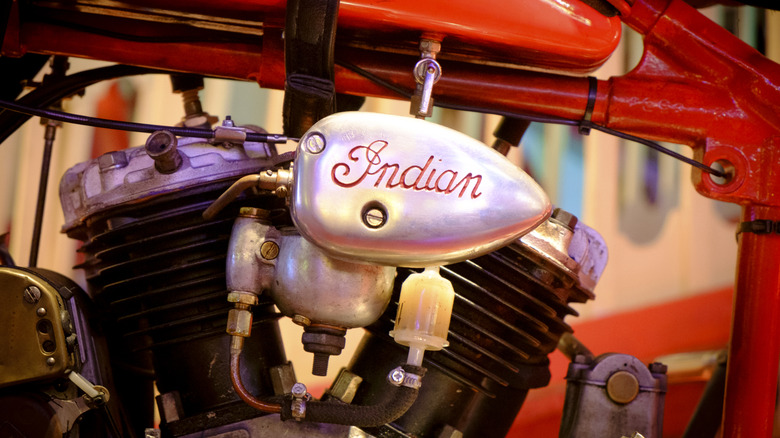
Two American performance stories have been doing the rounds this week, and they sit at opposite ends of the same century. One concerns the earliest machines built by Indian, the company that called itself America’s first motorcycle maker and spent its first decade arguing about how many bikes it had actually produced. The other concerns the muscle truck, a genre Detroit invented, perfected and then quietly walked away from.
Both are American stories, and both have a foothold in Britain: early Indian material has traded through British auction houses for years, and the performance pickup has a small but committed following here despite never being sold in right-hand drive in meaningful numbers. Neither is a UK market story, and the prices below are American unless stated otherwise. What connects them is a pattern worth setting out plainly: the machines that become collectible are rarely the ones that sold best. They are the ones surrounded by doubt.
Indian’s Beginnings and the 1903 Camelback
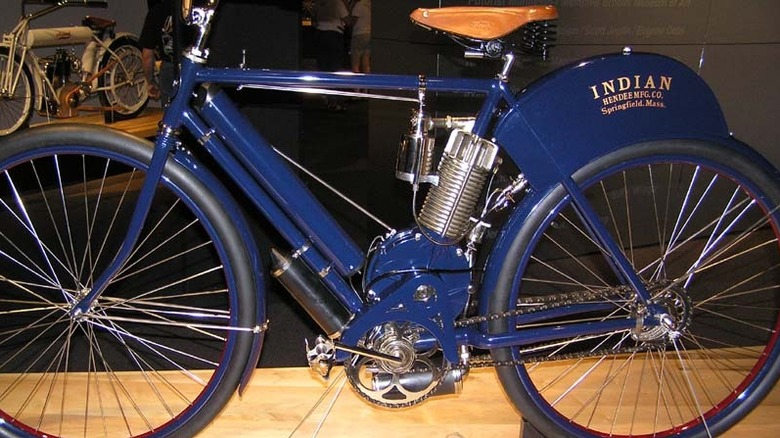
George Hendee founded the Hendee Manufacturing Company in Springfield, Massachusetts, in 1897, initially building bicycles. He hired engineer Oscar Hedstrom in 1901, and the pair presented their first motorcycle prototype to the public on 1 June 1901. It reached the streets in 1902.
The Camelback, as the early model became known, drew its power from a 2hp air-cooled single-cylinder four-stroke of roughly 213cc (13 cubic inches). The engines came from the Aurora Automatic Machinery Company of Aurora, Illinois, while the frames were built back in Springfield. The bike sat on a diamond-shaped steel bicycle frame, and the fuel tank was mounted at the rear in a distinctive hump, which is where the name came from.
Hedstrom rode one to a world motorcycle speed record of 56mph in 1903, a figure that says as much about the state of motorcycle engineering at the time as it does about Indian’s ambitions. By 1905 the Camelback had gained a sprung front fork and a twist-grip throttle and ignition, two features that would become industry standard.
Then there is the matter of production. The National Motorcycle Museum has claimed that just 1,000 examples were built between 1902 and 1905. A Bonhams listing, by contrast, states that 1,182 were built in 1905 alone. Those two figures cannot both be right, and the gap between them is the kind of thing that keeps collectors awake at night. Indian went on to become the world’s largest motorcycle manufacturer during the 1910s, building 32,000 bikes in 1913, before closing in 1953.
An unrestored Camelback sold in England for £40,250 in 2015, a reminder that early Indian material has long since crossed the Atlantic in both directions and that British salerooms are one of the places it surfaces.
The Indian 841: The Military Motorcycle the Army Didn’t Want
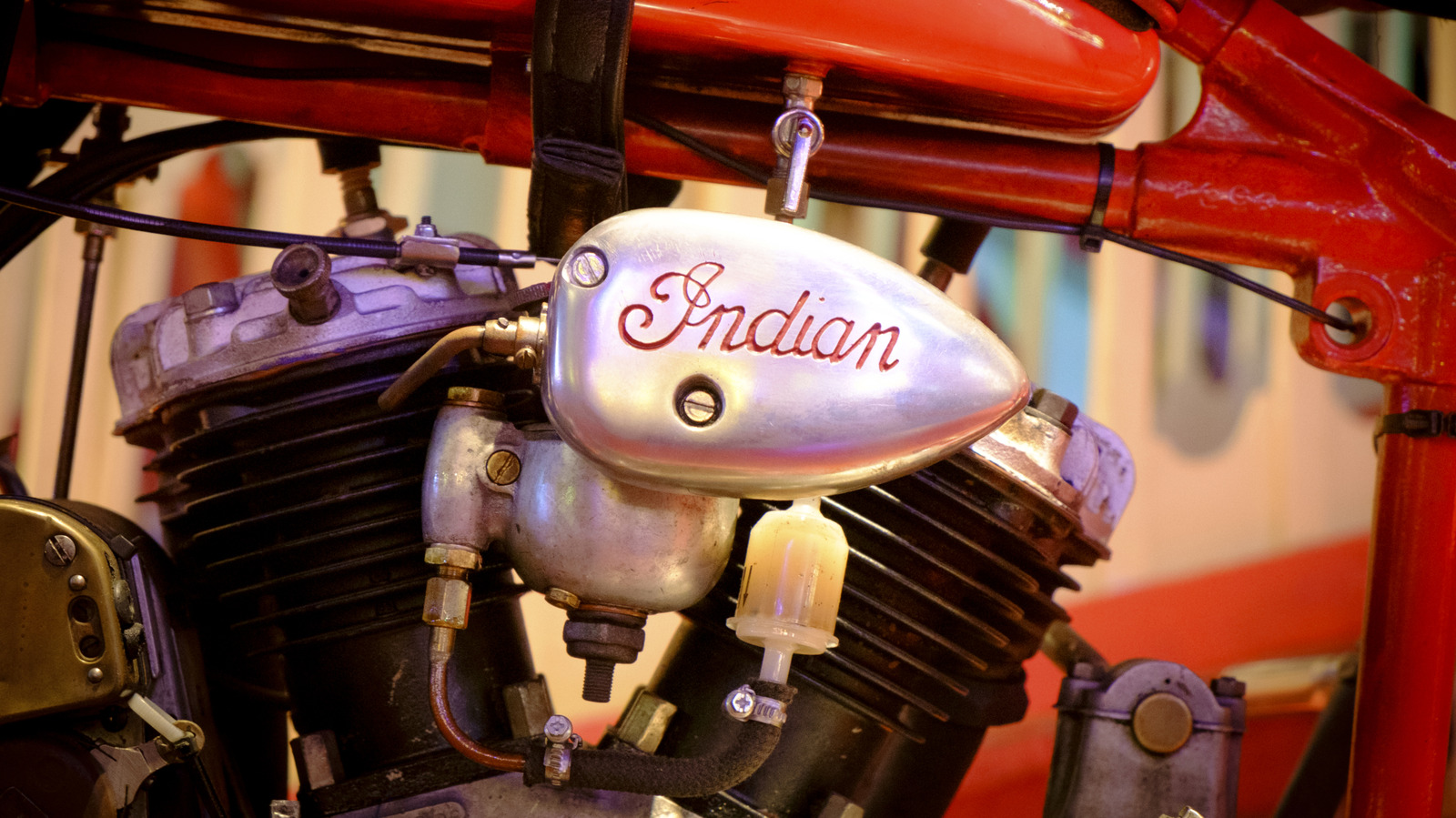
If the Camelback shows Indian at its most inventive, the 841 shows the company at its most overqualified. In 1941 the U.S. Army commissioned Harley-Davidson and Indian to design motorcycles for desert warfare in North Africa. Harley’s response was the XA, a close copy of BMW’s R71. Indian went its own way.
The 841 used a 45-cubic-inch (738cc) 90-degree side-valve V-twin with a longitudinal crankshaft, positioned for maximum air cooling. Compression was set at a low 5.1:1 so the engine could run on poor-quality fuel. It had a four-speed foot shift, an enclosed driveshaft, a girder front fork with coil springs and shocks, 8-inch drum brakes, plunger rear suspension and rubber-mounted handlebars. On paper it was a thorough piece of engineering.
The Army rejected both it and the Harley XA, choosing Jeeps instead. Indian built around 1,000 prototypes, possibly as many as 1,056, and none were deployed. Bonhams notes that surplus examples sold for roughly $500 each around 1945, and that fewer than 100 complete bikes survive today.
One of them was owned by E. Paul du Pont, Indian’s president from 1930 to 1945 and the man credited with saving the company during the Great Depression. That bike is held at the Hagley Museum. It is a strange afterlife for a machine the military decided it did not need: preserved not because it succeeded, but because it failed so completely and so rarely.
How the Muscle Truck Era Began, and How It Ended
The muscle truck followed a similar arc of invention and abandonment. Dodge’s Li’l Red Express laid the foundation, and the Chevrolet 454 SS and the original Ford F-150 SVT Lightning shaped the segment that followed. These were street machines first and work vehicles second, which was precisely the point.
Then came the 2010 Ford F-150 Raptor. It pushed the market towards off-road performance and, on the reading of the original feature, largely killed off the street-focused performance truck. Buyers who wanted a fast pickup were now sold one that could also jump a dune, and the goalposts moved. The same piece argues that the only current option in that vein is the Hellcat-powered 2027 Ram 1500 Rumble Bee, quoted at under $63,000 in the United States for the base version and approaching $100,000 for the desirable one. That is a future model year, so treat those figures as reported US pricing rather than a confirmed showroom sticker.
Dodge Ram SRT-10: Viper Power in a Pickup
The SRT-10 remains the high-water mark. An 8.3-litre, 500hp V10 derived from the Dodge Viper made it the biggest-displacement engine offered in a new truck at the time. It hit 60mph in 5.2 seconds, and a quad cab version followed in its second model year.
Values, though, are all over the place. Cars & Bids sold one for $30,000 in June and another for $27,250 in August, while the CLASSIC.com Market Benchmark sits closer to $41,000. That spread tells you the market has not settled on what these trucks are worth, which is often the sign of a modern classic still finding its level.
Second-Generation Dodge Dakota R/T: The Compact V8 Outlier
The Dakota R/T occupies stranger ground still. Dodge was the only manufacturer at the time offering a compact truck with a V8, a 5.9-litre Magnum unit making 250hp and 345 lb-ft of torque. Hot Rod recorded a sub-15-second quarter mile but noted that the power struggled to reach the ground.
Auction results reflect that ambiguity. Bring a Trailer sold one for $15,250 and another for $8,800 last year, with CLASSIC.com estimates telling a similar story. A truck that was genuinely unique in its class, and genuinely compromised in its execution, is now priced accordingly.
Ford F-150 Lightning: The Original, and the Nameplate’s Electric Rebirth
The original Lightning earned its cult status partly through screen time, appearing in The Fast and the Furious delivering parts for The Racer’s Edge. The name was later revived for an electric pickup, a move that disappointed some enthusiasts who felt the badge belonged to a supercharged V8 and nothing else.
That disappointment is itself instructive. Enthusiast communities do not simply value performance; they value continuity of meaning. When a nameplate is reassigned, the original becomes more desirable, not less. It is the clearest mechanism in this whole story, and the one most often mistaken for nostalgia.
The same instinct drives interest in limited-run specials from the same era. The Ford Mustang Mach 1 Twister Special: The 96-Car Rarity That Never Went National began not as a Ford marketing exercise but with a property developer named Larry LoPatin, who owned a string of racetracks and wanted promotional cars to shift tickets. Scarcity born of circumstance, rather than strategy, tends to age well.
At the other end of the restoration spectrum sits the Revology Mustang Boss 302: The $400,000 Restomod That Outruns the Original, which raises a separate question about whether a machine that never rusted can ever carry the same weight as one that did.
What Scarcity, Disputed Records and Shifting Tastes Say About Collectability
Three forces keep surfacing, and none of them is a prediction. Scarcity of the accidental kind, where the 841 survives because the Army said no rather than because anyone planned it. Uncertainty that turns into volatility, as the SRT-10 and Dakota figures show. And taste, which does not make a machine worse, only unfashionable, and unfashionable machines get cheap before they get expensive.
What that leaves is a description of how American performance history keeps sorting itself: the rejected prototype outlives the production model, the compromised outlier finds a buyer, and the machine nobody wanted becomes the one nobody can find.




One Comment