Jaclyn McQuaid has spent her career around trucks, so when the woman who launched General Motors’ heavy-duty pickup programme was asked what she would say to a diesel loyalist wary of electric trucks, her answer carried more weight than the average executive soundbite. Her verdict: “I think there is a huge application for electrification in the truck space, huge application in the truck space.”
She said it on The Drivecast, repeating the phrase for emphasis. It is a striking position to take at a moment when electric pickups are widely reported to be struggling to find buyers. But McQuaid, GM’s Senior Vice President of Vehicle Products, is not arguing that the battery will bury the diesel. Her pitch is subtler, and it rests on a simple claim about corporate identity.
‘We know trucks’
McQuaid framed electrification as an extension of GM’s core competence rather than a departure from it. “I actually see them working together really well, and what you have to remember about General Motors is we know trucks,” she said.
She went further, arguing that the propulsion method does not change what the company is: whether a truck is “propelled by a diesel or a gas engine or whether it’s propelled by an electronic propulsion in battery, we know trucks.” That last phrase is her wording, not an engineering term. GM, she added, will “continue to develop the EV technology.”
That framing matters. For years the electric pickup conversation has been conducted as a contest, with battery power cast as the challenger to diesel’s crown. McQuaid’s version is a household with room for both, at least while the market works out what it wants.
The engineer behind the message
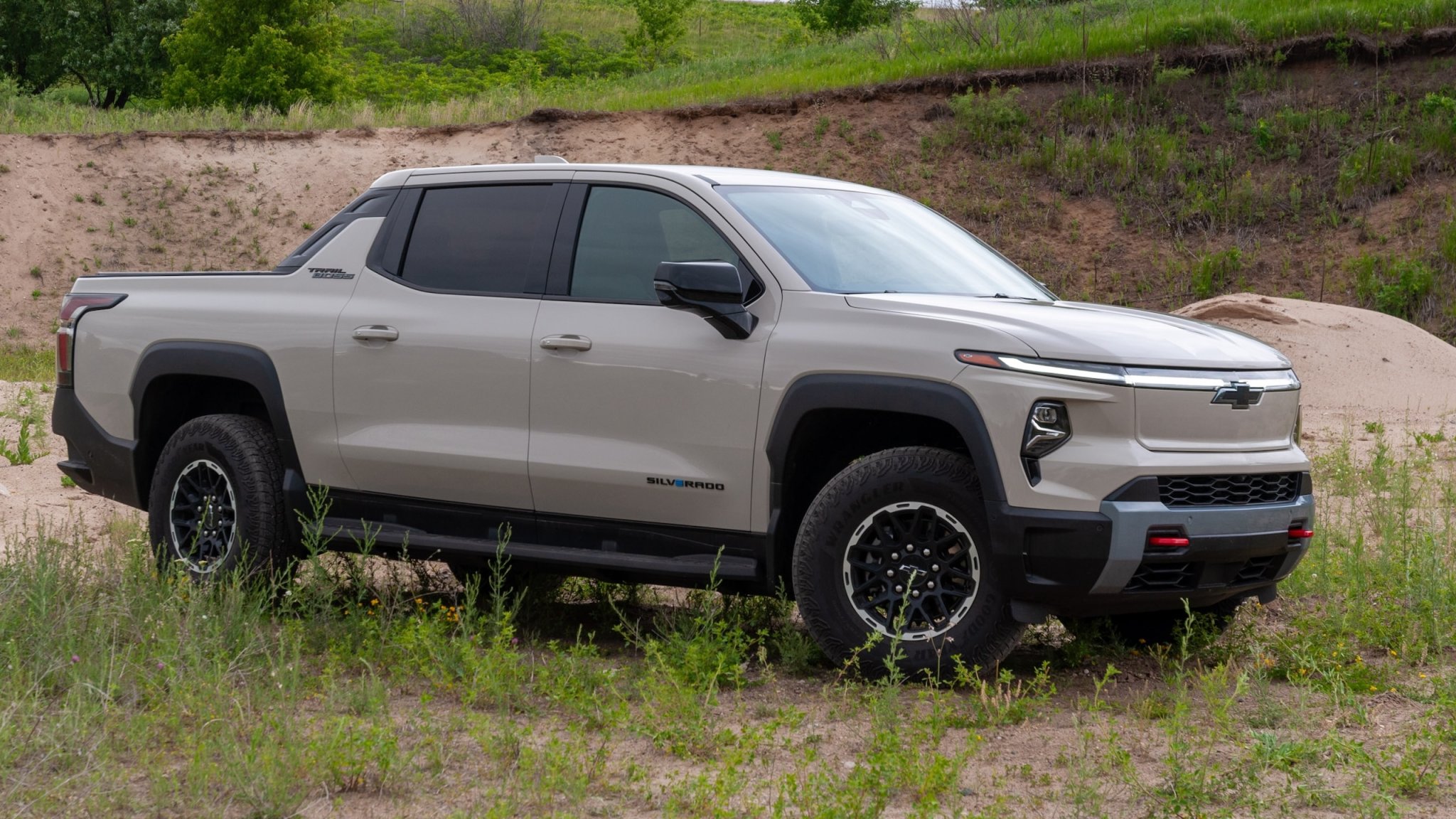
The credibility of that message rests heavily on who is delivering it. McQuaid’s route through GM ran through the unglamorous parts of truck engineering: exhaust, tyres, wheels, brakes and seats. Those are the systems owners notice every day, and the ones that decide whether a vehicle feels durable after a decade of hard use. She went on to become the company’s first chief engineer for heavy-duty trucks, launching the programme GM calls T1, the architecture behind its current heavy-duty pickups, and she has lived with the electric product too, spending a year driving a Silverado EV and describing the range of GM’s current electric trucks as “incredibly impressive.” In other words, the person making the case for electric trucks is the same person who signed off on some of GM’s most capable diesel machines, and she has put real miles on the alternative.
Off-board power and the towing equation
Asked to make the case, McQuaid did not lead with acceleration or styling. She led with utility. She cited “off-board power that it can provide, running a job site, running your home” as a major part of the argument.
That is a genuinely truck-shaped benefit. A pickup that can power tools on site, or keep a house running during an outage, does something a diesel truck cannot do without a separate generator. For tradespeople and rural households, that capability may matter more than a 0-60mph time.
The second plank is battery progress. “We’re continuing to make advancements in battery technology, in energy density, in range, in cost. With that increase in range and performance comes increase in towing,” she said.
Towing is the traditional weak point of electric pickups, the test that separates a lifestyle vehicle from a workhorse. McQuaid’s argument is essentially that this is an engineering problem in active retreat rather than a permanent limitation. More energy density and lower cost per kilowatt hour translate directly into more miles with a trailer attached.
Charging is not the deal breaker
The obvious objection is infrastructure. A diesel pickup refuels in minutes almost anywhere; an electric one depends on a charging network that is uneven at best and, for a truck towing a trailer, often awkward.
McQuaid acknowledged that the network has ground to cover but rejected the idea that trucks and electrification are incompatible. “I think the infrastructure is going to continue to develop as we continue to develop, but I do not see those two things as mutually exclusive, the truck space and electrification,” she said.
It is a reasonable position in the abstract. It is also the point where the argument runs into the market. Fleet buyers plan around today’s infrastructure, not tomorrow’s, and a contractor who cannot reliably charge between jobs will stay with diesel regardless of how good the truck is.
A strategy briefing and an awkward sales picture
The timing of McQuaid’s remarks is telling. They came on the Wednesday that GM’s executive team laid out its future in New York, with the company stating that its end game is electric vehicles.
That is an awkward message to deliver while electric truck sales remain weak. GM has already made painful adjustments to its electrification plans, including the decision to close its Brownstown Battery Assembly plant near Detroit, as we reported in our coverage of GM Shuts Detroit Battery Plant as EV Retreat Deepens.
Set that against a senior engineer insisting there is a “huge application” for electrification in trucks and the picture is one of a company managing two timelines at once. The long-term destination is electric. The near-term reality is that customers are not moving as fast as the strategy assumes. The gap between the two is where the scepticism belongs, and it applies as much to the sales charts as to the charging network.
What comes next for GM’s trucks
The next wave of GM trucks will get the automaker’s new central computer, a shift that consolidates the dozens of electronic control units scattered through current vehicles into far fewer, more powerful brains. That architecture is the foundation for everything else.
Full-size pickups are next in line for GM’s eyes-off highway driving system, following the 2028 Cadillac Escalade IQ in the US. The staged rollout will let drivers stop monitoring the road on defined motorways while the vehicle handles the task, a plan we examined in GM’s Eyes-Off Highway Driving Coming in 2028: Inside the Plan to Skip Level 3. Handing long motorway stints to the truck is a plausible selling point for the high-mileage drivers who buy full-size pickups.
Less clear is when GM’s next-generation EV technology will reach its electric trucks. No timeline has been given for lithium manganese-rich batteries, a chemistry GM has promoted as a route to lower cost and greater density. Until that lands, the towing and cost improvements McQuaid describes remain a promise rather than a specification.
What GM’s truck-first EV message means for the heavy-duty debate
The significance of McQuaid’s intervention is less about any single claim and more about who is making it. The engineer who built GM’s heavy-duty programme is not treating electrification as an invading force. She is treating it as the next chapter of a discipline the company already dominates.
That is a more honest argument than the ones that cast electric pickups as diesel killers. It concedes that the two will coexist, that infrastructure needs time, and that battery chemistry has to improve before a towing-heavy buyer is convinced. It also quietly accepts that the heavy-duty diesel pickup is not going anywhere soon, whatever the end game says.
GM’s message, delivered by the person best placed to know, is that it intends to be credible in both camps. Whether the market rewards that patience is the question the next few years of electric truck sales will answer. The company has bet its truck expertise, not its marketing budget, on being right.
We covered used midsize pickup trucks in more detail elsewhere.
We covered electric pick trucks ranked in more detail elsewhere.