The Golden Steering Wheel: how the awards work
The Golden Steering Wheel has been German motoring’s most closely watched prize for half a century, and its 50th edition has delivered a genuinely interesting result. Run by Auto Bild, the sister title of Auto Express, the awards are a German-market prize rather than a British one, and they are not decided by a small committee in a boardroom. They begin with readers, who voted to create a shortlist from 79 models, with the three most-voted cars in each of nine main categories progressing to the finals. From there, a 23-member judging panel of racing drivers, car journalists and industry figures put the contenders through extensive testing at the Lausitzring, scoring them against a 19-point criteria list that runs from handling and performance to everyday usability.
There is no single overall winner, which is part of the appeal. Instead, the trophies are split across categories, and the 2026 honours tell a story of two brands in particular. Skoda landed a pair of electric wins with the Epiq and the Peaq, while BMW took the headlines thanks to a reborn i3 and an M2 CS that proved fast petrol coupes still matter to the people doing the judging.
Skoda Epiq: small SUV, big impression
The Epiq is Skoda’s new compact electric SUV and the car charged with bringing the brand’s sensible, keenly priced formula to the compact EV class. On first drive, Auto Express awarded it 4.5 stars out of five, singling out its value, handling and styling for praise. That combination is harder to pull off than it sounds. Plenty of small electric SUVs get the price right and the driving experience wrong, or vice versa, and the Epiq apparently manages both without looking like a white goods appliance in the process.
Its win is also a marker of how seriously the Volkswagen Group is taking the small electric segment. The Epiq is part of a broader push that includes the ID. Polo and Cupra Raval, a trio examined in our piece on VW Group’s Small EV Gamble: ID. Polo, Cupra Raval and Skoda Epiq Set for 2026. If that gamble pays off, the Epiq’s Golden Steering Wheel will look like an early signal rather than a one-off.
Skoda Peaq: the biggest Skoda yet makes it two
Skoda’s second win came from the opposite end of the range. The Peaq is the brand’s largest model to date, a family SUV with vast interior space and a decent range on a full charge. Where the Epiq won on price and polish, the Peaq impressed the judges with sheer size and the kind of long-legged usability that matters to families covering big distances. It is the roomiest car Skoda has ever built, and it wraps that space in an electric package that does not ask for sacrifices on range.
Two wins in one year is a notable result for any manufacturer, and it underlines how quickly Skoda has moved from the value alternative to a genuine force in the electric market. The Peaq’s combination of space and usable range is exactly what buyers moving out of large petrol SUVs tend to ask for first, and the judges clearly found little to fault in how it delivers both.
Kia K4: petrol still has a seat at the table
Among the electric winners, the Kia K4 stood out for the simplest of reasons: it runs on petrol. The all-new hatchback, which has also spawned a practical estate version described as excellent value, flew the flag for combustion in a year when Kia’s EV line-up has been expanding rapidly.
That a petrol hatchback earned a trophy alongside the electric heavyweights says something about how the judges approach the awards. The criteria are about how well a car does its job, not which powertrain it uses. The K4’s win is a reminder that for buyers without charging access, or simply without the budget for an EV, a well-executed petrol car remains a thoroughly rational choice. The estate version in particular looks like the kind of honest, useful family car that has become rarer than it should be.
BMW i3: the name returns, and everything else changes
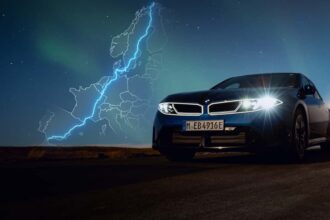
Few badges have been recycled with as much intrigue as the i3. The original was BMW’s pioneering small electric hatch, a distinctive early electric car that was ahead of its time and never quite found the audience it deserved. The 2026 i3 is a completely different proposition. It sits on the same platform and uses the same technology as the iX3, the first BMW Neue Klasse model, which means the badge now sits on a conventionally packaged, tech-rich saloon rather than an experiment.
Auto Express gave it five stars out of five, praising its driving dynamics, its looks and a range of up to 566 miles on the WLTP test cycle. That range figure is the headline number, and it puts the i3 firmly among the long-distance electric saloons that have made range anxiety look increasingly old-fashioned. The Neue Klasse platform has already made its mark on the SUV side, as our coverage of the new BMW iX5 revealed: 528-mile electric X5 arrives with 460kW charging shows, and its arrival under the 3 Series is arguably the more consequential moment. The electric saloon market now has a proper fight on its hands, and we have compared the i3 directly with its closest rivals in BMW i3 vs Mercedes C-Class Electric vs Hyundai Ioniq 6: Which New Electric Saloon Wins?
BMW M2 CS: proof that fast coupes still count
If the i3 represents BMW’s future, the M2 CS is a loud, six-cylinder argument that the old ways still have merit. The judges described it as expensive and busier-looking than the version it replaces, but also as a fantastically exciting sports car. It is a small coupe with a powerful six-cylinder engine, and it rewards the kind of driving that is getting harder to enjoy on crowded roads.
The M2 CS is not a sensible purchase, and it is not meant to be. Its win matters because it shows the Golden Steering Wheel panel is not simply ticking boxes for electrification. A car can be costly, visually challenging and entirely impractical, and still take home a trophy if it stirs the people who test it. In a year dominated by EVs, that is worth noting.
What the 2026 winners say about the market
Look at the list as a whole and the message is straightforward: electric cars took the top prizes, but the Kia K4 and BMW M2 CS prove the awards are not a simple referendum on powertrains. Value, driving pleasure and sheer competence still carry weight, whether the engine burns petrol or runs on electrons. The full list of winners is available via Auto Bild.
Related: bmw 838bhp electric super.
Related: bmw sets electric record.