
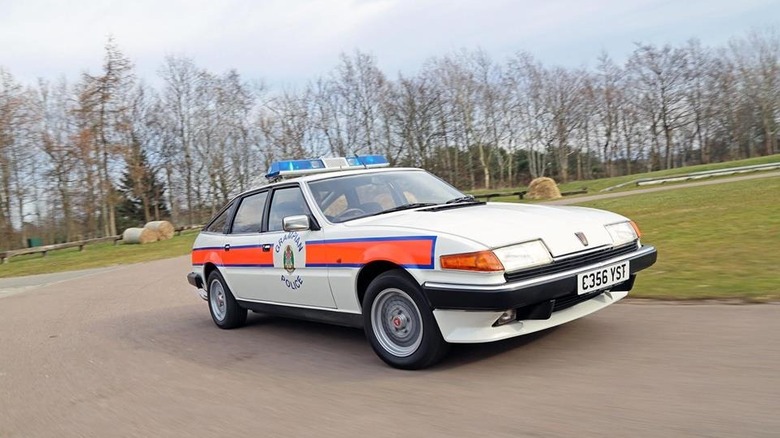
What Was a Jam Sandwich Police Car?
The formula was almost absurdly simple. Take a white (occasionally silver) police car, run a bright fluorescent red-orange stripe down each side, and send it out on patrol. That’s it. Forces began adopting the design from the 1970s onwards, replacing a patchwork of earlier schemes that varied from one constabulary to the next. Adoption was never uniform, and some forces moved across from black-and-white cars rather than blue-and-white, but the red stripe gradually became the visual signature of British policing.
The nickname came from the way the colour scheme read at speed. A white car with a bold red band along its flanks looked, from a distance and in a hurry, like a jam sandwich. The comparison was made often enough, and with enough relish, that it stuck almost immediately.
What made the livery clever was its dual purpose. It was cheap to apply, easy to read in a rear-view mirror, and distinctive enough that you knew exactly what you were looking at before the blue lights even came on. It wasn’t subtle, but it didn’t need to be.
How the Nickname Spread and Faded
The jam sandwich didn’t stay confined to police stations and road signs. It entered mainstream popular culture through use in various TV shows, and once a nickname turns up on screen it tends to lodge itself in the language. Drivers who had never been pulled over still knew what a jam sandwich was.
Its decline was just as gradual. The livery was replaced by the yellow-and-blue squared “Battenburg” design, a high-visibility pattern that was harder to mistake and easier to see in poor light. As the red stripe disappeared from the roads, so did the phrase from everyday speech. The design that replaced it was arguably better, but it never picked up a nickname half as good.
That’s the way with British motoring slang. It comes and goes with the cars themselves. A “Chelsea tractor” is still a Chelsea tractor, a “sleeping policeman” is still a sleeping policeman, and the jam sandwich survives largely as a memory. Language and livery rise and fall together.
The Rover SD1 Years
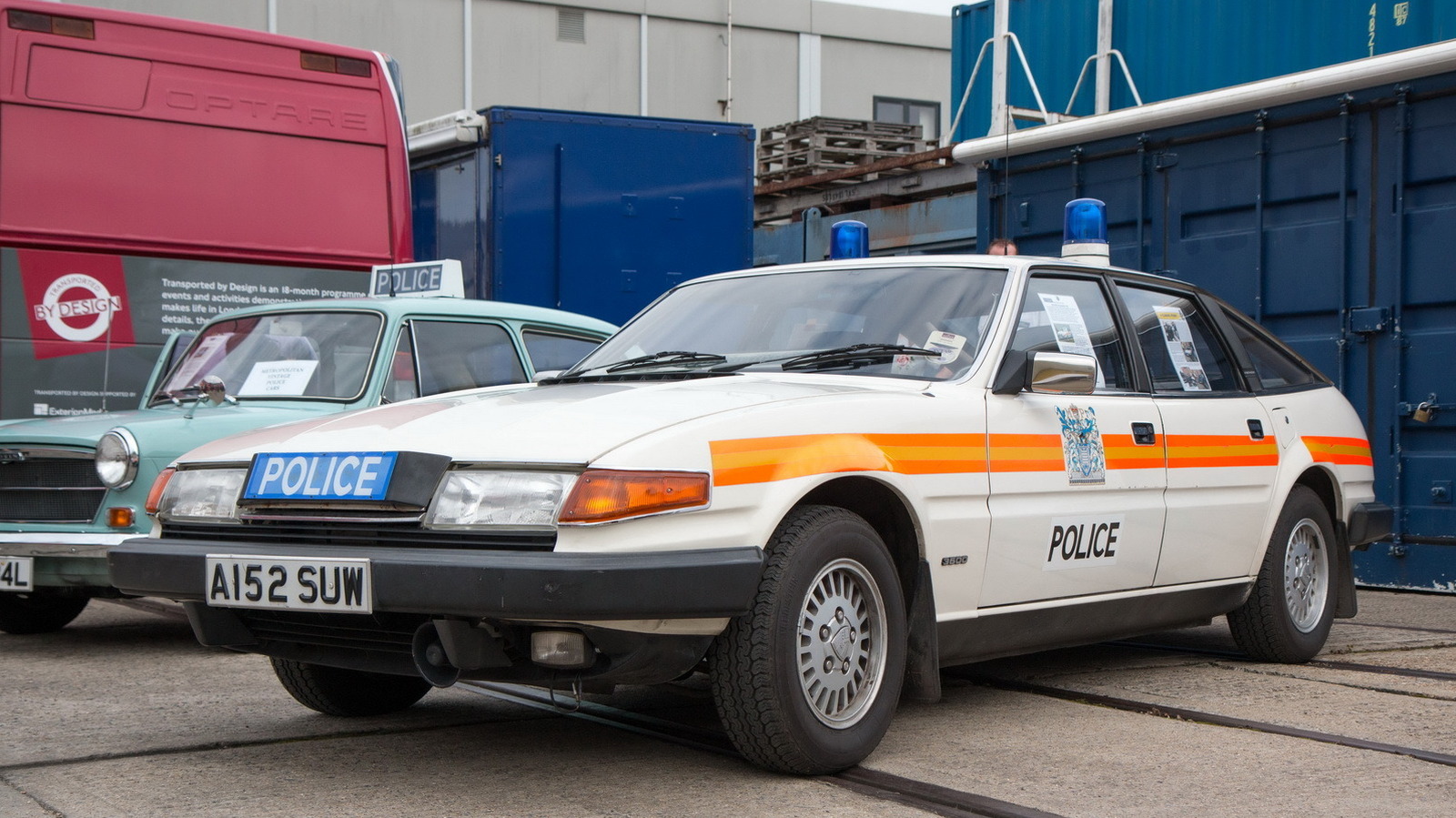
If the jam sandwich livery gave the police a recognisable uniform, the Rover SD1 gave it an unlikely performance edge. Under the bonnet sat a naturally aspirated 3.5-litre V8, which made the SD1 arguably one of the most exciting cars ever used in British policing. This was a big, rear-driven saloon with genuine pace, the kind of machine that could hold its own on a motorway and looked the part doing it.
On paper, the SD1 should have been a legend. In practice, it was a car with a split personality. The V8 was glorious, but the electrics were a recurring nightmare and the corrosion was severe enough to become a genuine liability. There’s a certain irony in the fact that these V8 jam sandwiches were, in reliability terms, probably less useful than the humble patrol cars that had preceded them. A police car that won’t start is no police car at all, however good it sounds.
The SD1 years are remembered fondly precisely because they were so contradictory. A brilliant engine, a handsome shape, a livery that became iconic, all undermined by the sort of build quality that made BL a byword for frustration. It’s the same tension that runs through so much of the era’s motoring. Enthusiasm and engineering ambition, undone by the details.
Before the Jam Sandwich: The Panda Cars
Long before the red stripe arrived, British forces had another nickname to contend with. In the 1960s, the police fleet leaned on the Austin A40, a modest machine powered by a 1,098cc engine and finished in black-and-white. The colour scheme earned it the “panda car” tag, and it became the everyday face of local policing.
These weren’t pursuit vehicles. They were the practical, economical backbone of the beat, and they reflected a very different philosophy of policing by car. That said, the pursuit side of the job was being taken seriously even then. From the 1930s, British racing drivers were asked to coach police drivers, a recognition that catching a suspect on the road was a skill in its own right. The lineage runs from those early lessons straight through to the advanced driver training that modern forces rely on.
The Fleet’s Odd Couples
The jam sandwich era was never just about V8 saloons. Britain’s police fleet back catalogue is a wonderfully strange mix, and the contrast tells you a lot about how forces actually bought cars.
At one end you had diesel Vauxhall Astras, sensible, frugal and entirely unglamorous, plus the Proton Impian, a car that has probably never been described as exciting by anyone. These were the workhorses, and there were far more of them than there were headline-grabbers.
At the other end, some genuinely fast metal did make the cut. The Lexus IS-F and the final-generation Mitsubishi Lancer Evo models found their way into service, though these were seldom, if ever, seen in actual use. They were the exception, the showpiece, the car that turned up at a school fete rather than a motorway pursuit. That gap between what a fleet contains and what actually patrols the roads is one of the more honest quirks of British policing.
Jam Sandwich vs the World
Set against the rest of the world, Britain’s police fleet looks positively restrained. Italy has famously used Lamborghinis, Dubai has put Bugattis and Ferraris into service, and the United States has a long tradition of proper pursuit hardware. Those are the cars that end up in posters.
Britain, by contrast, did its high-speed work with a Rover and its everyday work with a diesel Astra. There’s something admirably practical about that. The jam sandwich wasn’t trying to win a supercar contest. It was trying to be seen, and it was very good at that.
Why the Jam Sandwich Still Matters
The jam sandwich police car endures because it captured something about British motoring that’s hard to pin down. It was modest, slightly improvised, and given a nickname that was affectionate rather than mocking. It wasn’t the fastest or the most reliable car on the road, but it was instantly recognisable.
The SD1 years gave it a V8 heart and a reputation for trouble in equal measure, the panda cars gave it a predecessor, and the Battenburg gave it a successor. What it never lost was the phrase. In a world of ever more exotic police hardware, there’s something quietly satisfying about a national icon that was, at heart, just a stripe.
For anyone who grew up watching that red band appear in the mirror, the jam sandwich isn’t just a car. It’s a reminder that the best motoring legends are rarely the most expensive ones.

One Comment