The sale: a record for the first-generation NSX
RM Sotheby’s London auction on 31 October was a mixed affair. Alongside the NSX sat a 2002 Ferrari 550 Maranello, a 1964 Ferrari 250 GT/L Berlinetta Lusso by Scaglietti and a 1903 Clement AC4R 12/16 HP Rear-Entrance Tonneau. The Honda was the lot that drew the crowd.
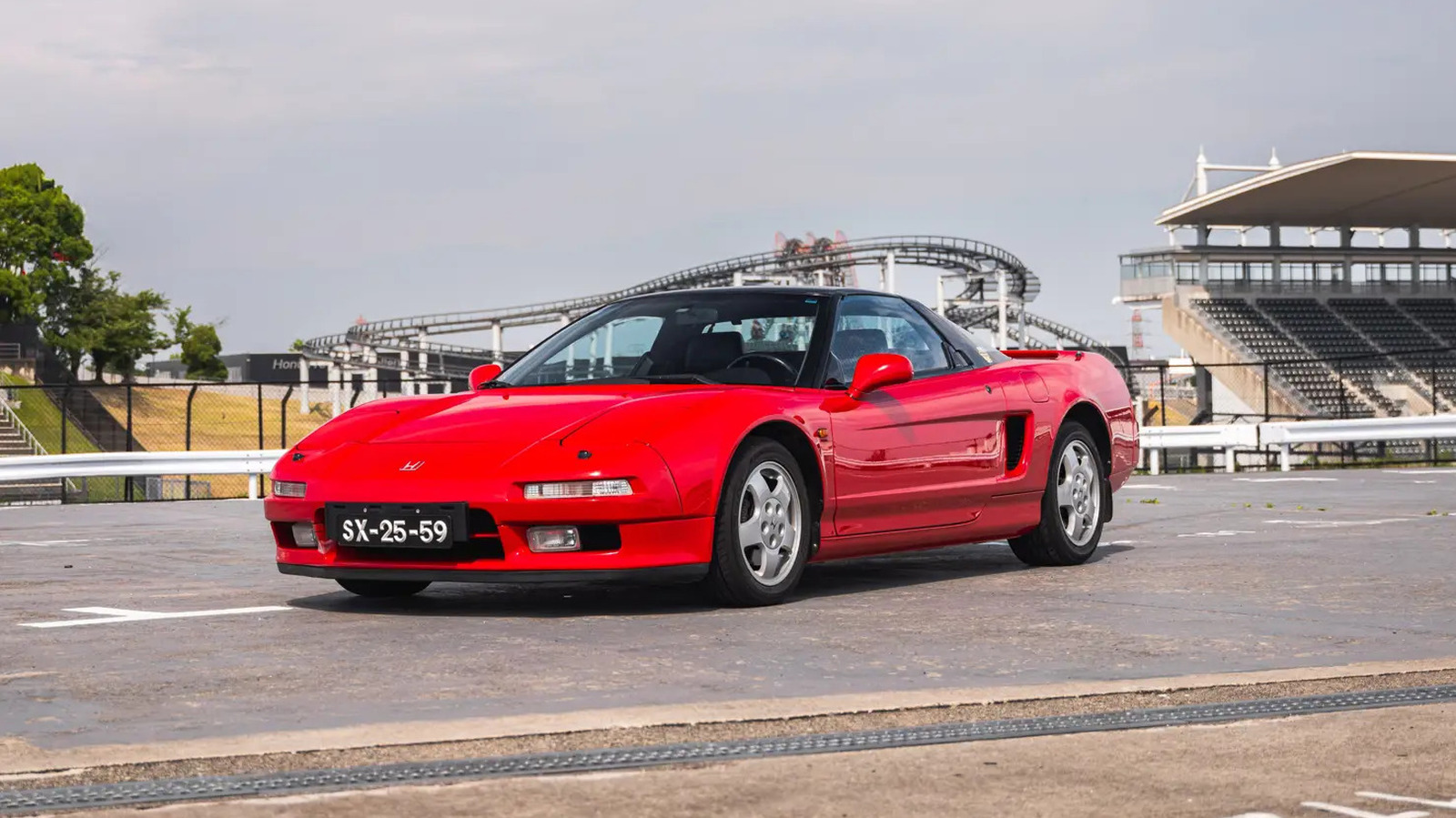
The final figure of £871,250 comfortably clears the previous record for an original NSX, a 2003 NSX-R that sold last year for $1.06m. At the exchange rate in force at the time, that was roughly £850,000, so the Senna car edges it on a like-for-like basis. The NSX-R was a hardcore, lightweight special. This one is a standard road car with an extraordinary paper trail, and it still beat it.
Sholto Gilbertson, RM Sotheby’s UK director of sales, put the appeal plainly: “Senna’s legacy runs far deeper than his three world championships. His style and elegance are everlasting, and when you think of Senna, nonchalantly dressed in jeans, white socks and brown loafers behind the wheel of a road car, you think of an NSX. This is a wonderful opportunity to own a genuine piece of sporting and cultural history.”
The provenance: one of three, kept in Portugal
Chassis T000233 was one of three NSXs Honda handed to Senna for personal use during his McLaren-Honda years. The other two were black. This one, in Formula Red with a black roof and black leather interior, was registered in Portugal as SX-25-59 in 1991 and kept in Lisbon, brought to Senna whenever he visited the country. He had bought a property at Quinta do Lago in the Algarve, and the car became part of his life there.
That life is documented. This is the NSX Senna was photographed washing with a garden hose, an image that has become one of the defining off-track portraits of the man. It also appears in the 1992 documentary Ayrton Senna: Racing Is In My Blood, where he spins its wheels for the camera.
The specification is standard early NSX: a three-litre naturally aspirated V6, quoted by Honda at 274PS (about 270bhp), with period road tests recording 0-60mph in around 5.8 seconds and a top speed nudging 165mph. On paper, modest by modern standards. In context, revolutionary.
Senna’s imprint: “a little fragile”
The NSX was Honda’s attempt to build a Ferrari-beater that would start every morning. The brief was aluminium bodywork, a mid-mounted V6 and reliability that European exotics could not match. What it lacked, initially, was the kind of steering feel and chassis composure that a racing driver would recognise.
In February 1989, McLaren held a pre-season test at Suzuka, the home of the Japanese Grand Prix. Honda’s R&D department was simultaneously finishing a month-long NSX test programme at the same circuit, and the engineers invited Senna to lap the prototype.
His feedback, as reported by Road & Track, was characteristically direct: “I’m not sure I can really give you appropriate advice on a mass-production car, but I feel it’s a little fragile.”
Fragile. Not slow, not ugly, not badly built. Fragile. For a company staking its reputation on a supercar, that single word was a problem.
Honda’s response was immediate and expensive. According to the company’s own account of the NSX programme, the chassis was stiffened by around 50% before production. Senna was invited back, this time to the Nürburgring, to help tune the suspension. The car that reached showrooms in 1990 was measurably sharper than the prototype he had driven, and the NSX’s reputation for handling has rested on that foundation ever since.
T000233 is not merely a car Senna owned. It is a car from the programme he influenced, built by the company that listened to him.
From Portugal to Japan and back
Senna died at the 1994 San Marino Grand Prix. The NSX stayed in Portugal until 1997, when it was sold to Robert McKagan and brought to the UK. The Briton kept it for nearly three decades before selling it in 2024, at which point its new owners returned it to Japan.
It came back to Britain for this sale, a round trip that mirrors the car’s own history: built in Japan, loaned to a Brazilian in Portugal, kept in Britain, sent home, and sold in London.
There is something of the analogue appeal in all this, the sense that a car’s value lies in its mechanical honesty rather than its specification sheet. It is a theme we have explored before in Why We Still Love Dangerous Old Cars: The Psychology of Analogue Motoring, and the NSX sits right at the edge of it: modern enough to be usable, old enough to demand something of the driver.
What it means for the market
The £871,250 result is a statement about provenance. A 2003 NSX-R is the more focused car, the one collectors have traditionally chased. But it does not have a photograph of Senna washing it. It does not appear in a documentary with him at the wheel. It was not the car he drove to dinner in Portugal.
The premium for genuine Senna association is now firmly established. The best-documented cars will command it. The rest will not.
Keeping the legend alive
The NSX’s value is not solely sentimental. Honda’s heritage programme now produces more than 3,000 official reproduction parts for the first-generation car, which means these machines can be maintained properly rather than mothballed. A car you can drive is a car that stays relevant, and relevance keeps prices honest.
That matters for anyone considering an older performance car, whether it is an NSX or something considerably less exotic. The practical questions, insurance, maintenance, even whether a child can legally travel in the passenger seat, are worth answering before the auction buzz wears off. Our guide to Kids in Classic Cars: What the Law Actually Says About Child Passengers covers the rules that apply to older vehicles.
A car that earned its price
Senna won three world championships and 35 races with McLaren between 1988 and 1993, with Honda power behind him for most of it. The partnership ended after the 1992 season. The NSX outlasted it, and so did the story.
What sold at RM Sotheby’s on 31 October was not simply a red 1991 Honda with a famous previous keeper. It was the physical record of a moment when a racing driver told a manufacturer the truth, and the manufacturer acted on it. Honda stiffened the chassis because Senna called the car fragile. Every NSX built since carries that decision.
£871,250 is a lot of money for a car that was, by its most famous driver’s own assessment, a little fragile. But it is not a lot of money for the evidence that he said so, and that Honda listened.