
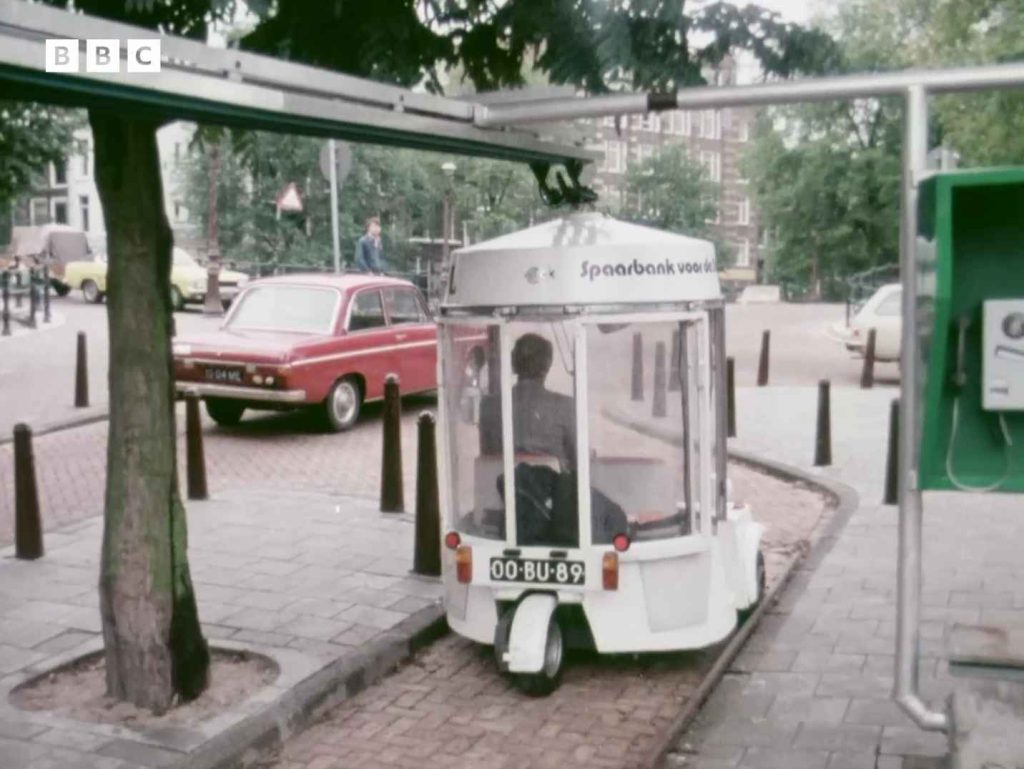
Amsterdam, 1974. A fleet of 35 tiny white electric cars, parked at a handful of stations around the city, available to anyone with a membership and a plastic key. You swipe in, tap your destination, drive across town, plug in and walk away. The car recharges in ten minutes. A central computer logs the trip and bills you about a guilder.
If that sounds like the pitch deck for a modern mobility startup, it isn’t. It is the Witkar, a Dutch car-sharing scheme that opened more than half a century ago and quietly ran the playbook that today’s app-based operators still follow. It was built on ideas its creator had been pushing since 1968, and it was eventually killed off not by technical failure but by a city that decided it preferred trams, buses and bicycles.
Born in 1968: Luud Schimmelpennink’s vision
The Witkar, Dutch for “white car”, was the brainchild of Luud Schimmelpennink, an industrial designer who also happened to be a politician. In 1968 he put forward the concept of a two-seat, fully electric microcar as a shared urban mobility solution, long before “shared urban mobility” was a phrase anyone used.
Schimmelpennink’s timing was not accidental. Amsterdam in the late 1960s was a city being strangled by cars, and the countercultural movement that would shape Dutch transport policy was already forming. His answer was not to ban the car but to rethink who needed to own one. A small, light, electric vehicle, used by many people for short trips rather than hoarded by one owner, was a radical proposition in an era when the private car was still the undisputed symbol of progress.
What was a Witkar? Design and specs
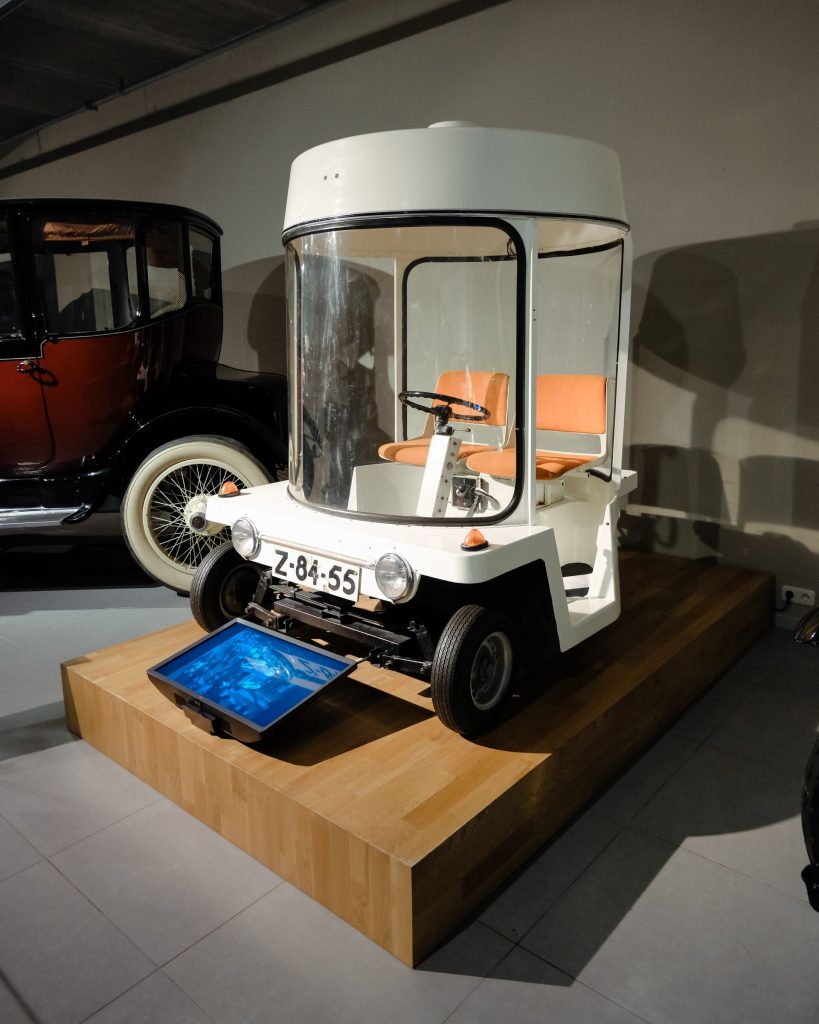
The Witkar was unlike anything else on the road, then or now. It was a two-seater with a cabin shaped like a glass tube, and it was noticeably taller than it was long or wide: roughly 2m high against a length of about 1.6m, giving it a distinctly upright, phone-booth silhouette. Passengers sat bolt upright inside, exposed on all sides, more goldfish bowl than automobile.
The numbers were modest. It weighed around 600kg, a figure swollen by its nickel-cadmium battery bank rather than any excess of bodywork. Range was about 10km (6.2 miles) and top speed was 20mph. This was never a car for the ring road, let alone a motorway. It was a device for moving one or two people a few miles across a dense city, and it was designed around that job rather than apologising for it.
How the system worked
The user experience was startlingly familiar. Members were issued a plastic key with an embedded sensor. At the station they tapped their destination into a keypad, waved the key over a reader and drove off. A central computer registered the key, the car and the station, and charged each driver accordingly, typically around one guilder per trip. At 1974 exchange rates that was a little under 16p in sterling, equivalent to roughly £1.60 in today’s money.
That is, functionally, the same chain of events as unlocking a modern share car with a phone: identify the user, identify the vehicle, record the location, bill the journey. The Witkar did it with a plastic fob and a mainframe four decades before the smartphone made it slick.
Recharging in ten minutes
Witkar stations used overhead conductors to top up the cars, and a full charge took around ten minutes. That is faster than most current rapid chargers manage for a comparable percentage of battery, though the comparison is flattered by the fact that the battery in question was tiny.
The network was also conceived with battery swapping in mind, which is telling. The thinking behind the stations was that energy supply was an infrastructure problem to be solved centrally, not something dumped on the driver. It is an argument that has resurfaced repeatedly since, most visibly in the current debate over battery-swap operators and depot charging for fleets.
The membership and the money
Amsterdam signed up. More than 4,000 people paid the 25 guilder joining fee, which was around £4 at 1974 rates and works out at roughly £40 today. For a scheme with 35 cars, that is a striking level of public appetite.
The usage data was equally revealing. Statistics suggested most members covered only about 5km (3.1 miles) per journey. The Witkar was not replacing the family car on a touring holiday. It was replacing a tram ride, a taxi or a walk in the rain, which is precisely the trip profile that modern car-sharing operators chase.
Scaling up that never happened
Here is where the Witkar ran into trouble. There were only five stations for 35 cars, which meant the network was thin from day one. Ten more stations were planned by the end of 1976, supporting a fleet of 100 Witkarren and eventually 1,400 cars. None of it materialised.
The imbalance made things worse. Some stations ended up with too many Witkars and others with none, so a member could walk to their nearest bay and find nothing, or arrive at their destination and find nowhere to leave the car. That is the same operational headache that has plagued docked bike schemes and one-way car clubs ever since. The Witkar’s backers never got the funding or the political backing to solve it at scale.
Behind the wheel: Chris Goffey’s 1976 verdict
Autocar’s Chris Goffey tried a Witkar in 1976 and found the controls “simple in the extreme”: a lever for forward, reverse and park, two pedals and a steering wheel. He also noted “extremely sensitive steering [and] a rather top heavy, unstable feel”, describing the result as not a completely reassuring sensation for the driver.
His most interesting observation was about everyone else. Other drivers and pedestrians, he reported, were generally friendly towards Witkar users. A tiny white glass tube pottering along at 20mph appears to have generated goodwill rather than road rage, which is more than can be said for plenty of modern microcars.
Goffey also made the strategic point that demand might never reach fever pitch given Amsterdam’s widespread tram network and the underground railway then under construction. The metro duly opened in 1977. He was right.
Why Amsterdam didn’t bite
The Witkar was not rejected. It was overtaken. Amsterdam already had an extensive tram network, and the arrival of the underground railway in 1977 gave the city another high-capacity option. Through the 1970s, particularly after the OPEC embargo, and into the 1980s, Dutch transport policy shifted decisively away from the private car and towards cycling, trams and buses.
A city making that choice does not necessarily need a fleet of shared microcars. The Witkar’s problem was that it sat awkwardly between modes: too slow and too limited to replace a car, too expensive and too scarce to beat a tram. The very congestion that inspired it was being addressed by other means.
Context matters here too. In the 1970s, cars were not yet shunned the way they increasingly are in modern cities. Superminis were cheap to own and run, and parking was mostly free. The economic case for giving up your own car in favour of a shared one was far weaker then than it is now, when parking permits, congestion charges and urban restrictions have changed the arithmetic entirely.
The Witkar’s long shadow
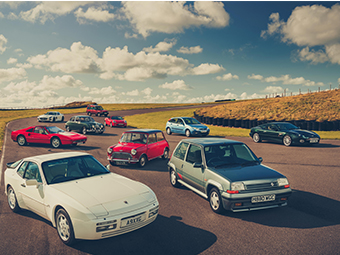
The experiment was repeated, at far greater expense, in Paris. Autolib’, launched in 2011, used the Bolloré Bluecar, an all-electric city car designed by Pininfarina. It was the Witkar’s direct descendant: station-based, centrally billed, electric, intended for short one-way trips.
It fared little better in the long run. Parisian driving and parking standards, combined with persistent vandalism, quickly reduced the fleet to scruffy jalopies, and the scheme was wound up in 2018. The lesson echoed Amsterdam’s: the hardware is the easy part. Keeping a shared fleet clean, charged, available and evenly distributed across a city is the hard part.
What the Witkar got right, and what it got wrong
The Witkar got the model right. A key fob with an embedded sensor, a station-based network, a central billing computer and a ten-minute recharge are all recognisably the architecture of modern car-sharing. Schimmelpennink saw in 1968 what the industry took another four decades to commercialise, and 4,000 Amsterdam residents were willing to put money down to try it.
It got the scale wrong, and it got the city wrong. Five stations for 35 cars was never enough to make the service reliable, the promised expansion to 100 and then 1,400 cars never came, and the redistribution problem was left unsolved. Amsterdam, meanwhile, was busy building a transport system that made the Witkar largely redundant.
That is not a failure so much as a fork in the road. The Witkar remains a landmark in electric and shared mobility: proof that the idea was viable, that users would embrace it, and that the technology was never really the obstacle. Fifty years on, the industry is still arguing about the same things, and the little white cars of Amsterdam got there first.





One Comment