Toyota has a long history of using SEMA as a laboratory for ideas that may or may not reach production. Sometimes those ideas are powertrain swaps, sometimes they are wild off-road builds, and sometimes they are simply a very well-judged styling exercise. The Toyota Crown Signia GT-S Concept, unveiled at the 2026 SEMA Show, falls firmly into the last category, and that is precisely what makes it interesting.
Built by Toyota Motorsports Garage, the GT-S takes the Crown Signia, a hybrid-only, all-wheel-drive estate crossover, and gives it a thoroughly aggressive makeover. Toyota says the concept offers the “attitude and road feel of a true sports car.” It is a bold claim for a car that, underneath the show-stand theatrics, retains exactly the same powertrain it left the factory with.
That is not a criticism so much as a clarification. The GT-S is a statement of intent about appearance, not a preview of a faster Crown. In a show season packed with ambitious concepts, it is a reminder that not every show car is chasing lap times. Two contrasting examples from the same season make the point: the Alfa Romeo Cuorerosso Concept: A 1,750kg Electrified 2+2 Coupé Manifesto and the Porsche Mission S Concept Revealed: Mid-Engined Supercar Slated to Sit Above the 911 both preview serious mechanical change, while the GT-S does not.
What Toyota built
The starting point is the Crown Signia as sold in the United States, a hybrid-only estate that sits somewhere between a traditional wagon and a high-riding crossover. Toyota Motorsports Garage has taken that sensible, efficient package and dropped it dramatically.
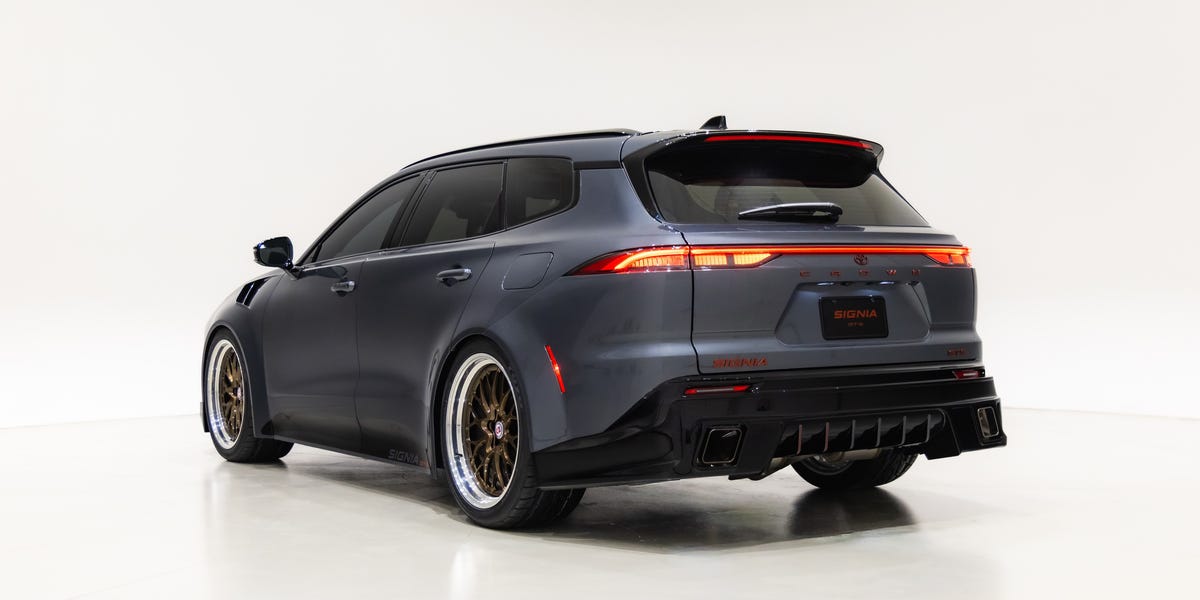
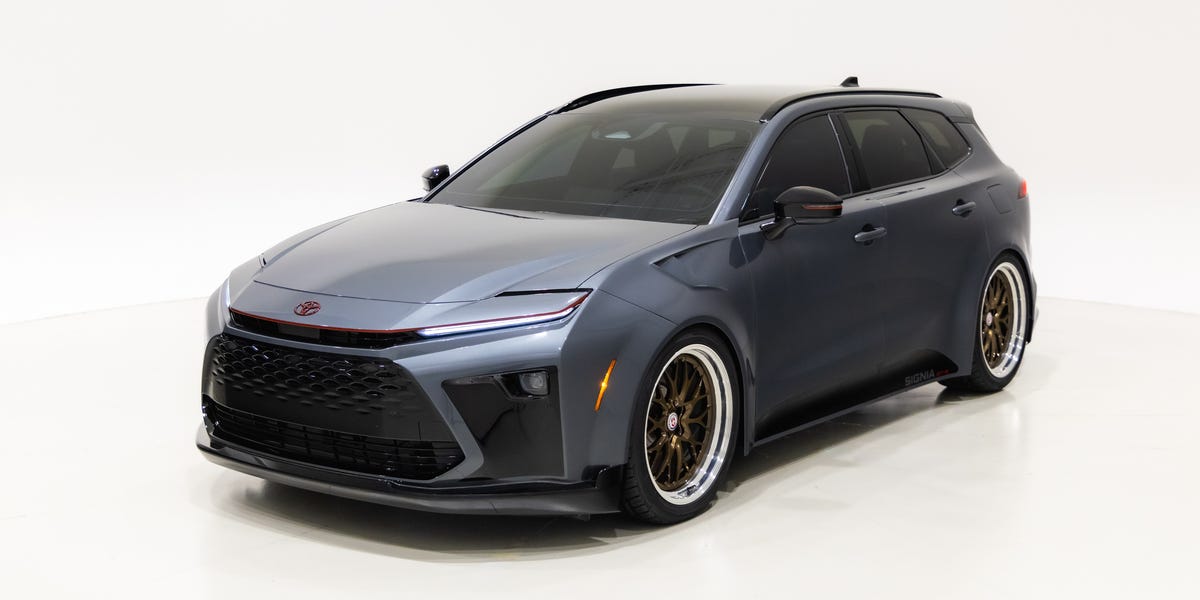
The headline number is the ride height. The GT-S sits roughly 13 cm lower than standard, a substantial drop for any car, let alone one with the Signia’s elevated stance. Achieving it required custom one-off MCS (Motion Control Suspension) coilovers, a properly engineered solution rather than a simple spring swap. Lowering a car by that much and widening the track is not a matter of bolting on parts and hoping for the best, and the widebody arches are integrated into the bodywork rather than simply riveted on.
The stance is further transformed by a set of 21-inch HRE wheels wrapped in 295-section Toyo tyres. That is serious rubber for a family-oriented hybrid estate. Toyota estimates the new setup delivers around 20 percent more tyre contact patch than the standard car, which suggests the aim was to make the car look planted as well as sit low. To cover the wider rubber, the concept wears integrated widebody fenders, giving it a presence the standard Signia simply cannot match.
Braking has been addressed too, with calipers sourced from the Lexus RX 500h F Sport and slightly modified before being fitted at all four corners. It is a neat piece of parts-bin engineering: a production component from within the Toyota group, adapted to fit, giving the GT-S the visual stopping power to match its new stance. Whether it actually delivers the “road feel of a true sports car” is impossible to verify from a show stand, but the hardware is at least in place to make the claim plausible.
Exterior and interior details
The paint is one of the standout features. Toyota describes it as a custom-mixed dark grey metallic with added flake and multiple clear coats, and the result is a finish that shifts and deepens depending on the light. It is the sort of colour that would be difficult and expensive to reproduce in production, which is exactly why it works on a concept.
Red accents run through the design, extending to the logos, door mirrors, headlamp covers and rear fascia. The effect is cohesive rather than gratuitous, tying the exterior details together without overwhelming the dark grey base.
There is a proper aero package too, including sculpted vents in each front fender, a front air dam and a rear diffuser. The trapezoidal dual exhaust tips are integrated into the rear bodywork, giving the back end a finished, purposeful look. Whether any of these elements generate meaningful downforce is beside the point; they contribute to the visual drama that a SEMA build is all about.
Inside, the changes are more restrained but no less deliberate. The front seats are heavily bolstered with red piping and embroidered GT-S lettering on the headrests, and the gear shifter carries matching GT-S treatment. It is a cabin that feels special without straying into the realm of the unusable.
The powertrain reality check
Here is where the GT-S concept demands a clear-eyed assessment. Toyota has announced no engine or hybrid-system upgrades, and no increase in output. The concept is based on the standard 2026 Crown Signia, which produces 240 hp in US specification from a naturally aspirated 2.5-litre four-cylinder hybrid, with all-wheel drive as standard. That equates to roughly 179 kW.
That is a perfectly respectable powertrain for a family estate, and the hybrid system’s instant torque delivery means it never feels sluggish in normal driving. But it is not a sports-car engine, and the GT-S makes no attempt to become one. The custom exhaust, despite its prominent tips and the visual promise they make, is not claimed to bring any performance benefit. It is cosmetic, and Toyota is refreshingly upfront about that.
Anyone hoping for a hotter Crown Signia with a power bump will need to look elsewhere, at least for now.
GT-S as a badge, not a tune
The Crown Signia GT-S is not the first Toyota concept to follow this formula. The Camry GT-S concept shown at SEMA the previous year took a similar approach, adding appearance changes only while keeping the standard 232 hp powertrain. Two concepts, two model lines, and the same philosophy: GT-S signals a styling package rather than added performance.
In the same way that some manufacturers use show cars to preview electrified powertrains or new platforms, Toyota appears to be using GT-S to test the visual language of a sportier sub-brand. The badge is emerging as a styling signature, not a performance division.
Toyota has announced no production plans for either GT-S concept. That does not mean the ideas will never reach showrooms, but it does mean buyers should not expect a faster Crown Signia or Camry to arrive on the back of these builds. The concepts are design studies, and they should be read as such.
A styling statement that knows exactly what it is
The Toyota Crown Signia GT-S Concept is a show car that understands its own brief. It lowers, widens and sharpens the Crown Signia’s stance with genuine engineering care, from the one-off MCS coilovers to the Lexus-sourced brake calipers and the 295-section Toyo tyres. The custom paint, red accents and embroidered interior are executed with the sort of attention to detail that suggests Toyota is serious about exploring a sportier visual identity for the Crown line.
What it does not do is pretend to be faster, and that is a perfectly legitimate thing for a concept to be. Not every show car needs to preview a new engine or a new platform. Sometimes the most useful thing a manufacturer can do is test how far it can push a design language before committing to it. The Crown Signia GT-S does exactly that, and it does it with a level of execution that makes the case for a sportier-looking Crown rather well. The most likely outcome, if anything comes of it, is an appearance package or a sharper trim rather than a new performance model. Buyers who want more power will have to wait, but those who simply want the Signia to look sharper have something to look forward to.