A one-off show car, not a showroom preview
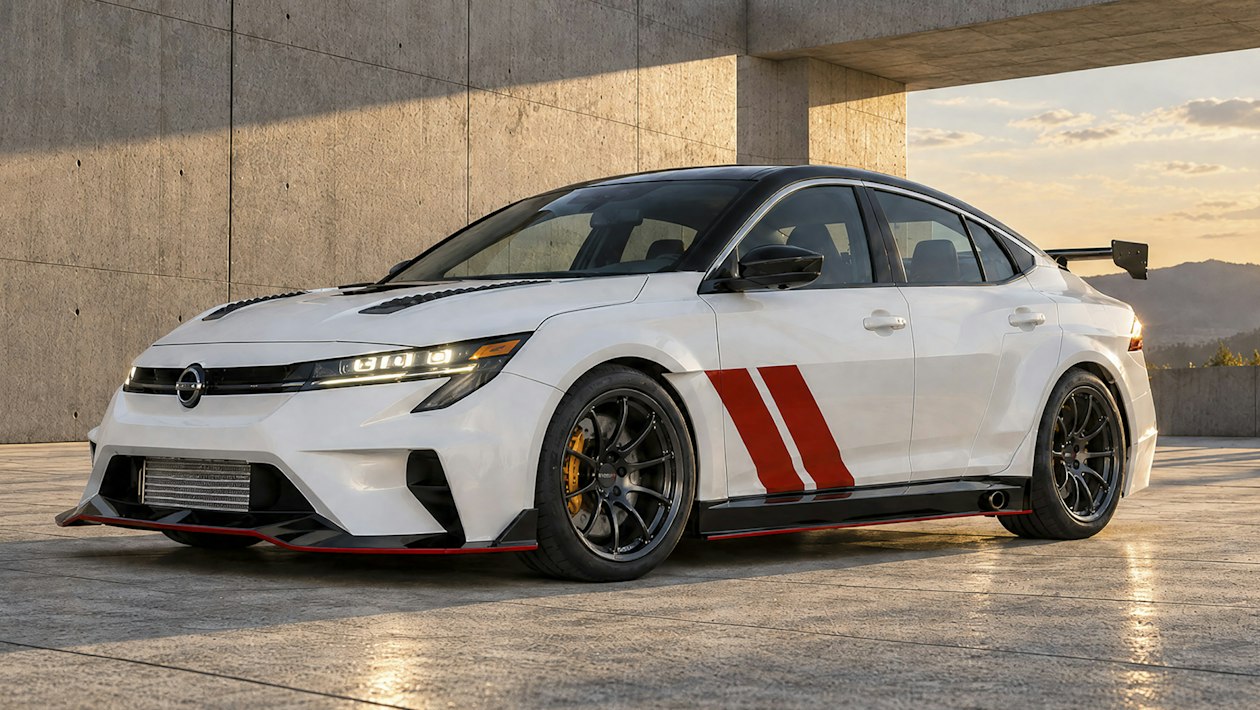
Let’s be clear about what this is from the outset: the Sentra Spec-V Concept is a one-off built for SEMA in Las Vegas, and it is not a production model. There is no expectation that even a heavily diluted version will reach showrooms. Nissan has built it as a celebration of what the Sentra could be if you handed the keys to the right people and told them to stop being sensible.
The badge is not new. The first Sentra Spec-V arrived in 2002, a sportier take on the standard saloon, and it has been used only a handful of times since, most recently on the B16-generation SE-R Spec-V that ran until 2012. What Nissan has done here is take that nameplate and push it considerably further than any previous Spec-V. Where the original was a warm-ish saloon with a bit more poke, this concept is a proper performance build with the hardware to back up the aesthetic.
Under the skin: 295bhp from a sensible four-pot
The starting point is the 2.0-litre four-cylinder engine shared with the standard Sentra, which is about as ordinary as engine specifications get. But Nissan’s engineers did not leave it alone. The internals have been uprated, a new turbocharger has been bolted on, and the result is 295bhp. That is well over one and a half times the power of the original 2002 car, which made around 175bhp, and it is the kind of figure that transforms a saloon from motorway muncher to something genuinely quick.
Just as importantly, it is paired with a six-speed manual gearbox sourced from the Juke Nismo RS. In an era when the manual is being quietly deleted from car after car, fitting a proper three-pedal ‘box to a 295bhp saloon concept feels like a deliberate two fingers to the trend.
The chassis has not been ignored either. Nismo suspension sits the car lower than standard, and uprated Brembo brakes provide the stopping power to match. It is a coherent package rather than a parts-bin mishmash, which is more than can be said for plenty of show cars.
Raiding the GT-R Nismo parts bin
The most entertaining part of the build is where the components came from. The large rear wing is lifted straight from an R35 GT-R Nismo, which is a sentence that should not make sense on a Sentra but absolutely does. There is a chunky front splitter, new side skirts and a set of 19-inch Nismo wheels to complete the stance.
Inside, the borrowing continues. The Nismo steering wheel and Recaro front seats both come from a GT-R Nismo, which means the driver sits in hardware developed for a car costing several times as much. It is the sort of cross-pollination that only works when you have a manufacturer with both a humble compact saloon and a flagship supercar in the same stable, and Nissan has leaned into the contrast rather than shying away from it.
The result is a car that looks like it was designed by someone with a sense of humour and access to a very well-stocked warehouse. It is a show car in the best tradition: visually loud, mechanically credible, and entirely unbothered by the idea that it might need to be practical.
The other concepts sharing the stand
The Sentra was not the only machine turning heads at the show. Nissan brought a pair of Z-based concepts alongside it, each with a different purpose.
Project NAT 2 SCCA T2 is a reworked Z sports car built to the Sports Car Club of America’s Touring 2 racing regulations. It is a proper racing build rather than a styling study, and it shows that Nissan’s motorsport department has not been idle.
Then there is the Restomod Fairlady Z, which takes an original Fairlady Z (the Japanese-market name for the car sold elsewhere as the Datsun 240Z and its successors) and brings it into the modern era. The headline change is under the bonnet, where the original inline-six has been replaced by a Nismo-tuned version of the twin-turbo V6 from the current Z sports car. Carbon fibre front wings, bonnet, bumpers and boot keep the weight down, and it is finished in Seiran Blue, the shade the current Z launched with. The suspension has been evolved rather than simply replaced, and braking comes courtesy of Wilwood six-piston front and four-piston rear callipers.
It is a lovely thing, and it sits in a long tradition of manufacturers building restomods to remind people how much affection there is for their back catalogue. The industry is full of them at the moment, from Peugeot’s RCZ Vision concept to Citroën’s electric 2CV reinvention. The Sentra is a different flavour of the same instinct: take something familiar and show what happens when you stop being careful.
Why a Sentra concept matters
It would be easy to dismiss the Spec-V Concept as a bit of fun with no wider significance, and in one sense that is exactly what it is. But there is a point to it. The Sentra is a car that exists to be leased, not loved, and the concept demonstrates that the platform underneath is capable of far more than its daily-driver brief suggests.
It also shows that Nissan still knows how to have fun with its back catalogue and its parts bin. The GT-R is now a very expensive flagship, and seeing its hardware turn up on a compact saloon is a reminder that the company has a deep well of performance components to draw on. Whether that translates into anything for customers is another matter, and the honest answer is that it probably will not.
SEMA runs from 3 to 6 November. It is a trade show first and foremost, but the public is admitted on the final day. For everyone else, the photographs will have to do.
A show car that knows exactly what it is
The Sentra Spec-V Concept is not a car you will ever be able to buy, and Nissan has made no attempt to pretend otherwise. What it is, instead, is a well-executed piece of enthusiast engineering: a 295bhp turbocharged saloon with a manual gearbox, GT-R suspension components and a rear wing that has no business being there. It revives a badge that has been used only a handful of times since its 2002 debut and gives it a send-off far more dramatic than the original ever managed.
In a world where concepts increasingly arrive as thinly disguised production previews, there is something refreshing about a build that exists purely to be looked at and enjoyed. The Sentra is not a car that gets its own poster, but for one week in Las Vegas, it might just deserve one.
For more on this, see nissan kaze concept tops.
For more on this, see car spec check verify.