
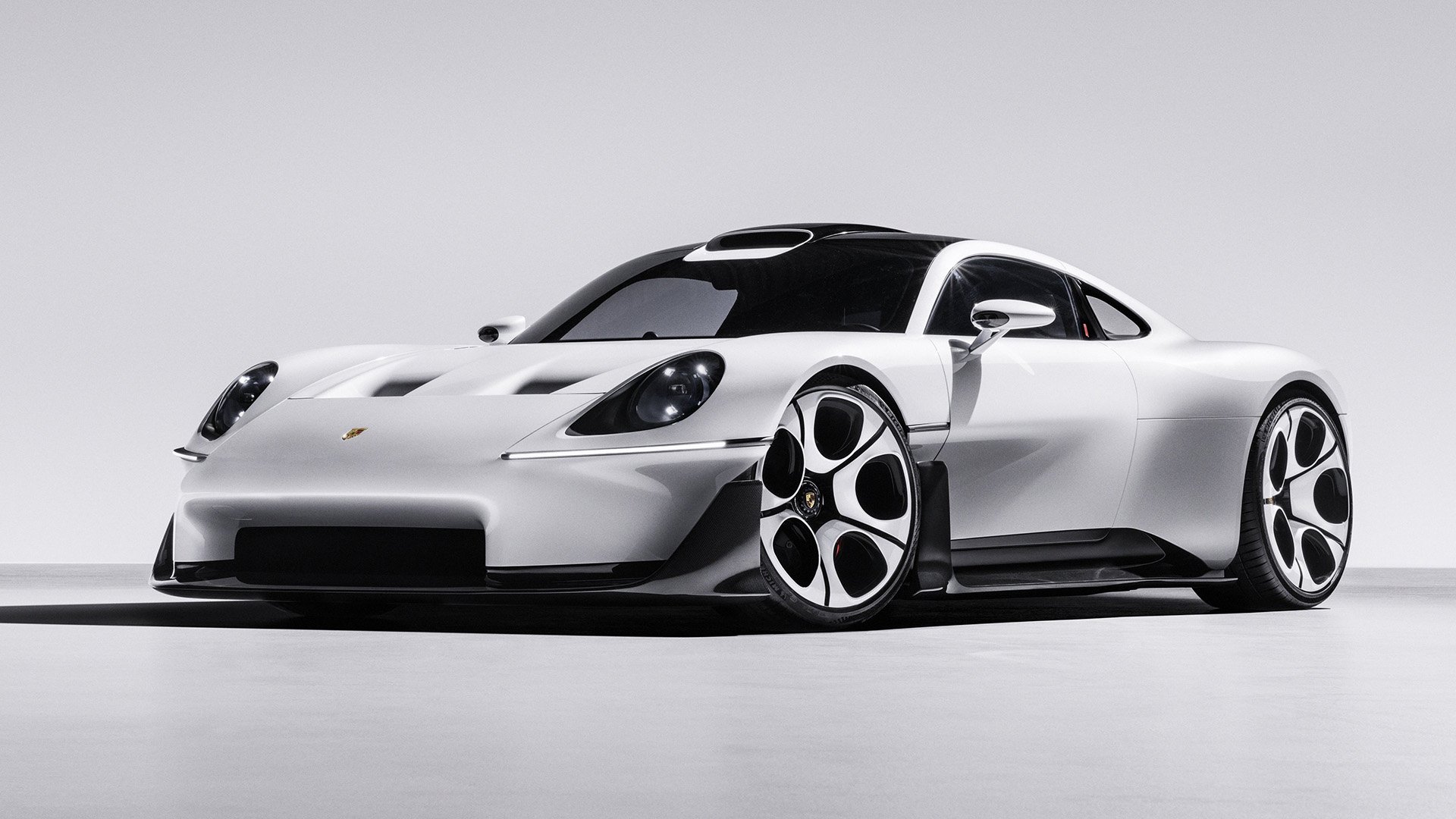
Porsche has spent decades resisting the obvious. The 911’s engine has stayed resolutely behind the rear axle, and every attempt to build something quicker has arrived as a limited-run special: the Carrera GT, the 918 Spyder, the Mission X concept that promised much in 2023 but has yet to be confirmed for production. So when the company unveiled the Mission S on the Queens waterfront in New York on Thursday, the interesting part was not the car. It was the commitment.
To be clear from the outset, the Mission S is not the Mission X. The 2023 concept was a one-off show car with no production pledge attached. The Mission S is a different proposition entirely: a concept that Porsche says previews a series-production model. Dr. Michael Leiters, Porsche CEO and chairman of the executive board, said it plainly: “The Mission S represents a mid-engined super sports car platform positioned above the 911, not as a one-off hypercar, but as a permanent and versatile addition to our customer offering.”
That is a first for Porsche. Not a hypercar with a waiting list and a seven-figure price, not a homologation special, but a series-production model that will sit above the 911 in the range and stay there. For a company whose identity is bound up in one silhouette, it is a significant strategic shift, and one that had been building for some time. Those who followed the Porsche Mission S Teased: Mid-Engine Halo Car Set to Sit Above the 911 story will recognise the shape, though the scale of the ambition is now considerably clearer.
Where the Mission S sits in the range
The positioning is unambiguous. The Mission S is not a 918 Spyder successor and not a Carrera GT heir. Porsche has gone out of its way to separate it from that lineage, which has always been about small numbers and enormous price tags. Instead, the Mission S is aimed squarely at the Ferrari 296, the Ferrari 849 Testarossa and whatever McLaren replaces the 750S with.
That is a different fight entirely. Those are cars built in meaningful volume for buyers who want a mid-engined supercar they can actually use, order and service through a normal dealer network. Porsche entering that segment with a permanent model changes the arithmetic for everyone in it. The 911 has always been the benchmark for usable performance, but it has never been a direct rival to a mid-engined Italian berlinetta in the way the Mission S will be. The supercar segment above the 911 has been left to Ferrari and McLaren for too long, and the Mission S is the company’s answer.
Internal combustion, and probably eight cylinders
Porsche has confirmed internal combustion and confirmed the engine sits between the driver and the rear axle. Beyond that, the company is staying quiet on specifics, which is entirely in character.
The visible clues are worth reading, though. Four tailpipes suggest an eight-cylinder layout rather than a six, though Porsche has not confirmed the cylinder count. German outlet Handelsblatt reported in September that a newly developed flat-eight was in the works at Porsche, and other details in that report, including the car’s position at the top of the line-up and a possible price, line up with what is now known about the Mission S. None of it is confirmed, and Porsche has not repeated the claim.
Inside, a knob marked “PRND” and metal paddle shifters behind the steering wheel point to a PDK automatic rather than a manual. That will disappoint a few purists, but it is consistent with a car intended to be driven daily and quickly in equal measure.
Design: a history lesson in metal
The Mission S wears its references openly, and the effect is less pastiche than a deliberately assembled family tree.
The flat front fascia comes from the 911 GT1 Le Mans racer, paired with round headlights and rounded fenders drawn from the 911 itself. The rear roofline, sitting beneath an active rear wing, carries a hint of the 959. The wheels are based on the 928’s dial-design rims, a detail that will delight anyone who remembers Porsche’s front-engined grand tourer fondly. Above the engine sits a cooling zone inspired by the 917’s radiator fan, though Porsche is clear that this is a cooling element rather than an active aero vent. The rear adopts what the company calls a car-in-car concept layout.
Tobias Sühlmann, head of Style Porsche, framed the exercise in strategic rather than nostalgic terms: “This vision model illustrates a fundamental strategic direction that we will soon be translating into our future product portfolio.”
An interior that argues with itself, on purpose
The cabin is where the Mission S gets genuinely interesting, because Porsche has made a decision that runs against almost every current supercar.
There is no permanently integrated centre display. There is no fixed passenger display. Instead, Porsche has designed a retractable smartphone system compatible with MagSafe, which lets the driver’s own phone serve as the navigation or information screen when needed and disappear when not. A My Porsche app provides access to functions and allows digitally rendered, historically inspired designs for the circular instruments.
Those instruments number five, arranged across the dash. The tachometer extends closer to the driver depending on drive mode, while the four secondary gauges rearrange themselves around it. The ignition key goes in on the left, as is Porsche tradition. Below the phone mount sit comfort and driving control knobs that pull out and push back in with an aircraft-style push-pull action.
Porsche describes the result as a “symbiosis of analogue and digital controls” in an interior that “puts the driving experience first.” Whether buyers agree will depend on how well the phone integration works in practice, but the intent is clear enough: fewer screens, more tactility.
No price, no date, no timing
Porsche has announced no price, no production date and no launch timing. The reported figure of around half a million dollars (roughly £400,000 at current rates), which surfaced in the German press, remains unconfirmed, and the company has not lent it any credibility. No UK price has been announced.
That silence is normal at concept stage, but it leaves the obvious questions open. Where the car will be built, how many Porsche intends to make each year, and what it will cost in the UK are all unanswered. Given the segment it is entering, a six-figure price is widely expected, though Porsche has confirmed nothing.
Why Porsche went back to Queens
The location was not a coincidence. The same stretch of Queens waterfront was used for the first photographs of the 550 Spyder in 1953, a car that established Porsche’s reputation for building small, light, mid-engined machines that punched far above their displacement.
Choosing that spot to announce a permanent mid-engined supercar is Porsche telling its own story in sequence. The 550 led to the 718, the 904, the 917 and eventually the Carrera GT and 918 Spyder, but always as interludes rather than fixtures. The Mission S is the company saying that chapter is now a permanent part of the range.
It is a striking piece of positioning from a manufacturer that has spent years being criticised for conservatism. Porsche has taken the quiet, deliberate approach, backed by a production pledge rather than a show stand flourish.
What the Mission S says about Porsche’s next decade
The significance of the Mission S is not the styling, appealing as it is, and not the engine, whatever it turns out to be. It is the word “permanent.”
Porsche has built faster cars than the 911 before. It has built more exclusive ones, more expensive ones and more technologically adventurous ones. What it has never done is commit to a mid-engined flagship as a standing part of the range, sold alongside the 911 rather than instead of it or briefly above it.
Doing so now, with internal combustion confirmed and a PDK gearbox implied, is a statement about where Porsche thinks the money is. The 911 remains the heart of the business, but the Mission S is the company’s bid to take on Ferrari and McLaren where they are strongest.
The details that matter most, price, production volume and timing, are still missing. Until Porsche fills them in, the Mission S remains a promise rather than a product. But it is a promise with a location, a quote and a strategy attached, and that is more than the Mission X ever offered.

One Comment