The headline: same weapon, new model year
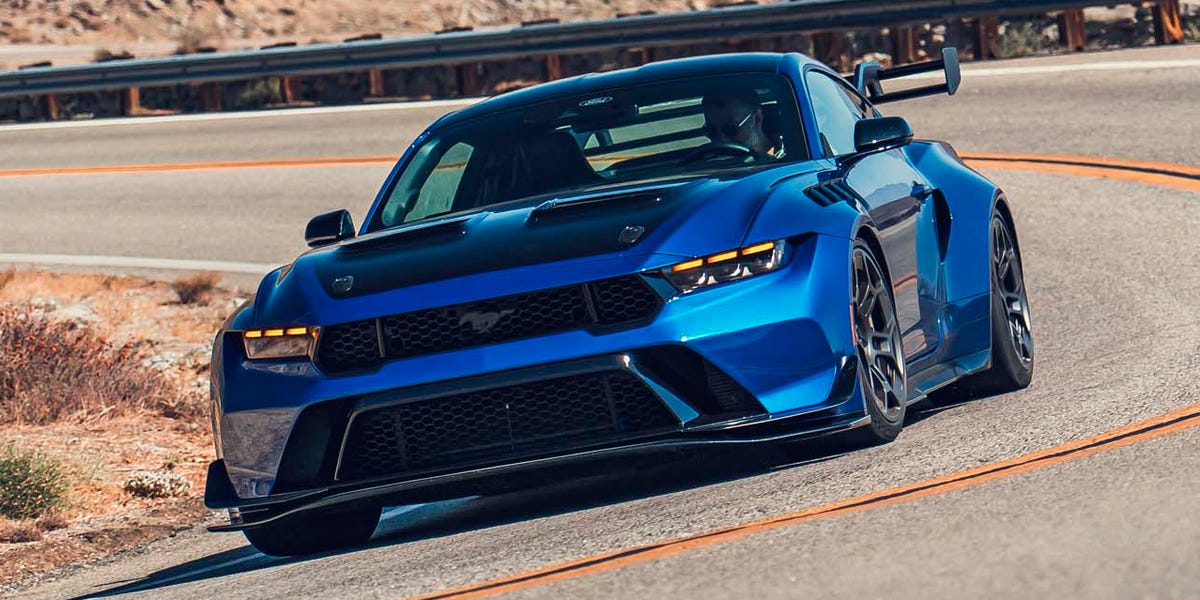
Nothing mechanical changes for 2027. Ford’s most extreme Mustang keeps its supercharged 5.2-litre V8 producing 815hp, sent to the rear wheels through an eight-speed dual-clutch transaxle mounted at the back of the car rather than bolted to the engine. That transaxle layout is a proper race-car solution, shifting weight rearward and sharpening turn-in, and it is the kind of engineering you normally associate with Ferrari or McLaren rather than a Blue Oval badge.
The GTD has always been a homologation-flavoured exercise, a road car built to ape the Mustang GT3 racer. The irony is that the road version is by far the more powerful of the two. The GT3 competition car runs a 5.4-litre V8 making around 550hp. So the road car has roughly 265hp more than the racing car it visually imitates. That tells you everything about how far Ford’s engineers were allowed to push.
Nürburgring credentials that demand respect
Car and Driver places the GTD as the second-quickest production car ever to lap the Nordschleife, a circuit that has become the industry’s de facto benchmark for chassis competence and outright pace. Getting near the top of that particular leaderboard is not something you do with a big engine alone. It requires aerodynamic downforce, suspension geometry and tyre management working in concert over the full length of unforgiving German tarmac.
The magazine’s testing operation is famously rigorous, and it has form for holding manufacturers to account. If you want a sense of how seriously its numbers are taken, read Inside Car and Driver’s Testing Regime: 400 Cars a Year, 200 Data Points and the Claims It Has Disproved, which recounts how the 1999 Mustang Cobra saga forced Ford to rebuild part of a production car. When that outfit calls the GTD the second-fastest production car around the Ring, it carries weight.
Race-car engineering you can actually buy
The GTD’s specification reads like a parts list from a GT3 garage. There is a carbon-fibre body, active underbody aerodynamics that shift the car’s aero balance on the move, and inboard pushrod suspension mounted where the standard Mustang’s rear seats would normally live. That last detail is the one that reframes the whole car. This is not a Mustang with stiffer springs and a big wing. It is a racing architecture with a Mustang shell draped over it.
The pushrod setup, with dampers operated via rocker arms rather than bolted directly to the hubs, is a layout borrowed straight from top-tier motorsport. It gives the engineers far more control over camber, roll and ride height, and it is a big part of why the GTD can lap the Ring at the pace it does while still, apparently, behaving itself on the road.
The practical trade-offs are severe
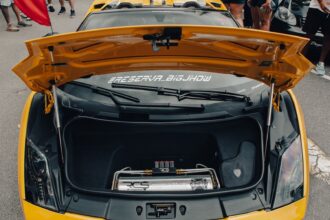
Then you open the boot, and the illusion of practicality evaporates. The boot houses suspension and cooling hardware, leaving no room for luggage whatsoever. Rear seats are deleted entirely, replaced by that inboard suspension. Two seats, no boot, and a cabin that in most respects resembles an ordinary Mustang.
Fuel economy, on US EPA figures, is 10 mpg in the city and 17 mpg on the highway, or 12 mpg combined. That is thirsty even by performance car standards. Nobody buys an 815hp supercharged V8 expecting frugality, but it is worth noting that the GTD is not a grand tourer in any meaningful sense. It is a track weapon that happens to be road legal, and it makes no apology for that.
Inside the cabin: familiar, with titanium trinkets
The interior is recognisably Mustang, upgraded with suede, leather and carbon fibre rather than reinvented. You get Recaro bucket seats for driver and passenger, paddle shifters, a rotary gear selector and a serial placard, all 3D-printed from titanium. Ford claims the titanium material came from retired Lockheed Martin F-22 fighter jets, which is a lovely piece of marketing theatre and entirely in keeping with the car’s fighter-jet aesthetic.
There is a 12.4-inch digital gauge cluster and a 13.2-inch touchscreen with Apple CarPlay and Android Auto, plus GTD-exclusive performance menus for configuring the car’s various modes. Driver assistance is limited to lane-keep assist and automatic emergency braking, which is fair enough. You are not buying this for adaptive cruise control.
How it drives: civilised, balanced, and a touch numb
Car and Driver’s driving impressions are largely glowing. The ride quality is described as shockingly civilised, which is a remarkable achievement given the spring rates and aero required to lap the Nordschleife at record pace. Handling is supremely balanced and grip is staggering. The one criticism is that more steering feedback would be welcome, a small chink in an otherwise formidable armoury.
That verdict fits the wider picture of modern fast Fords. The company knows how to make a chassis communicate, and it has a long history of doing so across the range, from the V8 GT to the four-cylinder turbo cars. The GTD sits at the extreme end of that spectrum.
The price problem: supercar money, supercar rivals
Here is where the GTD’s story gets uncomfortable. In the US, Car and Driver describes the MSRP as supercar-rivalling, framed around the $300,000 mark (roughly £235,000). For that money you are deep into Chevrolet Corvette ZR1X territory, and the Corvette makes 1,250hp, hits 60 mph in 2.1 seconds, and starts $100,000 less. On a straightforward performance-per-pound basis, the Chevrolet wins comfortably before you have even discussed the warranty.
Car and Driver’s own testing underlines the point. The GTD was outrun to 60 mph by the Chevrolet Corvette ZR1, which recorded 2.2 seconds, and by the Porsche 911 GT3 RS at 2.7 seconds. The GTD is not slow, but it is not the quickest thing in its price bracket either. Its strengths lie in aero, chassis balance and lap times over a full circuit rather than in traffic-light bragging rights.
That is the central tension of the GTD. It is a magnificent piece of engineering, but it is priced against cars that are faster in a straight line and, in the Corvette’s case, arguably better value in every measurable respect. The GTD’s counter-argument is rarity, theatre and that Nürburgring time, but those are emotional rather than rational selling points. It is built to lap, not to launch, and buyers need to understand which one they are paying for.
Warranty, servicing and the ownership experience
Car and Driver describes the warranty as solid but average, and notes that, unlike Chevrolet, Ford does not include a complimentary scheduled maintenance visit. It is a small detail, but at this price point those small details matter. Supercar buyers are used to being cosseted, and the GTD’s ownership package does not quite match its price tag.
The wider Mustang picture: Dark Horse changes for 2027
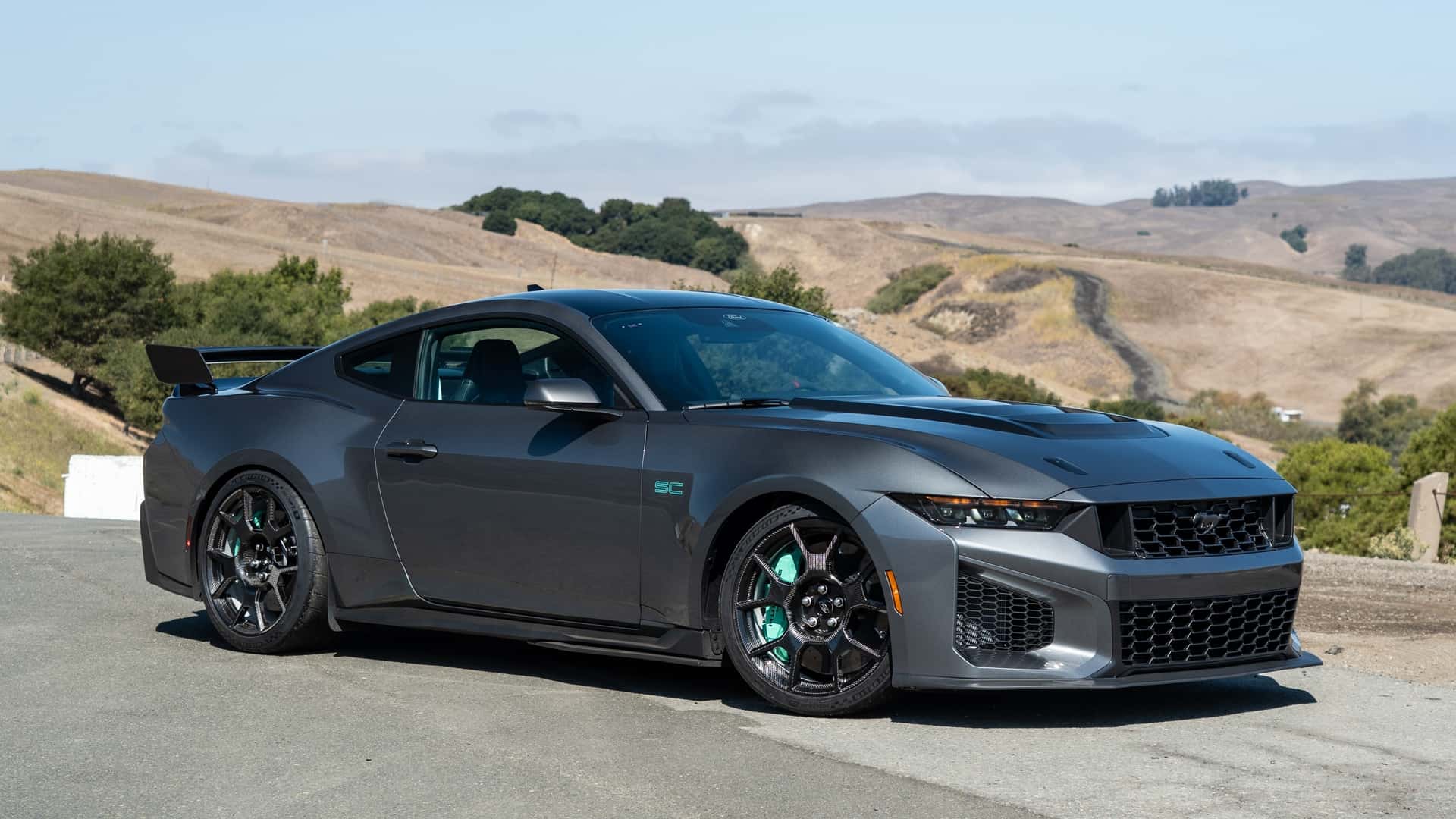
Away from the GTD, the Mustang range is shifting. The Dark Horse SC Track Pack Special Edition, a $31,980 option that pushed a 2026 car to $144,985, will not return for 2027. The package brought carbon-ceramic brakes with Race Red Brembo calipers, 3D-printed titanium shift components and serialised instrument-panel badging, among a long list of cosmetic additions. Ford never published a production cap for it.
In the US, standard Dark Horse SC pricing starts at $108,485 before destination and delivery, and a fully loaded example reportedly reached $175,965, according to Ford Authority. That ceiling drops for 2027. Ford is also adding a Dark Horse SC convertible, the first open-top version of a model previously pitched purely as a track car. The Dark Horse SC arrived for 2026 as the spiritual successor to the S550-generation Shelby GT500, and it now spans a broader brief.
What the GTD gets right, and what it cannot escape
The Mustang GTD is a genuinely extraordinary thing. It is a race car with number plates, a machine that borrows its suspension architecture from top-tier motorsport, laps the Nordschleife faster than almost anything else in production, and still rides with a civility that borders on the surreal. Ford’s engineers deserve enormous credit for making it work at all, let alone work this well.
But the 2027 carryover also highlights what has not changed. The GTD remains a two-seater with no boot, a 12 mpg combined appetite and a price that puts it among supercars that beat it in a straight line. It remains a car you buy with your heart rather than your head. That is fine. Some of the best cars ever built have been exactly that. But anyone writing the cheque should know precisely which bargain they are striking.
Related reading: our 2026 Ford Mustang RTR Review: The 315bhp EcoBoost Built to Go Sideways covers the opposite end of the Mustang spectrum, and the one-off Ford Racing R125 Mustang: 360hp 1966 Fastback Celebrates 125 Years of Ford Motorsport is a neat reminder of Ford’s long motorsport heritage.
Related: ford gt350 successor mustang.