Halloween is a strange time to be a motoring journalist
For eleven months of the year we write about torque figures, residual values and whether the ride is too firm over speed humps. Then the clocks go back, the nights draw in, and the stories that surface are rather older and rather stranger than a press release about a mid-cycle facelift.
The car world has its own ghostlore, and it is not as random as it first appears. Look at where the hauntings cluster and a pattern emerges. They sit at the places where speed and danger met: a banked Surrey circuit where a record attempt ended in a burst tyre, a Pennine pass that has claimed more than its share of lives, a dual carriageway laid over a monastery, a hearse that spent its retirement pulling broken-down cars off the road. These are not haunted houses in the traditional sense. They are haunted infrastructure.
What follows is a tour of Britain’s most storied motoring landmarks, with the history that made them. Take it as a seasonal diversion or as an itinerary for a very peculiar weekend away. Either way, bring a torch.
Percy Lambert and Brooklands: the man who died on Halloween
Percy Lambert was the first person to drive 100 miles in an hour, a feat he achieved at Brooklands in Surrey in 1913. It made him a household name in an era when breaking records was a spectator sport, and it made him a fixture at the world’s first purpose-built racing circuit.
He died there on 31 October 1913. Lambert was attempting another record when his back tyre burst at The Members’ Banking, the track’s fastest and steepest corner. The car flipped, and Lambert died on the way to Weybridge Hospital.
The detail that gives the story its weight is a promise. Lambert was engaged to be married, and he had told his fiancée that this run would be his last. Whether he meant it as reassurance or had genuinely decided to stop is lost to history. What is not lost is the sense, reported by staff at the museum that now occupies the site, of an uncanny presence that is said to be strongest on dark winter nights. A headless man in white overalls has reportedly been seen pacing the old track, and the smell of cigar smoke is said to linger where no cigar has been smoked.
Brooklands today is a museum, a business park and a slice of British motorsport history all at once. It is also, if the stories are to be believed, still running one final lap.
The Cat & Fiddle: a travellers’ rest with a body count
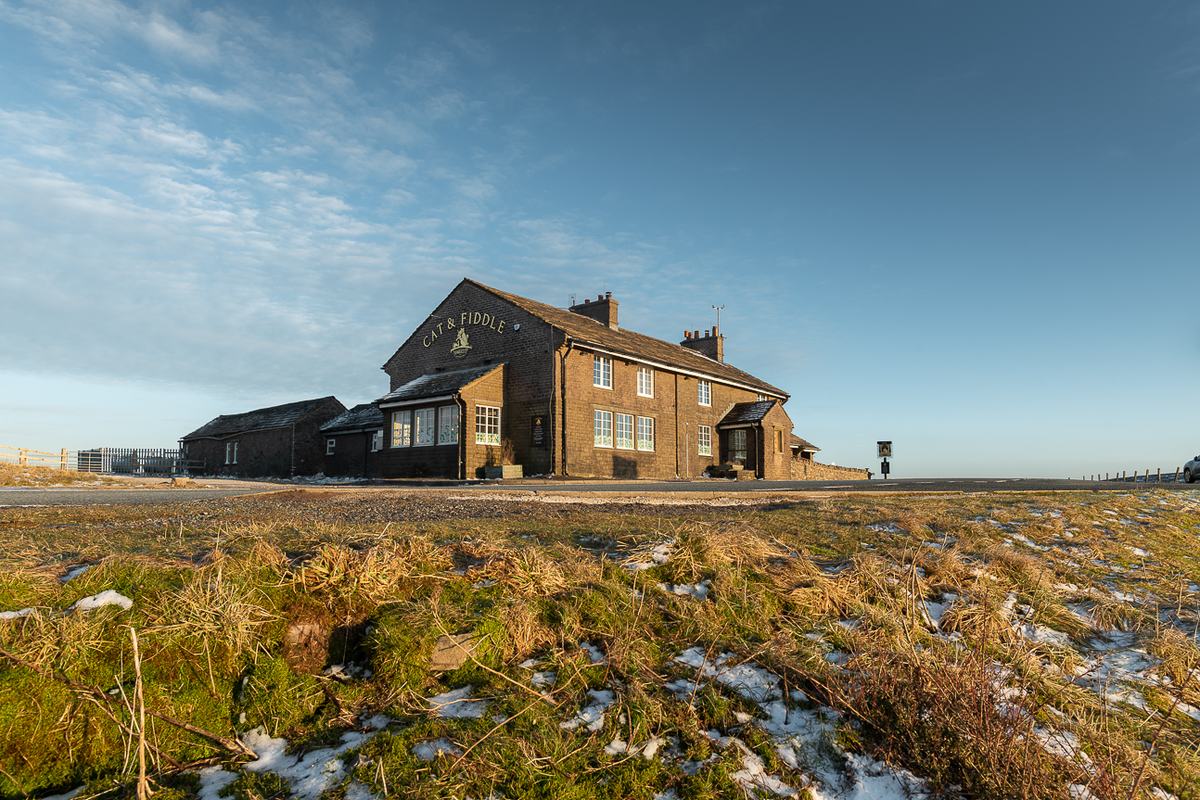
The Cat & Fiddle sits at the summit of the road between Macclesfield and Buxton, on a stretch regularly named among the UK’s deadliest. It was built in the early 1800s as a travellers’ rest, which is a polite way of saying it served people making a genuinely hazardous journey across the Peaks in an age before heated seats and traction control.
In the 1920s it became a pit-stop favoured by Charles Rolls during vehicle test runs with Henry Royce, which gives the pub a legitimate claim to a place in Rolls-Royce folklore. It is now a pub that also distils, and it holds a Halloween storytelling night on the eve of Hallows’ Eve, leaning into its reputation rather than running from it.
The reputed hauntings are suitably bleak. A hiker who froze to death in a blizzard is said to occupy the upper floors. A landlord who hanged himself in an outbuilding is said to make himself known too. Local legend adds the Beast of the Peak District for good measure, though the pub’s own ghosts are more unsettling precisely because they are so ordinary. People really did freeze on that road. Landlords really did reach the end of their tether in isolated inns.
If you drive the Cat & Fiddle today, you may find average speed cameras and a 50mph limit in place, which has done a great deal for the survival rate and very little for the atmosphere. The ghosts, presumably, are unbothered.
The A616 Stocksbridge Bypass: Britain’s most haunted road
No British road has a reputation quite like the A616 Stocksbridge Bypass in South Yorkshire. It was built in the 1980s on the site of a former monastery, which is the kind of detail horror films use as a first act, and it has been described ever since as Britain’s most haunted road.
The defining account dates from 1987, during construction. Two security guards reportedly encountered children singing “ring a ring of roses” near Pea Royd Lane Bridge at night. The children vanished, and the men were then accosted by a hooded man. Their Land Rover would not start. They called the police and a priest. A police officer reportedly saw a spectral monk through the windscreen of their Vauxhall Astra patrol car, and the priest performed an exorcism.
It is worth pausing on the patrol car, because it grounds the story in the mundane machinery of British policing. The officer was not in a marked supernatural response vehicle; he was in an Astra, the same car that spent the 1980s and 90s being ragged around housing estates. For a fuller picture of how police cars of the era looked and why, this history of Jam Sandwich Police Cars: The Story Behind Britain’s Most Famous Police Livery is a good place to start.
Other sightings on the bypass include faceless figures and phantom children. The road itself is a busy dual carriageway across the Pennines towards Manchester, complete with average speed cameras. It is, by any measure, an ordinary piece of transport infrastructure. Which is precisely what makes the stories stick.
The Dundee Silver Ghost hearse: a Rolls-Royce with a day job
Not every haunted vehicle is a phantom. Some are simply cars with unusually full lives, and few have lived fuller ones than the 1909 Rolls-Royce Silver Ghost that spent its early years as a family tourer and then a taxi in Dundee.
In 1923 it was recommissioned to carry the city’s deceased, which is to say it became a hearse. By 1930 its owner had converted it into a recovery vehicle, strengthening the suspension to support a crane and towing mechanism and painting it blue with red wheels. A car that had carried the dead was now hauling the broken down.
Lord Edward Montagu acquired it in 1954, and it now resides at The National Motor Museum at Beaulieu. It is a genuinely lovely thing to look at, and a reminder that before the cult of the concours garage queen, a Rolls-Royce was a tool that earned its keep. Whether it is haunted is a matter for you and your conscience. Whether it is one of the most quietly odd vehicles in Britain is not in doubt.
The Grenadier, Belgravia: Cedric, the card cheat and the fiver
The Grenadier in Belgravia was formerly the barracks pub for the Duke of Wellington’s troops, and it is reportedly haunted by a soldier named Cedric, beaten to death after cheating at cards. Activity is said to peak in September.
Visitors hang money from the ceiling to free his soul and settle his debt. A fiver is said to be the going rate. It is a wonderfully British arrangement: a murdered soldier, an unpaid gambling debt and a pub that has turned the whole thing into a tradition involving loose change and the ceiling.
The Grenadier is also owned by Sir Jim Ratcliffe and described as the birthplace of the Grenadier, the 4×4 his company Ineos built to replace the old Defender. There is something pleasing about a vehicle named after a haunted pub, particularly one whose ghost is a cheat who could not pay up. Ratcliffe, a man who once tried to buy Chelsea and now owns a chunk of Manchester United, presumably has some sympathy with a character who overreached.
Silverstone: a monastery, a bomber base and a grand prix
Silverstone’s history spans a medieval monastery, a Second World War bomber base and a motorsport circuit, which is a remarkable amount of human activity to stack on one piece of Northamptonshire countryside. The monastery is the interesting part. Circuits built on old religious sites have a habit of attracting stories, and Silverstone’s transformation from quiet monastic land to the home of the British Grand Prix is the kind of change that leaves a mark.
The track has no ghostlore to rival the A616 or the Cat & Fiddle, and it is worth saying so plainly. What it has instead is a sense of accumulated history: the same acres that once housed monks and then Wellington bombers now host 150,000 people on a July weekend. If you want a sense of how quickly the extraordinary becomes routine in this world, consider that the same circuits that host grand prix weekends also host tractor record attempts. That is motorsport.
Why these stories endure, and where to go this Halloween
The pattern in all of this is not supernatural. It is geographical. Britain’s motoring ghosts cluster where speed, danger and memory overlap: the banked corner that killed a record breaker, the mountain pass that froze a walker, the dual carriageway laid over consecrated ground, the pub where a soldier lost at cards and then lost everything.
These are places where the past is not buried very deep, partly because we keep driving over it. The A616 is a working road. Brooklands is a museum with a car park. The Cat & Fiddle pours pints. You cannot separate the history from the tarmac, and that is why the stories survive the way a ghost story about a random cottage never quite does. We have all driven a road at night and felt the temperature drop.
If you want to meet a ghost this Halloween, the itinerary writes itself. Brooklands for the museum and the banking. The Cat & Fiddle for a distillery tour and a walk on the moors. A night drive on the A616, ideally with someone else driving. The Grenadier for a pint and a fiver on the ceiling. And Beaulieu, if you want to see the hearse that became a tow truck, which remains the least frightening and most charming story of the lot.
Just do not cheat at cards. Cedric is still waiting.