Badge engineering gets a bad name, but it shouldn’t. Sharing a platform or an entire body shell between two models is one of the oldest and most sensible tricks in the car industry, spreading development costs and filling gaps in showrooms. The original Mini and the Riley Elf were the same car underneath. The Volkswagen Golf and the SEAT Leon have shared bones for decades without anyone feeling short-changed.
The trouble starts when the two brands sit at opposite ends of the market. A rebadge only works when the cheaper car is genuinely good enough to wear the dearer badge, or when the dearer car brings something real to the party beyond a new grille and a bigger invoice. These are five that got it most spectacularly wrong, judged on two questions: how little was adapted, and how little sense it made.
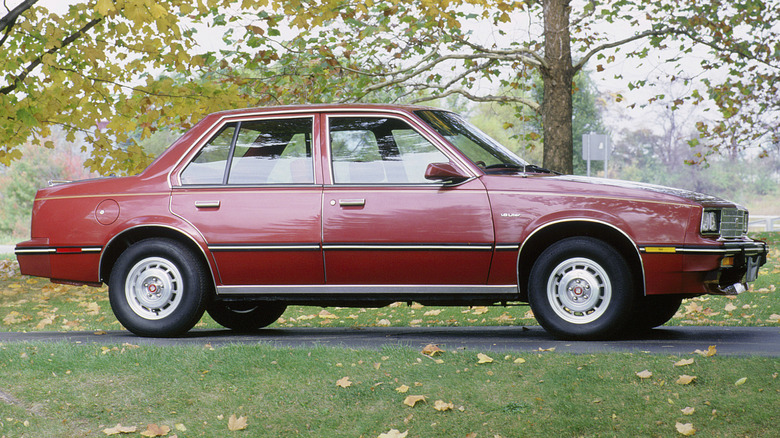
Cadillac Cimarron (1982): a Cavalier in a sharp suit
General Motors had a plan. Cadillac needed a compact car to take on the BMW 3 Series E30 and the Mercedes-Benz 190E, the two cars defining the European sports saloon at the time. Rather than engineer one, GM reached into its own parts bin and pulled out the entry-level Chevrolet Cavalier.
The Cimarron sat on the same J-body platform as the Cavalier, used the same powertrains and shared most of its design. What changed? A Cadillac-specific grille, some extra chrome, wraparound taillights, alloy wheels and an optional vinyl roof. Inside there were more heavily bolstered leather seats, fake aluminium or fake wood trim, and a longer standard equipment list including air conditioning. That was the sum of it.
Then came the pricing. In the United States the Cadillac started at around $12,000 in 1982, against roughly $7,000 for the Chevrolet it was built from, a premium of about $5,000, well over half the price of the base car. The motoring press was merciless, and the damage went beyond one model. The Cimarron became shorthand for everything wrong with badge engineering, and it took Cadillac the better part of two decades to rebuild the credibility it lost in a single model cycle. Its failure mode was pure arithmetic: buyers could see exactly what the extra money bought, and it was not enough.
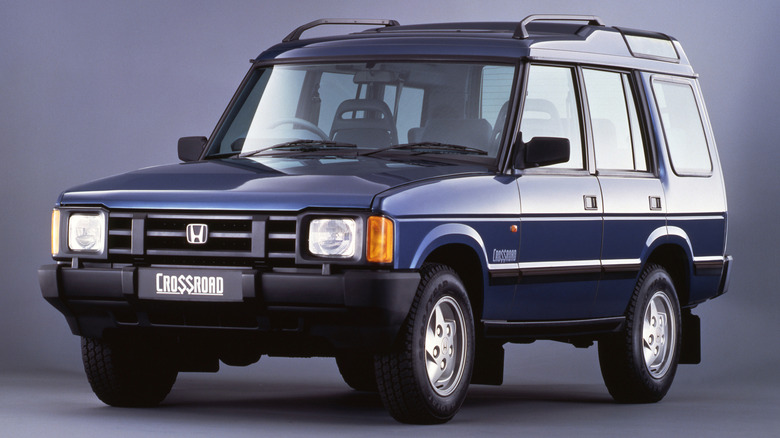
Honda Crossroad (1993): the only V8 Honda ever built
Here is a piece of trivia that still stops people in their tracks: the only V8-powered Honda ever produced was a Land Rover Discovery. The first-generation Crossroad, launched in Japan in 1993, was a rebadged Discovery Series I, complete with Honda emblems on the grille, tailgate, steering wheel and centre caps.
Everything else came straight from Britain. The bodywork, the interior, the V8 engine, the full-time four-wheel-drive system and the ladder-frame chassis were all carried over unchanged. It was offered as a three-door with five seats or a five-door with seven, which at least made it useful.
The problem was context. Japanese buyers walked into Honda showrooms expecting the engineering of a Civic, the polish of an Accord or the excitement of the original NSX, and found a British 4×4 with a V8 under the bonnet. However capable the Discovery was in its own right, it made no sense in a Honda line-up, and the Crossroad found few takers. Its failure mode was market mismatch: the hardware was fine, but it belonged to a different brand’s story.
Kia Elan (mid-1990s): the sports car that lost its soul
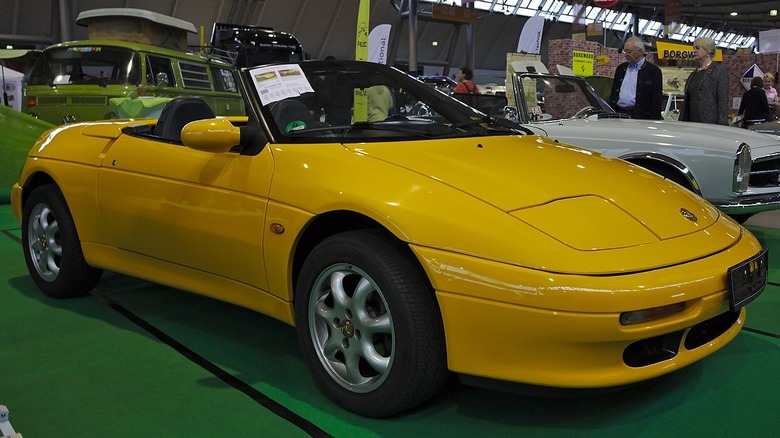
This one is stranger still, because the car underneath was genuinely brilliant. Lotus discontinued its front-wheel-drive Elan M100 in 1995 after the model lost out in the marketplace to the rear-wheel-drive Mazda MX-5. Kia then bought the tooling and the licence to build it, selling the result in Korea and exporting it to Japan as the Kia Vigato.
The changes were modest: unique taillight clusters, new wheels and a revised suspension set-up with increased ground clearance. The fibreglass body and steel backbone chassis carried over intact. The Isuzu-sourced engine was swapped for a Kia-built naturally aspirated 1.8-litre unit.
The result was a Kia that drove like a Lotus, which sounds like a compliment until you consider what it cost. Priced at ₩27,500,000 in Korea, the Elan was one of the most expensive cars on the domestic market, and buyers simply did not accept a sports car at that money wearing a Kia badge. Its failure mode was brand dilution in reverse: Kia was asking premium money before it had earned premium credibility, and no amount of suspension tweaking could fix that.
Lancia’s Chrysler era (2009 to 2014): a name revived without the credentials
The most recent and arguably most cynical chapter came after Fiat took a stake in Chrysler in 2009, before the two merged into FCA Group in 2014. Lancia, a brand with a genuine motorsport heritage and a reputation for style, was handed three new models for the European market: the Flavia Convertible, the Thema saloon and the Voyager MPV. They were rebadged versions of the Chrysler 200, the Chrysler 300 and the Chrysler Voyager respectively. The Voyager did not even get a new name.
The Flavia was the worst offender. Lancia was reviving one of its most evocative nameplates, a badge with real history behind it, and attaching it to a convertible with none of the credentials that made the original worth remembering. The changes over the Chrysler 200 were essentially cosmetic: a Lancia grille, badges and trim, with the American bones and cabin architecture left largely intact. A famous name on an unfamiliar car is not heritage. It is marketing, and buyers can tell the difference.
The Thema and Voyager were less insulting and more pointless. A Chrysler 300 with a Lancia grille was never going to persuade a European buyer that they were getting Italian design, and the Voyager’s unchanged name suggested nobody could even be bothered to finish the job. All three sold slowly, and Lancia was reduced to a single-model range in Italy by 2014. Their failure mode was naming and positioning: the engineering was competent enough, but the badge was doing work the product could not back up.
What separates a good rebadge from a bad one
The difference is rarely about the hardware. It is about whether the swap respects what the badge stands for.
Shared platforms done well are everywhere and mostly invisible. The Volkswagen Group’s MQB architecture underpins everything from a Skoda to an Audi, and buyers accept it because each brand brings its own interior, its own tuning and its own character. Nobody accuses those cars of badge engineering, because the product is unmistakably the brand it wears and the pricing reflects a deliberate choice rather than a shortcut.
The failures share a pattern, but not a single one. The Cimarron failed on price, asking buyers to pay for a badge and nothing else. The Crossroad failed on fit, dropping a British 4×4 into a showroom built on Japanese engineering. The Elan failed on timing, charging premium money under a badge that had not yet earned it. The Flavia, Thema and Voyager failed on naming and positioning, borrowing heritage the product could not justify. Each was a different mistake, and each is remembered longer than the competent cars around it. Badge engineering is not the villain here. Bad judgement is, and the industry has never quite stopped making the same mistake.
We covered car scratch repair realistic in more detail elsewhere.
We covered jamie chadwick history williams in more detail elsewhere.