A landmark win in Red Bull’s own right
The headline numbers matter. It was Verstappen’s 11th consecutive season with at least one win, a streak that now stretches back more than a decade and shows no sign of ending. It was his first of 2026, and it arrived in the strangest of circumstances.
But the significance goes beyond the driver. Red Bull spent years as an engine customer before committing to building its own powertrains, and the first win with that unit is the milestone every works team chases. Verstappen was clear about what it meant.
“I’m incredibly proud of everyone. Just super nice to win here. It’s incredible,” he said. “To win our first race in our first year with our own power unit is pretty impressive.”
He added: “It’s a really nice one after the year we’ve had and the progression we have made.”
That phrasing is telling. Red Bull has had a difficult run of results, and a win delivered by its own hardware, in a race that demanded clear thinking under pressure, is worth more than a straightforward lights-to-flag cruise.
How a 100-minute delay turned into a thriller
The race had already lost its shape before a single competitive lap was run. Heavy rainfall delayed the start by 40 minutes, and the suspended start procedure was then red-flagged for a further 60 minutes when cars suffered weather-related software glitches around the circuit. In total, the delay ran to roughly one hour and 40 minutes.
When the field finally got going, Verstappen lost the lead on the opening lap to both Mercedes, with Kimi Antonelli and George Russell sweeping past. It was the first of several swings in a race that refused to settle.
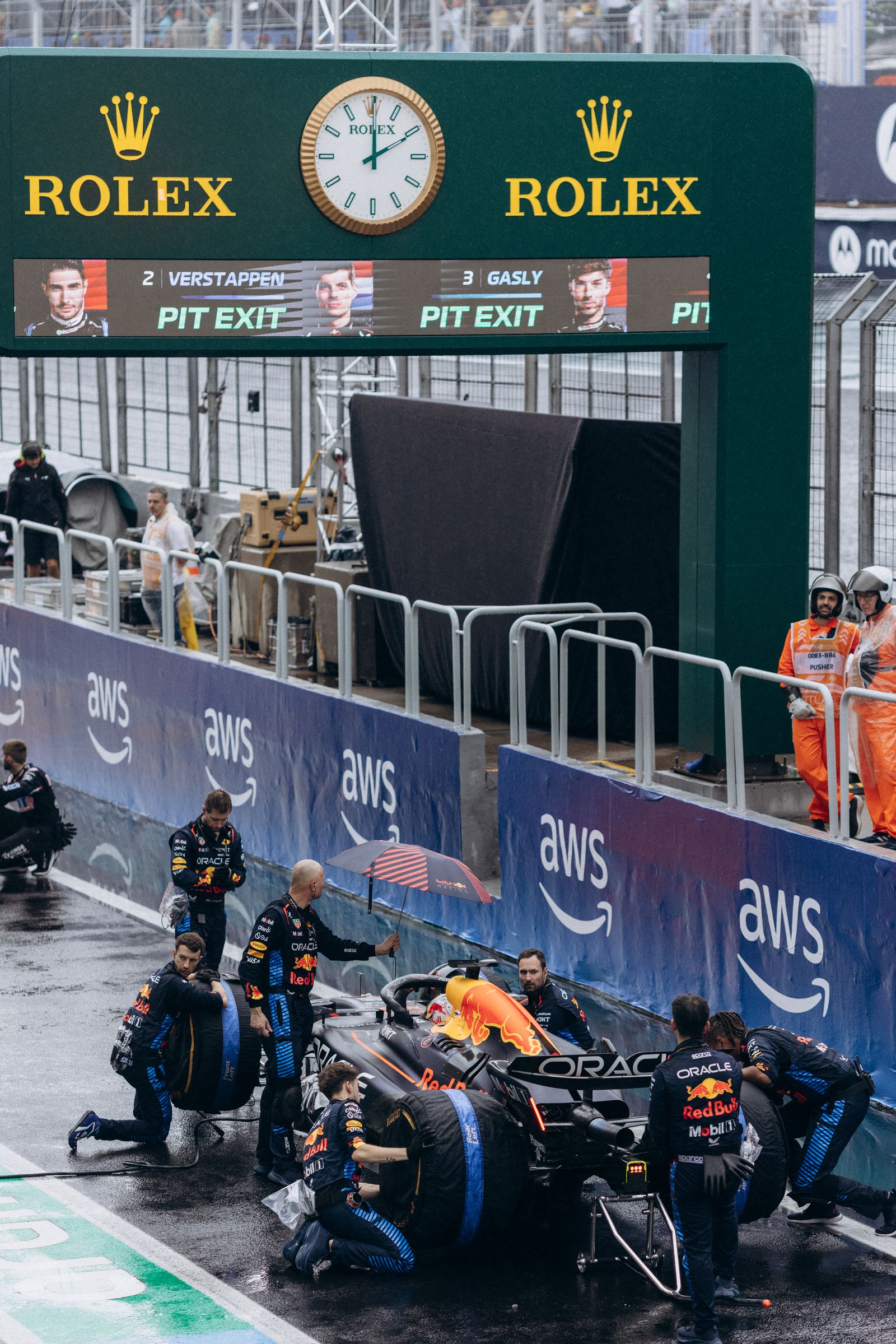
The decisive moment came on the restart. Nine drivers, including both Red Bulls and both Mercedes, chose to go straight to intermediate tyres rather than full wets. It was a calculated risk on a track that was drying faster than the radar suggested, and it split the field in two.
Valtteri Bottas spun his Cadillac, and the safety car that followed gave the intermediate runners a free stop window. They could switch to slicks without losing the time a green-flag stop would have cost. From there, Verstappen was back up to second by lap six and battling for the lead two laps later.
“It was very hectic with a lot of different things at the start. No power, so you have to wait for the power to kick in,” Verstappen said. “But then yeah, we made the right call with the intermediates and after that, step by step we moved our way forward and from there once we could do our own race until the end again, of course with a safety car, but we kept it all under control.”
The chaos at the front was not unfamiliar territory for a season that has already produced its share of restart mayhem, the sort of thing that Franco Colapinto’s Baku Crash, Five-Place Penalty and the Abuse Storm Engulfing Alpine captured earlier in the year.
Ferrari’s afternoon went missing early
While Red Bull read the conditions correctly, Ferrari read them badly. Both cars went to slicks at the start, a call that dropped Lewis Hamilton and Charles Leclerc down the order almost immediately. On a track still carrying standing water in places, it was a decision that never looked recoverable.
Hamilton salvaged third and Leclerc fourth, which flatters the raw pace Ferrari showed at points during the weekend. Oscar Piastri finished sixth, ahead of Liam Lawson in seventh and Fernando Alonso in eighth.
Isack Hadjar, in the second Red Bull, was on course for a second consecutive podium before fading late, a reminder that the sister car had the strategy right even if the result slipped away.
Russell’s retirement
With seven laps remaining, Russell stopped under the safety car with an apparent power unit failure. The timing could hardly have been worse. Instead of losing three points to teammate Antonelli, he lost 18, and with them, realistically, his championship chances.
The knock-on effect caught others too. With the field halted behind Russell’s stricken Mercedes, Lando Norris locked up and ran wide, tumbling down the order to ninth, which handed the final point to Arvid Lindblad in tenth.
“You’ve got to laugh, so many times that it’s happened this year,” Russell said. “Beyond disappointment.”
It is a brutal turn for a driver who has shown championship-winning pace this season. Earlier in the year he delivered a performance that will be remembered for years, taking a grand slam in Baku with pole, victory, fastest lap and every lap led, as covered in our F1 and MotoGP Weekend Review: Russell’s Baku Grand Slam, Colapinto’s Alpine Disaster and Acosta’s KTM Breakthrough. Reliability, not speed, has been the story of his campaign.
The championship picture
Antonelli now leads Russell by 84 points, and on this evidence the title may already be decided. The maths is unforgiving. Even if Russell won the next three Grands Prix and Antonelli retired or finished outside the points in all of them, Antonelli would still lead by nine points heading into the final four-race stretch.
That is not a gap that closes through performance alone. It requires the kind of mechanical misfortune that has already shaped this season, and it requires it to fall almost entirely on one side of the garage.
What it means for Red Bull Powertrains
The wider significance of Verstappen’s win was not lost on observers. Martin Brundle, the former F1 driver and Sky Sports analyst, was direct about the scale of the achievement.
“Christian Horner got a very good group of people together to start the Red Bull Powertrains project,” Brundle said. “That’s a hugely impressive victory for the team, power unit and chassis, from Milton Keynes.”
That framing is the right one. Building a competitive power unit from scratch is one of the hardest engineering tasks in motorsport, and doing it while also running a championship-calibre chassis operation is harder still. The first win validates years of investment.
For Aston Martin, there was a smaller but meaningful consolation. Alonso’s eighth place was the team’s best result of the season, securing four points and more than doubling their year’s total. It is a modest return, but progress is progress.
Red Bull’s own transformation, from engine customer to works winner, is the kind of change that reshapes how a team is perceived. Few such stories, though, were settled in a single rain-soaked afternoon in Bahrain.
Verstappen’s win will be remembered as the day the Red Bull Powertrains project delivered. The championship may already be Antonelli’s, but the longer game just changed hands.
For more on this, see singapore sprint verstappen wins.