
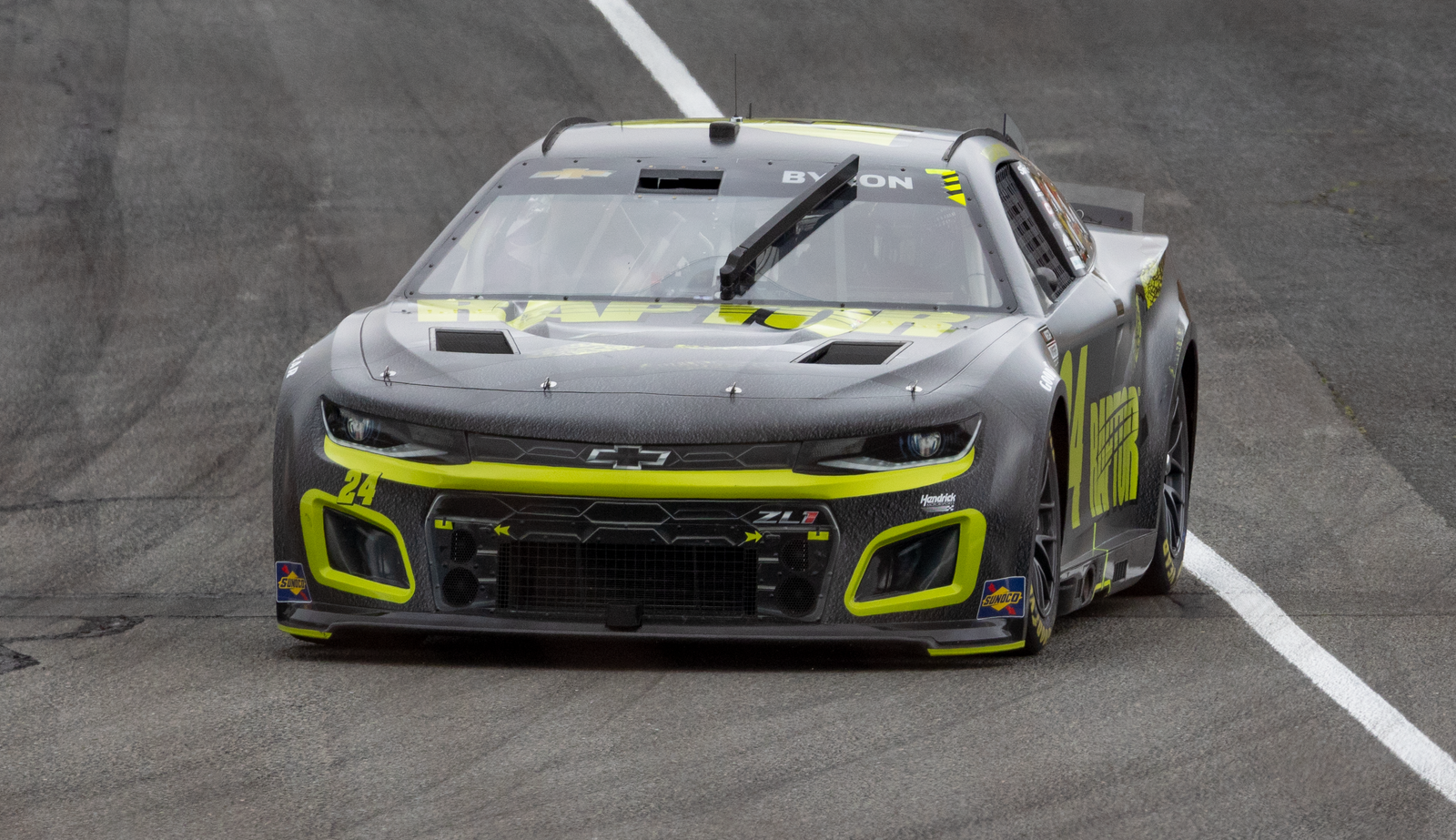
Chase Briscoe arrived in Las Vegas carrying the weight of a race he felt he had thrown away. He left it holding a trophy, a swept pair of stages and the satisfaction of beating the same driver who had denied him seven days earlier.
Briscoe won the South Point 400 at Las Vegas Motor Speedway, leading the most laps and holding off Kyle Larson across the final 12 laps to bank 75 points for the victory. Tyler Reddick finished third, despite being sent spinning through the grass on the last lap and crossing the start-finish line via the pit lane.
It was a performance that answered the question hanging over Briscoe’s week. At Kansas, he had passed a dominant Larson with 30 laps to go, only for the championship leader to snatch the lead back with seven remaining and win. Briscoe described his mindset in that closing stretch as “desperation mode,” chasing a driver he had already beaten to the corner. This time, he did not have to chase.
Briscoe sweeps the stages and controls the closing laps
The win was built on front-running rather than recovery. Briscoe took both stages, kept his car in clean air when it mattered and gave himself track position to defend over a final run that turned into a straight fight with the fastest driver in the series.
His account of the last 12 laps was refreshingly honest about how much guesswork is involved in defending at a mile-and-a-half oval.
“In one and two, I felt like if I could just somewhat cover where he was at, it’s a huge guessing game,” Briscoe said. “But I knew in three and four, if I just hit the bottom properly and slowed down, which I’m normally not very good at, that he was going to have a hard time getting by me.”
That self-assessment is telling. Briscoe has won races on raw speed, but this one required him to be patient in the corners where patience does not come naturally. He slowed the car deliberately, hit the bottom of turns three and four, and made Larson’s preferred line a difficult one to complete.
“Just glad I was able to hold on,” he said. “Last week was not a very fun mental place to be after throwing one away.”
Redemption, with an apology attached
Briscoe did not pretend the Las Vegas result erased Kansas. Asked whether the win made up for the previous week, his answer moved in two directions at once.
“Yeah, absolutely… I mean, not really. We could have had another win,” he said. “I don’t think I would’ve been able to get on the plane, they would’ve all kicked my butt if I – [crew chief] James [Small] definitely. I was scared to see him if I didn’t pull that one off. What an amazing day.”
The apology to his crew for “not going back-to-back” says plenty about how NASCAR teams measure a fortnight. Two wins in two weeks would have been a statement. One win, however well driven, still leaves a crew chief and a pit crew wondering about the one that got away.
How the final lap fell apart behind him
Larson’s last-lap attempt was the kind that decides races and, occasionally, championships. He entered turn four hot, the car got loose, and he slapped the wall. The contact collected Reddick, who was spun through the grass and had to complete his lap by way of the pits. Reddick kept the podium because the caution came out after he had already been scored on the previous timing loop, and the field behind him was not close enough to be shuffled ahead.
For Larson, it was the last act of a race that had already gone badly and then gone well and then gone badly again.
Larson extends his points lead from a poor race
The championship leader should not have been in contention at all. Larson fell a lap down in stage one after dropping through the field from a fifth-place battle and taking a long pit stop so his crew could work on the right front of the car.
From there he rebuilt. He was back in the top three with 75 laps to go, passed Bubba Wallace with 12 laps remaining and looked set to make Briscoe’s life genuinely difficult. Then his charge slowed with five laps left, and the final-lap wall contact finished the job.
Despite all of it, Larson left Las Vegas with his advantage extended to 40 points over Denny Hamlin. In NASCAR’s scoring, a race win is worth up to 60 points and a stage win up to 10, so a single afternoon can swing 70 or more. Forty points with five races left is roughly two-thirds of a race win, which is why it counts as a cushion rather than a lock. That is the mark of a driver and a team operating at a level where a compromised afternoon still returns a net gain.
Hamlin’s luck runs out again
Hamlin’s afternoon lasted only as far as stage one. Running fourth, he spun on his own, an unforced error that cost him track position and points on a day when his closest rival was struggling.
The 40-point gap to Larson is not insurmountable with five races remaining, but it is the kind of margin that requires the leader to have problems. Larson has now shown he can absorb a poor race and still come out ahead.
The playoff standings after Las Vegas
Briscoe’s win moved him up three positions in the Cup Series Playoffs, from ninth to sixth. He now sits four points behind Ryan Blaney and 84 points off the lead with five races remaining. Briscoe drives the No. 19 Toyota for Joe Gibbs Racing, the same team that fields Hamlin’s No. 11.
The swing matters because of what it does to the shape of the playoff field. Briscoe has gone from a driver hoping to survive the next cut to one who is genuinely in the mix for the rounds beyond it. Four points to Blaney is a single bad pit stop. Eighty-four to Larson is a tall order, but the gap to the front of the chasing pack is now measured in single digits.
Reddick’s third place, earned the hard way, keeps him in the conversation as well. The final-lap contact could easily have cost him a top-five finish and the points that come with it.
What comes next at Charlotte
The playoffs move on to Charlotte next week, a track that rewards a different set of qualities. Las Vegas was about managing a long-run car and defending clean air. Charlotte tends to put more emphasis on pit strategy and track position, and it has a habit of producing the kind of late-race restarts that turn a controlled afternoon into a lottery.
For Briscoe, the task is to prove that Las Vegas was more than a single good day. He has now beaten Larson in a straight fight, which is the hardest thing to do in this series. Doing it twice in five weeks, at a track where Larson has had strong results in the past, would change how the rest of the field views him.
For Larson, the task is simpler and more familiar. He leads by 40 points with five races left, he survived a race in which he went a lap down, and he still nearly won it. That is not a warning. It is a status report.
Las Vegas delivered a race decided by a driver refusing to repeat a mistake. Briscoe had one lap, one corner and one of the best drivers in the world behind him. He got it right.
We covered forever rowdy las vegas in more detail elsewhere.





One Comment