
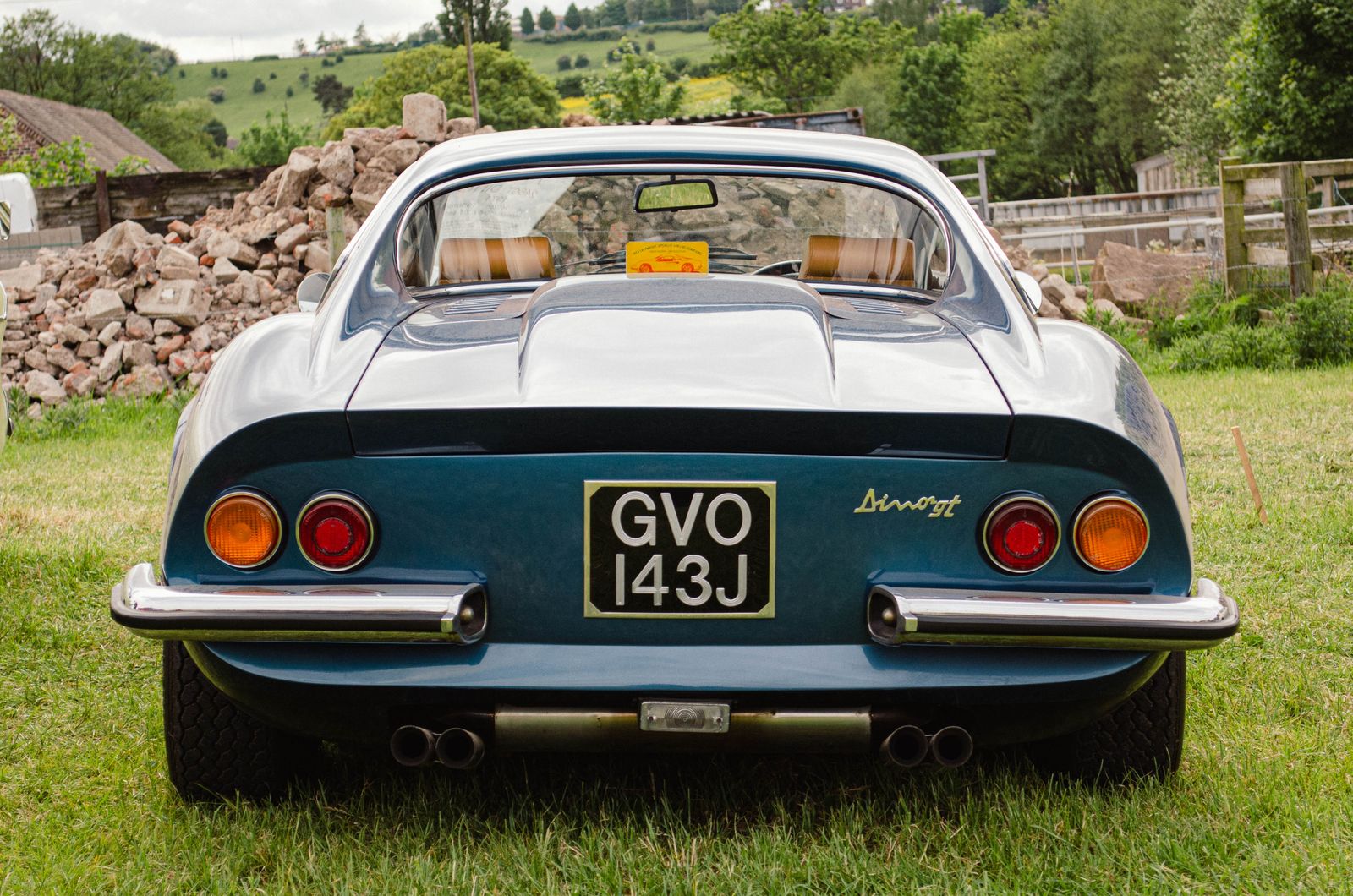
The Ferrari that wasn’t allowed to be a Ferrari. No prancing horse on the nose, no Ferrari script on the cam covers, just a single word: Dino. When it launched in 1967, putting the Ferrari badge on a V6-powered car was considered sacrilege. Maranello’s road cars had V12s, and that was that. Yet the car born from that compromise is now regularly called one of the most beautiful shapes ever to come out of Maranello, even though it never wore the Ferrari badge at all.
A Son’s Legacy
The Dino story starts with a person, not a product. Alfredo “Dino” Ferrari, Enzo’s son, spent the 1950s arguing that Ferrari should build a mid-engine road car, and he helped design a series of small-bore twin-cam V6 engines for Grand Prix racing. He died of muscular dystrophy at just 24, before any of that work reached the road.
The V6 might have stayed a racing curiosity were it not for the rulebook. Formula 2 regulations required racing engines to be production-based, with a homologation minimum of 500 units. Building 500 road cars to go racing was a stretch for Ferrari alone, so Fiat came in on the project. The lightweight aluminium V6 would be shared between two cars: the mid-engine Dino 206 and the front-engine Fiat Dino. One engine, two very different machines, and a sub-brand invented partly to keep the Ferrari name clean.
From Concept to Road: The 206 GT
The roadgoing Dino was the first mid-engine Ferrari road car, and it began as a 1965 concept by Sergio Pininfarina. Aldo Brovarone at Pininfarina developed that show car into the production Dino street machine, which debuted in 1967 and was widely praised at the time as the best-looking car on sale.
The numbers backed up the shape. A 2.0-litre V6 produced 178 bhp, and Ferrari quoted a dry weight of just 900 kg. Its contemporary rival, the Porsche 911S, made 160 bhp. The Dino was more than a match on power while weighing around 136 kg less. This was not a styling exercise with a modest engine; it was a genuine performance car that happened to look like a sculpture.
The 246 GT Arrives
For the 1969 model year, capacity rose to 2.4 litres and quoted output climbed to 195 bhp. The 911, meanwhile, had moved to 170 bhp, so the gap widened rather than closed. The 246 GT also grew its wheelbase slightly and put on about 180 kg as alloy bodywork gave way to steel. Even carrying that extra mass, it still bettered the 911’s power-to-weight ratio.
Buyers could choose the closed-top GT or the GTS with its lift-out roof. Ferrari quoted 0-60mph in 8.2 seconds, a serious figure for a car of its era. That lengthened wheelbase, a light tweak in engineering terms, is the change most often credited with turning a very pretty car into a legendary one.
Behind the Wheel
The mechanical recipe is as romantic as the bodywork. A trio of Weber downdraft carburettors feeds the V6, which spins to an 8,000 rpm redline through a gated manual gearbox, with steering that responds directly and without filter. On a British B-road, that combination is the whole event: a narrow, cammy V6 that needs revs, a dogleg gate that rewards a clean shift, and unassisted-feeling steering that telegraphs every camber and patch of broken tarmac straight to your palms. It is not a car you drive quickly so much as one you drive precisely.
Hagerty’s David Lillywhite put the experience better than any spec sheet can: “this 192bhp V6 (175bhp for the US) is perfectly suited for the little Dino, lighter and more subtle than a V8, more special than a four-pot … It’s smooth and, when the triple carbs are set up well, it pulls without complaint until it starts to emit a suitably Ferrari-like howl that somehow no other marque quite achieves.”
That last clause is the whole appeal in one sentence. The Dino may not have been badged as a Ferrari, but it sounded like one.
The Horsepower Question
Ask what a Dino 246 GT actually produced and the answers diverge. Ferrari’s own figures and Hagerty’s drive report cite 192 bhp, with 175 bhp for US-market cars. Jalopnik’s figure for the 246 is 195 bhp. The discrepancy is unresolved in the sources, and it says something about how period performance was quoted: differently by different markets, at different times, sometimes rounded for effect. For a buyer or an enthusiast today, the honest answer is that a well-sorted 246 makes somewhere in the region of 190 bhp, and that the exact number matters far less than how it delivers it.
The Shape That Never Left
Pininfarina was ready for the critics. As he put it, per Motor Trend: “The voluptuous thematic of the curves, stylistically fascinating and aerodynamically exact, goes beyond any hasty criticism which might object to the front, exposed to bumps and mud.”
He had a point. The curvaceous, pointed nose and the delicate flying buttresses that taper the silhouette into something impossibly smooth are the details that make the Dino. It is worth remembering what it avoided becoming. Mid-engine layouts of the era produced the Lotus Europa and the Porsche 914, both interesting cars and neither remotely beautiful. The Dino took the same packaging problem and solved it with grace.
The argument that follows is a strong one, and it belongs to a particular school of Ferrari enthusiasts rather than to any settled consensus: that Maranello has not built a truly beautiful car since. The last genuinely handsome machine to wear the Ferrari badge, on this reading, was the 1964 250 LM, and that was a race car. Everything since has been fast, dramatic, sometimes spectacular, but rarely as quietly perfect as the Dino.
It is a theme that runs through the collector market more broadly: distinctive, well-documented cars with a story attached keep finding serious money, whether that is Michael Jordan’s Ferrari 550 Maranello selling for $2.7 million (around £2.1 million), more than double its estimate, or a Ruf-rebuilt Porsche 914-6 once owned by designer Luc Donckerwolke making €225,000. Provenance and design integrity carry a premium, and the Dino has both in abundance, which is why values have never really softened.
Why the Dino Earned Its Legend
Strip away the badge politics and the Dino’s achievement is straightforward. It was the first mid-engine Ferrari road car, a machine built to satisfy a homologation rule and honour a son, which turned out to be better than anyone at Maranello had any right to expect. The 206 proved the concept; the 246, with its slightly longer wheelbase and steel body, perfected it.
The badge question has aged into a curiosity rather than a criticism. Nobody today looks at a Dino and thinks it is diminished by the absence of a prancing horse. If anything, the missing badge is the point: it marks the one time Ferrari built something this beautiful without needing to say its own name. Enzo reportedly considered the V6 unworthy of the Ferrari name. Six decades of enthusiasts have decided otherwise.




2 Comments