
What the teaser actually shows
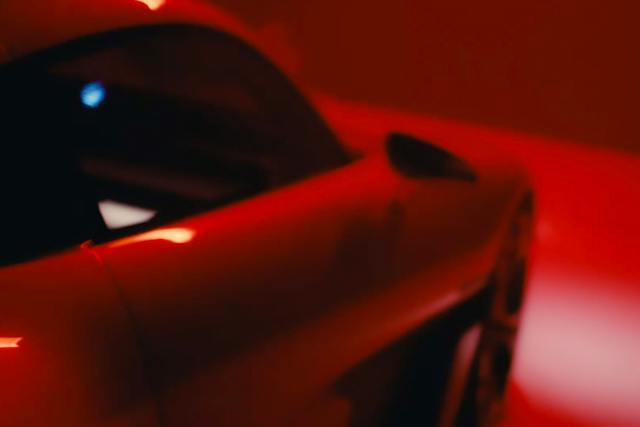
Porsche has been characteristically stingy with detail, but the 30-second clip gives away more than the company might like to admit. The headlights are the first clue. They sit closer in shape and proportion to the 918 Spyder than to the sharp, vertically stacked units of the Mission X concept that previewed Porsche’s electric hypercar ambitions. That alone suggests the Mission S is a different kind of statement, less sci-fi showpiece and more road-going supercar.
At the rear, thin horizontal taillights echo the Mission X, but the more interesting detail is the silhouette. There is a prominent centre spine running along the deck, and what looks like a snorkel feeding an airbox. That is classic mid-engine territory, and it lines up neatly with Porsche’s own confirmation of the layout. If you are old enough to remember the 918, the shape will feel familiar in all the right ways.
A model line above the 911
The hierarchy is the real story here. Porsche has built halo cars before. The Carrera GT arrived in 2004 and the 918 Spyder followed in 2013, both widely documented milestones in the company’s back catalogue. Neither displaced the 911 from the top of the range. They were flagships in spirit, not in the showroom pecking order.
The Mission S changes that. Porsche has stated plainly that the architecture supports a full model line above the 911, which is a first for a company that has guarded its core model with almost religious devotion. The 911 continues to sell strongly, so this is not a case of a struggling model being nudged aside. It is a deliberate expansion upward, into territory Porsche has largely left to Ferrari, McLaren and Lamborghini.
That shift matters because it reframes what Porsche is as a brand. For decades, the 911 has been the answer to the question of what a Porsche sports car is. Now there may be a more expensive, more exotic answer sitting above it.
Filling an 11-year gap
The 918 Spyder left production 11 years ago. Since then, Porsche has had nothing to offer at the very top of the supercar market, a gap that has grown more glaring as rivals have refreshed their line-ups. If the Mission S reaches production, it would line up against the Ferrari 849 Testarossa and the McLaren 750S, both of which occupy the rarefied air Porsche has been absent from.
That absence has not gone unnoticed by buyers with seven-figure budgets. The 918 was a technological showcase, a plug-in hybrid hypercar that arrived before the market was ready for it. A successor has been rumoured for years, and the Mission S finally gives those rumours a shape.
The supercar segment has always been as much about heritage as performance, and Porsche’s rivals lean heavily on theirs. Marques like Alfa Romeo have shown how a brand’s back catalogue can be marketed for decades, and Porsche has a comparable treasure chest, from the 959 to the Carrera GT. The Mission S is a chance to add to it rather than simply trade on it.
Flat-eight rumours and the Audi question
The production version is rumoured to use a flat-eight engine, which would be a genuinely unusual choice. Porsche has a long history with flat-sixes, and the 918 used a hybrid powertrain pairing a V8 with electric motors. A flat-eight would be a new chapter, and it would give the car a distinctive character in a market where turbocharged V6 and V8 hybrids are the norm.
There is also the question of the Audi Nuvolari. The Mission S is expected to differ from its stablemate under the Volkswagen Group umbrella, though how much is unclear. Shared platforms are standard practice across the group, but Porsche has been careful to signal that the Mission S will have its own identity. More detail should arrive at the reveal, and the engine choice will be the clearest indicator of how serious Porsche is about separating the two cars.
It is worth remembering that Porsche has form when it comes to making a shared architecture feel entirely its own. Within the Volkswagen Group, the same underpinnings have produced wildly different characters depending on how a model is specified and tuned, and Porsche will be hoping the Mission S does the same for its own flagship ambitions.
The business case behind the halo car
This is not purely an emotional project. Porsche CEO Michael Leiters has cited a new mid-engine supercar as part of the plan to improve the company’s finances, and the numbers explain why. Porsche’s profits fell from just under £4.7 billion in 2024 to roughly £80 million in 2025, according to reported figures. That is not a dip. That is a collapse.
A halo car will not fix those figures on its own, and Porsche knows it. Low-volume supercars rarely do. But a flagship can lift a brand’s entire perception, support residual values and give dealers something to draw customers into showrooms. It also signals confidence at a moment when the wider industry is navigating an uncertain transition to electrification, a theme that runs through Chinese EV Threat, BMW’s New 3-Series and Mazda’s Rotary Revival: This Week’s Auto Industry Roundup.
Reports about a month before the teaser suggested Porsche was considering a new sports car and would decide on production by the end of the summer. The Mission S teaser landing now suggests that decision has been made, or is close to it. Either way, the timing is not accidental.
What to watch for on 15 October
The full reveal should answer the questions the teaser deliberately leaves open. Will the production car use a flat-eight, or will Porsche fall back on a hybrid V8? Will the Mission S be a limited-run flagship or the first of a broader model line? And will it actually reach production, or is this another concept destined for a museum floor?
The deeper question is whether Porsche can succeed where the Carrera GT and 918 Spyder did not, by building a car that genuinely sits above the 911 without undermining it. That is a delicate balancing act for a company whose identity is tied so tightly to one model. Get it right, and Porsche has a new flagship for the electric era. Get it wrong, and it risks confusing the very customers who have kept the 911 at the top for decades.
For now, all we have is a silhouette, a slogan and a date. On 15 October, Porsche will have to show its hand.




One Comment