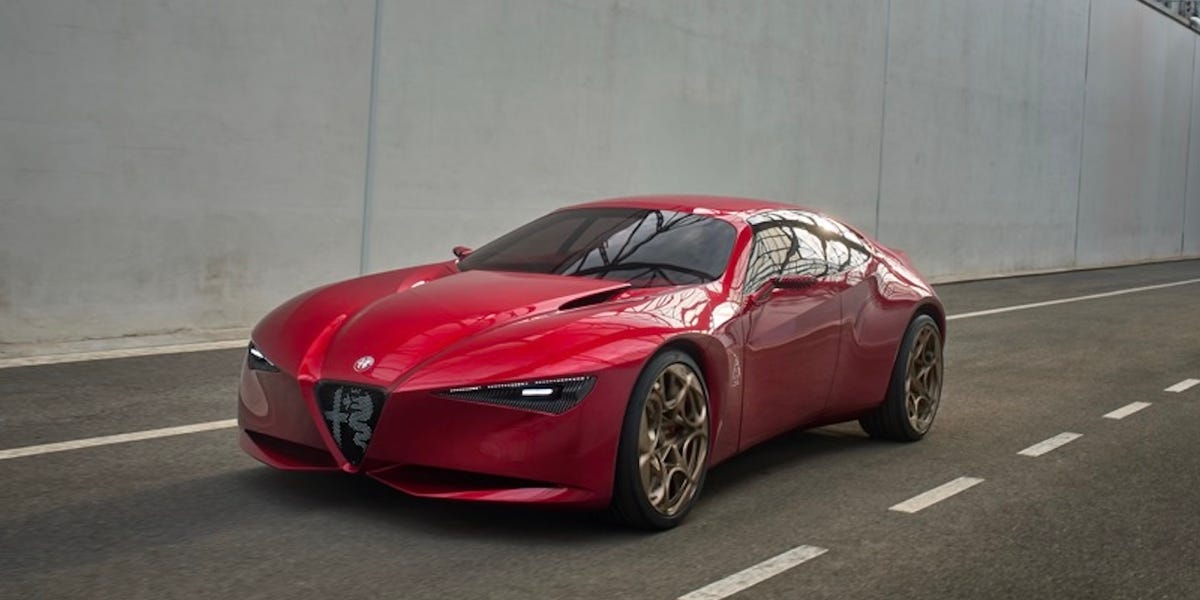
Alfa Romeo’s Cuorerosso concept has arrived at the 2026 Paris Motor Show, and it comes with a built-in contradiction. The Italian brand describes it as a 2+2 coupé with rear-hinged coach doors, a hybridised twin-turbo V6, a 1,750 kg kerb weight and a paint finish that shifts from red to black as you walk around it. It is also, by Alfa’s own admission, a car you will never be able to buy.
That contradiction is the whole point. The brand is unusually blunt about what the Cuorerosso is and is not. It describes the concept not as “an anticipation of a production model” but as a “manifesto destined to inspire future models,” and as a preview of how the marque intends to electrify its line-up. Read that carefully and you get the shape of Alfa’s next decade: hybridised combustion, all-wheel drive, aggressive aerodynamics and a design language meant to survive the transition to whatever powers cars in the 2030s.
The Paris show has become a reliable stage for exactly this kind of statement, much as it was for the Fiat Multiplay concept, and the Cuorerosso sits in that tradition of concepts built to plant a flag rather than fill an order book.
Chassis and powertrain: hybrid V6, all-wheel drive, steer-by-wire
The hybridised 2.9-litre V6 is the most significant detail for anyone watching the brand’s direction, so it belongs near the top. Alfa has not gone all-electric here, and it has not ruled electrification out either. Instead it has shown a halfway house: combustion heart, electric assistance, all-wheel drive traction and a chassis sophisticated enough to manage the weight that comes with it.
Beyond the engine, Alfa has confirmed air suspension and steer-by-wire, plus Brembo carbon ceramic brakes. The combination points to a car designed to switch character on demand, comfortable over distance and sharp when asked, which fits the GT-supercar brief Alfa keeps returning to. Whether any of it becomes a production reality is a separate question, and one Alfa is refusing to answer.
A manifesto, not a showroom car
Alfa’s messaging around the Cuorerosso is deliberately careful. There are no production plans, no launch window, no confirmed price and, notably, no performance figures at all. The powertrain is described only in outline: a hybridised version of Alfa’s familiar twin-turbocharged 2.9-litre V6, sending drive to all four wheels through a torque-converter automatic and a carbon-fibre driveshaft. Power, torque, acceleration and top speed have all been left unsaid.
What Alfa will talk about is intent. The Cuorerosso is framed as a demonstration that electrification and the Quadrifoglio spirit can coexist, and the company’s stated hope is that the concept inspires future Quadrifoglio models. In other words, this is the brand sketching out its own future in public, then inviting everyone to argue about it.
Proportions that sit between GT and supercar
The Cuorerosso is a 2+2 coupé, which already sets it apart from the two-seat supercar template. It is slightly longer and slightly wider than a Giulia Quadrifoglio, and Alfa describes the proportions as blending GT car and supercar character. The rear-hinged doors are the most theatrical element, opening to reveal a cabin with no B-pillar interruption and a clear view straight through the car.
At 1,750 kg, the concept sits in an unusual spot. A Giulia Quadrifoglio weighs around 1,620 kg, so the Cuorerosso carries roughly 130 kg more than Alfa’s own super-saloon, while a dual-motor electric SUV of comparable size typically runs well past 2,200 kg. That puts the concept in the middle ground Alfa is aiming for: enough battery and hybrid hardware to make a difference, but not so much that the car stops feeling like an Alfa.
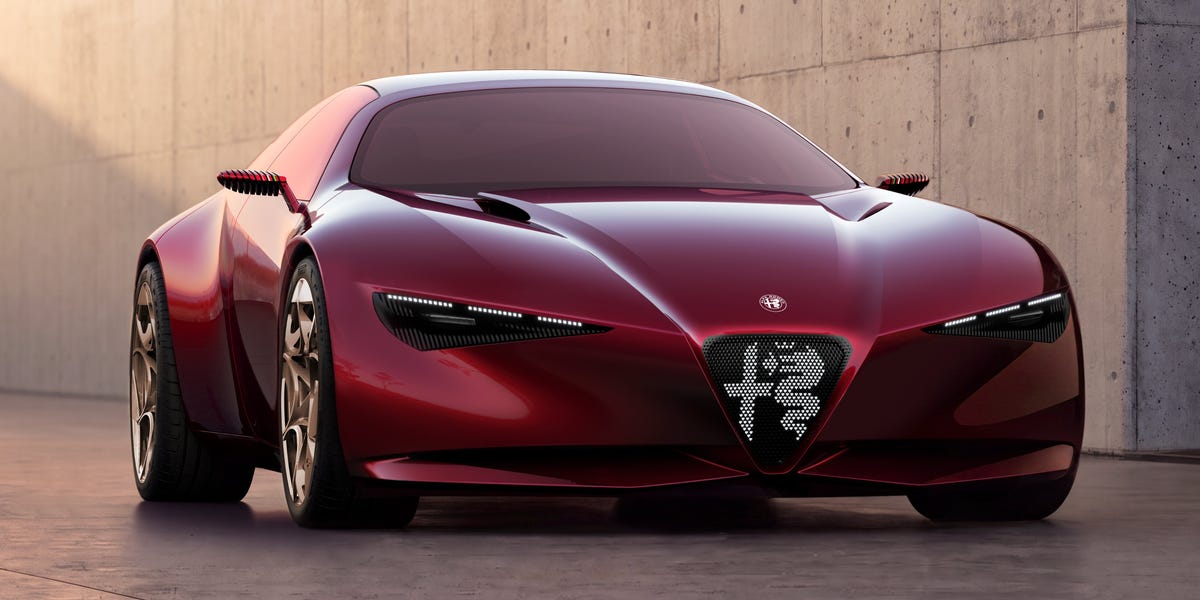
The paint is a new shade called Liquid Red Ink, built on a fine aluminium base with a coloured transparent layer. Depending on the viewing angle it reads as deep red or near black, which gives the bodywork a moving, liquid quality that static photography struggles to capture.
Exterior details and a 0.28 drag coefficient
Up front, the Scudetto grille is backlit and carries Cross and Biscione graphics, a modern reading of Alfa’s oldest symbols. The bonnet is sculpted in a shape the designers describe as inspired by a boat’s wake, a flourish that gives the nose a sense of motion even when parked.
The wheels are forged and reinterpret Alfa’s classic telephone design, with six circular elements arranged across three spokes. Quadrifoglio logos sit behind the front fenders, two circular taillights bookend the rear, and stacked centre-exit dual exhausts finish the car off. There is an integrated diffuser below, and a rear window shaped as a triangle in the Scudetto’s own form.
Aerodynamics rarely make headlines, but the Cuorerosso’s 0.28 drag coefficient is one of the more revealing numbers in the whole package. For context, a Porsche 911 Carrera runs at around 0.29, so Alfa has matched or edged a benchmark sports car despite the concept’s more theatrical surfacing. The figure comes from a rear end Alfa calls the Coda Trunca, or truncated tail. Instead of tapering gently, the bodywork is cut off sharply, letting the airflow separate cleanly rather than cling to a long sloping deck.
The triangular rear window, styled in the Scudetto shape, contributes to the same goal while doubling as a piece of brand iconography. It is a neat piece of engineering-as-identity: the feature that helps the car slip through the air is also the one that makes it unmistakably an Alfa Romeo from behind.
That heritage-first approach is a thread running through the group’s recent concept work, much as it was with the Peugeot E-T16 tribute, which dressed modern electric hardware in a livery lifted straight from the eighties.
Inside the Magma Display cabin
The interior is aggressively minimal. Alfa calls the centrepiece the Magma Display, and it amounts to two gauges, two air vents, a futuristic shifter and physical controls in the centre stack. After a decade of manufacturers replacing knobs with screens, the presence of actual buttons is a deliberate statement.
Materials include leather, recycled carbon fibre and a monofilament fabric developed with the sailing team Luna Rossa, a partnership that gives Alfa access to lightweight textile expertise from outside the car industry. The overall effect is closer to a cockpit than a lounge, which is presumably the intention.
What the Cuorerosso signals for the next Quadrifoglio
The concept sets out the brand’s terms for electrification: hybridised powertrains rather than an immediate jump to batteries alone, weight kept in check, aerodynamics treated as a design discipline rather than an afterthought, and the Quadrifoglio badge reserved for cars that earn it. The real question is what that means for the next Quadrifoglio to reach showrooms.
The answer, reading between the lines, is that Alfa is buying itself time. Rivals have committed to full electrification on fixed dates and then quietly walked some of those commitments back. Alfa has done the opposite: it has shown a hybrid flagship concept first and left the door open on timing, which suggests the next Quadrifoglio will arrive with combustion still under the bonnet and electric assistance alongside it.
There is no confirmed production model, no timeline and no price. What there is, for now, is a statement that Alfa intends to electrify without sanding off the edges, and a hope from the company that this concept shapes the Quadrifoglios still to come. Given how many recent concepts have promised reinvention, that is a modest ambition. It is also, for a brand with Alfa’s history, the one that matters most.