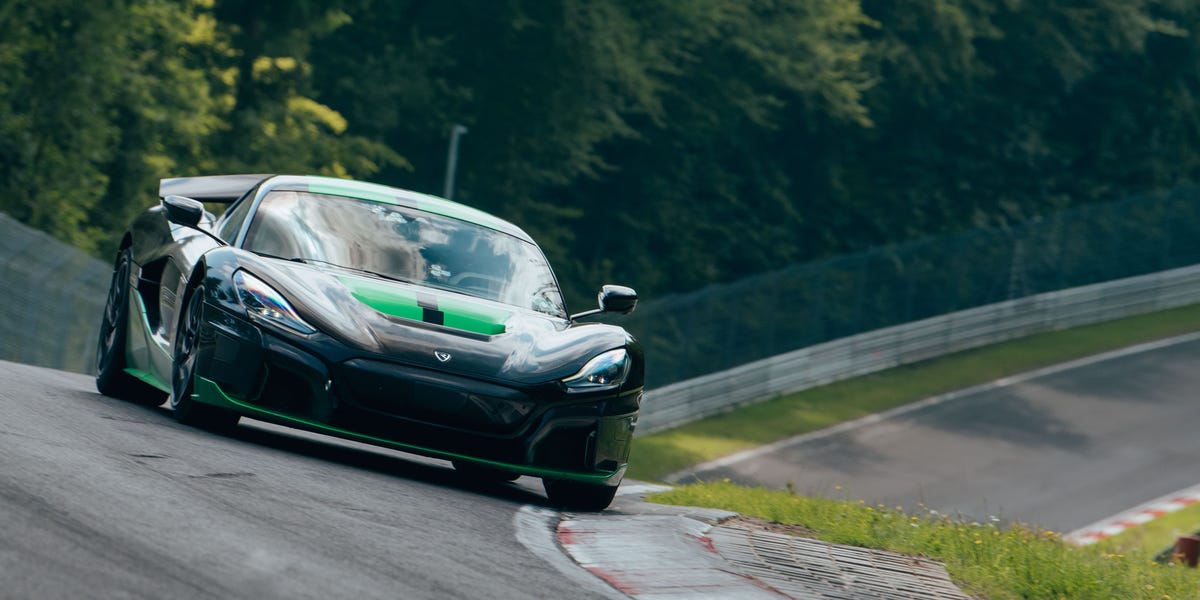
Production ends in 2026 with 71 cars built
The numbers behind the Nevera’s retirement are stark. Of the 190 cars originally planned, Rimac will have built 51 of a planned 150 base Neveras and 20 of a planned 40 Nevera R models. Mate Rimac confirmed that 51 plus 20 split himself in a recent Instagram video, so there is no ambiguity about the arithmetic. Treat the 71 figure as the projected final tally rather than a confirmed one, since the line is still running until the end of 2026.
It is worth keeping some perspective, though. Even at 71 cars, the Nevera remains the highest-selling electric hypercar of its kind. That says as much about the size of the market as it does about the car. Building a four-figure hypercar run was always going to be a stretch when the pool of buyers prepared to spend seven figures on an EV is so shallow.
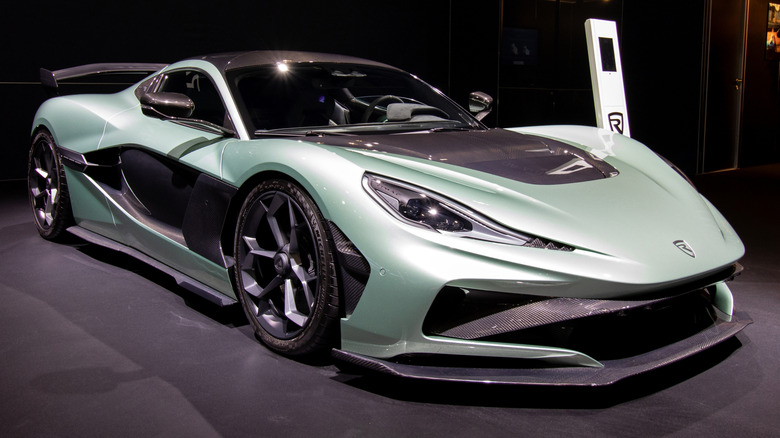
The record book the Nevera wrote
If sales were modest, the achievements were anything but. The Nevera and Nevera R have held a remarkable collection of records:
- World’s quickest car in the quarter-mile, with a run under 7.9 seconds
- Former EV lap record at the Nürburgring Nordschleife
- 0 – 249 – 0 mph (0 – 400 – 0 km/h) in 25.79 seconds, set in a single-day run of 24 world records
- 0 – 62 mph (0 – 100 km/h) in 2.96 seconds
- 0 – 124 mph (0 – 200 km/h) in 3.95 seconds
- 0 – 186 mph (0 – 300 km/h) in 7.89 seconds
- 268.2 mph top speed, an EV record until the Yangwang U9 Xtreme
The 24-record day came in 2024, and the Nevera R’s sprint and top-speed marks followed in 2025. The 0 – 249 – 0 mph figure has since been beaten by the Koenigsegg Jesko Absolut.
The Nevera was unveiled in 2021, and in the years since it has been the benchmark against which every fast electric car has been measured. Very few cars retire with a record book that dense.
Mate Rimac’s verdict: smartwatches versus watches
So how does the founder square 71 cars against a plan of 190? With an analogy rather than an apology. Mate Rimac has compared electric cars like the Nevera to smartwatches: technically more advanced than a traditional timepiece, but lacking the same cachet and the same enduring value. On that reading, the Nevera’s shortfall is not a product failure but a category problem. Buyers at this end of the market are not shopping for the most capable object. They are shopping for the one they want to keep.
Rimac has said plainly that he does not consider the Nevera a failure, and he expects high-end cars to stick with combustion engines in future. It is a striking thing to hear from the man who built the world’s most celebrated electric hypercar, and it lands with more weight because of who is saying it.
A pattern across the electric hypercar market
The Nevera’s early retirement fits a wider pattern. Lotus has moved from the Evija to a hybrid V8 supercar. Porsche, once a Rimac stakeholder, considered an electric hypercar before pivoting to an internal combustion supercar. The direction of travel at the top of the market is clear.
Buyers are increasingly gravitating towards what the industry likes to call analogue performance cars: big engines, mechanical feel, and the sense that the thing will still matter in twenty years. Gordon Murray Automotive and Koenigsegg are among the marques associated with that analogue approach. When the people with the deepest pockets want a hypercar, they are reaching for cylinders, not kilowatts.
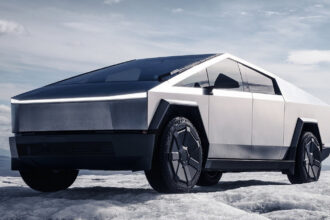
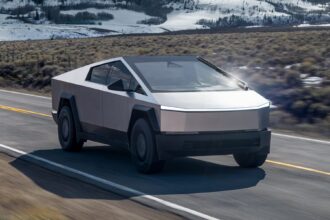
It is a pattern echoed elsewhere in the EV world, where ambitious production plans have run into the reality of softer demand. Tesla, for one, is winding down its Cybertruck, as covered in our report on Tesla Cybertruck production to end in 2027: what went wrong for the polarising pickup.
What the Nevera leaves behind
The Nevera’s real legacy is not the sales chart. It is what the car made possible. Without it, the Volkswagen Group may never have pursued a deal with Rimac at all, and Mate Rimac would not now be fully in charge of Bugatti. The Nevera put a small Croatian outfit on the map and turned its founder into the man running one of the most storied names in motoring.
The car’s influence runs through the Bugatti Tourbillon, too. The Nevera was originally intended as the basis for an all-electric Bugatti, but Rimac instead made the Tourbillon a hybrid with a naturally aspirated 8.3-litre V16 from Cosworth. The fastest electric car of its era directly shaped the decision to keep combustion at the heart of Bugatti’s future.
There is a commercial legacy as well. Rimac Technology now supplies electric powertrain components to major cars, including the Porsche 911 Turbo S, and the Nevera served as the base for the closely related Pininfarina Battista. The car’s engineering has outlived its order book.
Rimac’s profile has brought its share of strange episodes, including the time a Bugatti Chiron was taken from the company’s headquarters and the boss gave chase himself, a story we covered in Mate Rimac’s Bugatti Chiron stolen from HQ and he chased it down himself.
The quickest cars, and what comes next
Until the new Tesla Roadster actually reaches the road, the Nevera remains among the quickest cars on the planet. That is an odd sentence to write about a model going out of production, but it is the honest one.
The end of the Nevera says something about the next generation of fast cars: that the halo model of the coming decade is more likely to be a hybrid V16 or a screaming naturally aspirated V8 than a quad-motor EV. The Nevera proved what electric power could do. It could not prove that buyers wanted it at any price. Seventy-one cars is the market’s answer, and Rimac, to his credit, is listening rather than arguing.
We covered james bond cars db5 in more detail elsewhere.