
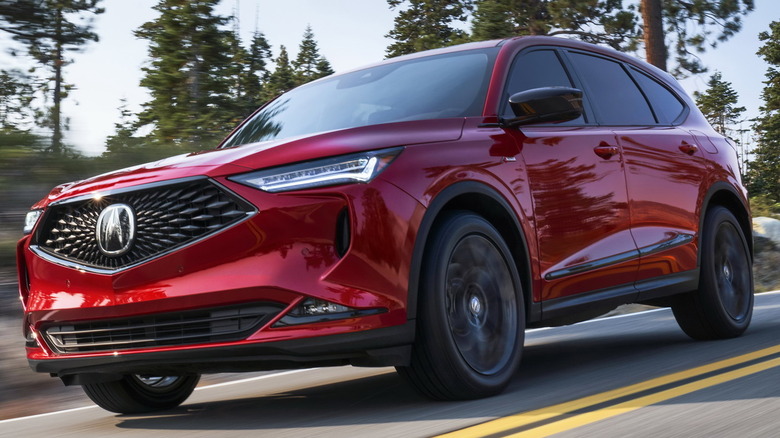
Acura has never been a brand to shout about its plans. So when three new SUVs surfaced at a meeting with US dealers this week, it counted as news: an eight-seat flagship that will become the largest vehicle in Acura’s history, a rugged off-roader confirmed for early 2028, and a fourth-generation RDX that will introduce the company’s new V6 hybrid powertrain.
It is the clearest signal yet of where the Honda-owned luxury marque is heading, and it arrives at an awkward moment. The current range is widely viewed as old and uninspired, and parent company Honda is still working through the financial fallout of a difficult year.
Acura’s Big SUV Offensive
The three-model expansion was outlined to Acura’s US dealer network, and the framing was blunt. These vehicles are intended to complement the existing lineup rather than replace it, which suggests Acura sees room above, below and alongside the ADX, MDX and Integra. The subcompact ADX, the three-row MDX and the Integra sedan are said to cover “a range of life stages,” though Acura offered no detail on their futures.
Acura has not confirmed pricing, specifications or UK availability for any of the three. As a North America-focused marque, a right-hand-drive future remains unlikely, though Acura has not commented on UK plans.
The Eight-Seat Flagship
At the top of the plan sits an eight-seat, three-row SUV that will slot above the seven-seat MDX. Acura has not confirmed a launch date. An August 2026 report claimed the model, codenamed “Acura XL,” would arrive in late 2029, but that timing remains unconfirmed.
What is clear is the scale. This will be the largest SUV Acura has ever built, and it will share its underpinnings with a three-row Honda model in development, referred to internally as “Pilot XXL.” That Honda is expected to be larger than the Toyota Grand Highlander, the Hyundai Palisade and the Jeep Grand Cherokee L, placing it firmly in the oversized crossover territory that has become a defining feature of the US market, where the upcoming Audi Q9 and the Lexus TX show premium brands racing in the same direction.
For a marque built on sharp-handling saloons and mid-size crossovers, an eight-seat flagship is a significant departure. It is also, on the evidence of the segment, an obvious commercial play.
The Adventure-Ready SUV
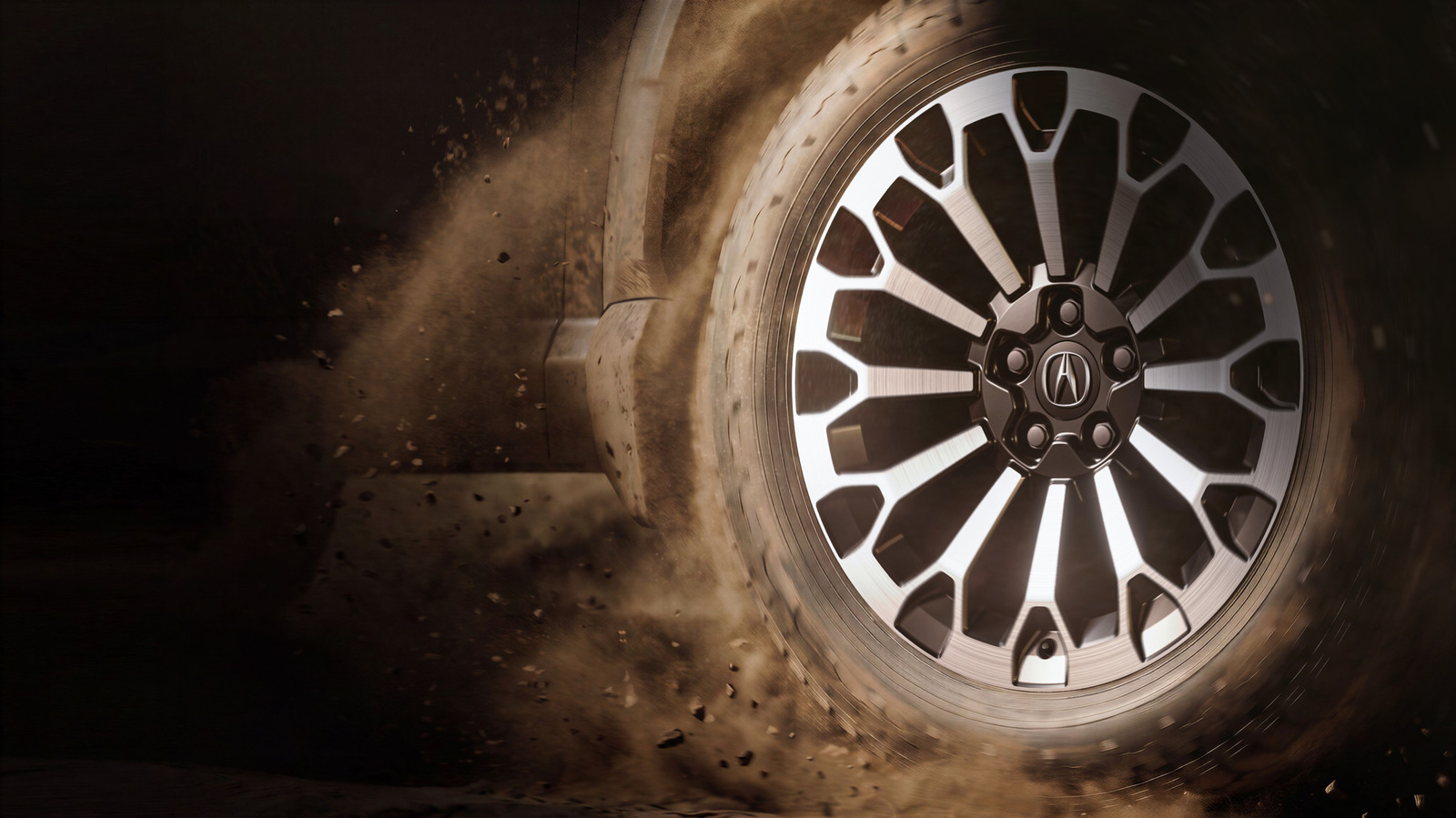
Confirmed for the first part of 2028, Acura’s off-roader is the most intriguing of the three. The company says it “will deliver the capability customers need for their outdoor adventures along with modern and premium styling, and the comfort and technology customers expect from an Acura.”
That is a broad brief, and Acura has not said whether the model will be based on an existing vehicle or developed from the ground up. The single teaser image released so far shows a silver and black wheel spinning in dirt alongside a black plastic fender flare, which hints at a machine with genuine rough-road intent rather than a styling package.
The obvious starting point is the 2027 Honda Passport, particularly in TrailSport form. Rivals have already shown how much appetite there is for this kind of machine: the 2027 Jeep Cherokee Trailhawk pairs hybrid power with a low-range transfer case, a locking rear axle and a suspension lift, proof that off-road hardware and electrification can coexist in a mainstream SUV.
TrailSport as the Template
If Acura follows the Passport playbook, the mechanical recipe is already proven. The Passport TrailSport uses Honda’s naturally aspirated 3.5-litre V6 producing 280 bhp, backed by unique springs, dampers, control arms and stabiliser bars. It is not a hardcore rock-crawler, but it is meaningfully more capable than a standard crossover.
The commercial case is stronger still. The TrailSport trim accounts for the vast majority of all Passport sales, which tells Acura everything it needs to know about how buyers respond to rugged positioning. A premium off-roader wearing an Acura badge, with the same hardware philosophy and a plusher interior, is a logical next step.
Next-Generation RDX
The fourth-generation RDX is scheduled for 2028 and was previewed by the Monterey concept. It will be the first Acura to use the company’s latest hybrid powertrain, a V6 hybrid planned for the brand’s larger models.
Acura has been teasing the next RDX for some time, and the only real update is confirmation that it remains on track for 2028 with hybrid power available. That matters, because the RDX has long been the volume seller that keeps Acura’s lights on in the US. A hybrid option brings it into line with a market that has moved decisively towards electrified powertrains, as the 2027 Hyundai Tucson’s hybrid and 50-mile PHEV options demonstrate.
A Brand in Need of a Reset
The context behind this product push is uncomfortable. Honda posted a loss of roughly £4.5 billion last year, including an approximately £1.3 billion hit on its electric Prologue and Acura ZDX models, both of which were built on GM’s Ultium platform. That partnership has now become a cautionary tale about badge-engineered EVs, and it has left Acura’s electrification story in need of a rewrite.
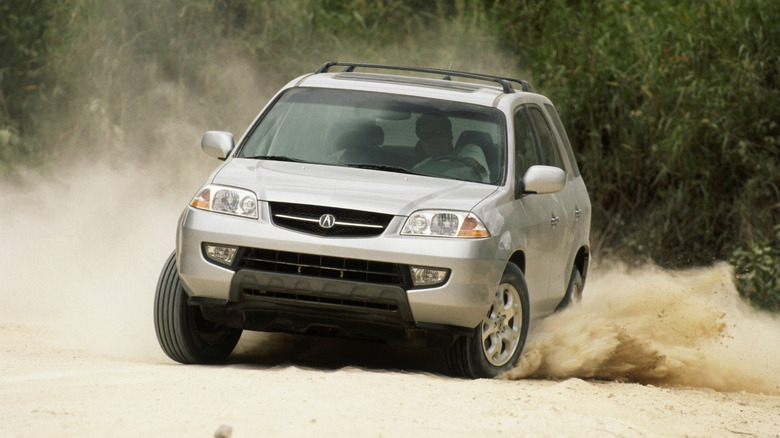
The new SUVs are intended to sit alongside existing models, but there is no escaping the sense that Acura is repositioning itself. The MDX, launched in 2001 as an Odyssey minivan-based model, was the first car-based three-row SUV and famously beat the BMW X5 and Lexus RX300 in a Car and Driver comparison. It went on to earn millions of sales. That is the template Acura is trying to rediscover: credible, desirable, and just different enough to matter.
Whether an eight-seat flagship and a trail-ready off-roader can recapture that spirit is an open question. The ADX, MDX and Integra are described as covering “a range of life stages,” but Acura has given no detail on their futures, and that ambiguity leaves the three new SUVs as the clearest signal of the brand’s direction. An eight-seat flagship arrives late in the decade, an off-roader lands in early 2028, and a hybrid RDX follows in the same year. For a brand whose engineering credentials have never been in doubt, Acura’s next three SUVs will test whether that philosophy can stretch to a full-scale product offensive.
For now, the specifics remain thin: no confirmed launch dates for the flagship, no pricing, no technical detail beyond the hybrid confirmation. What Acura has done is commit publicly to a substantial expansion at a time when its range is being written off. The next two years will determine whether that commitment translates into the kind of product that changes perceptions.

One Comment